Skip to content
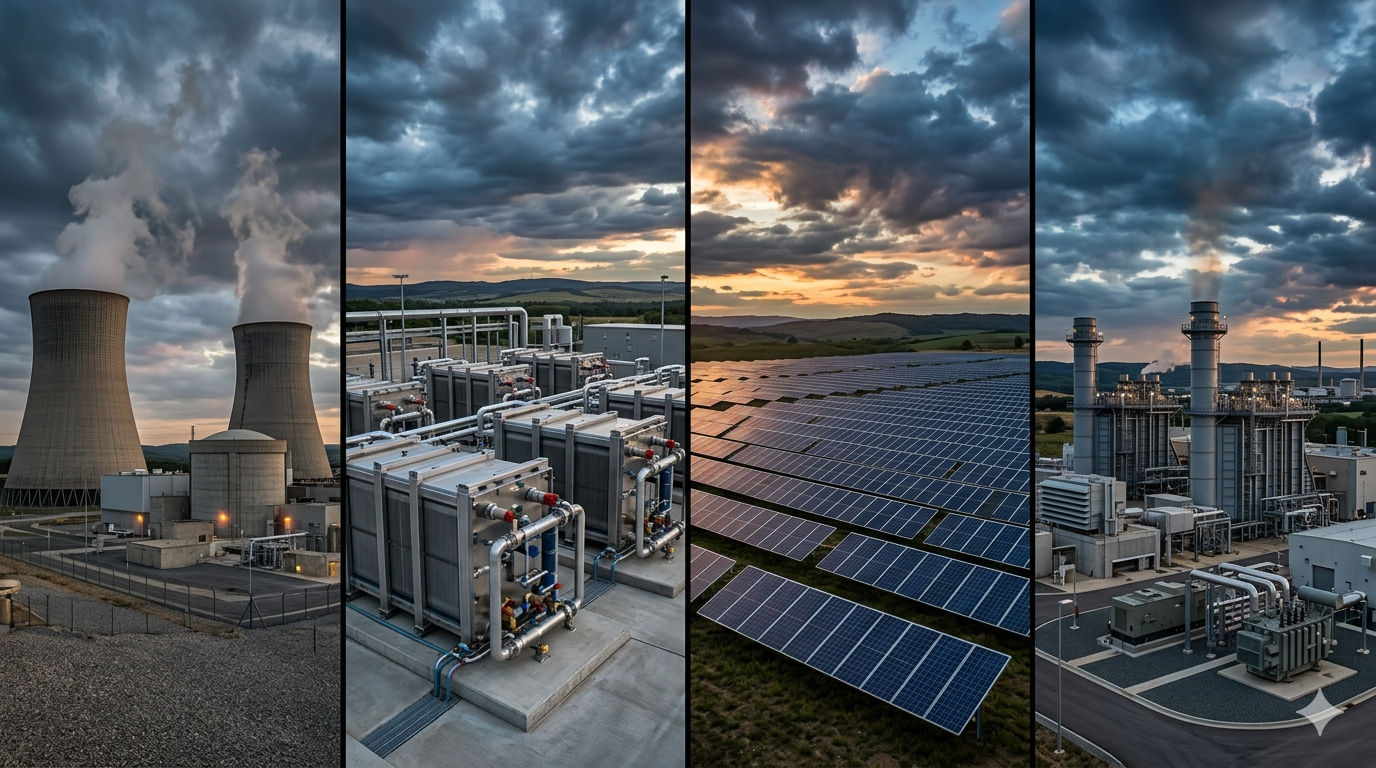
The five largest AI infrastructure operators in the world are each pursuing a fundamentally different power strategy. Microsoft has bet on nuclear, signing agreements to restart Three Mile Island and committing to multiple small modular reactor developers. Google is pursuing a combination of geothermal, nuclear, and advanced renewables. Amazon has signed more renewable energy deals than any other company in history while simultaneously committing to SMR developers and maintaining large gas-backed generation agreements. Meta is building what is effectively a hybrid power portfolio spanning renewables, natural gas backup, and now orbital solar experiments. Oracle has made the most dramatic bet of all, committing to run its Project Jupiter campus entirely on Bloom Energy solid oxide fuel cells while abandoning gas turbines entirely.

These strategies are not converging. They are, in fact, actively diverging at an accelerating rate as each company doubles down on its chosen approach. Three years into the AI infrastructure buildout, the industry’s most well-resourced operators have not settled on a consensus answer to the question of how to power AI at scale. Each company’s strategy reflects a different set of assumptions about cost trajectories, technology readiness, regulatory risk, and competitive positioning in its key markets. Understanding why those strategies diverge, what each bet implies, and which assumptions are most likely to prove correct is, consequently, one of the most important analytical questions in the AI infrastructure market right now. The answer will shape the competitive dynamics of AI infrastructure development for the next decade.
Why This Divergence Matters Beyond Individual Strategy
The divergence is not primarily a values question. It is not principally about which company is most serious about decarbonisation, though that dimension is genuinely present. It is, rather, a question of operational strategy under conditions of deep uncertainty about which power technologies will be most competitive in five to ten years, which markets will face the most acute grid constraints, and which regulatory environments will favour which generation types. Each company has made a different bet under that uncertainty. Those bets are, in turn, large enough to materially shape the competitive landscape of AI infrastructure development for the next decade.
Why the Strategies Diverged in the First Place
The divergence in hyperscaler energy strategies reflects three distinct forces that have been operating simultaneously since 2022. First is the acceleration of AI demand beyond what any planning scenario anticipated. AI infrastructure buildout has, indeed, created power demand timelines incompatible with the conventional energy procurement processes that hyperscalers had been using. Renewable energy PPAs signed in 2020 and 2021 assumed development timelines of 18 to 36 months. The grid interconnection queues in primary AI markets have extended those timelines dramatically. Hyperscalers that relied on conventional renewable procurement found themselves facing capacity gaps their existing energy strategies could not bridge on the timescales AI infrastructure buildout required. The response, consequently, was to accelerate the shift toward behind-the-meter generation.

The second force is the recognition that behind-the-meter generation is the only reliable way to bypass grid interconnection queues in constrained markets. When grid interconnection timelines extend to five or seven years in the markets where AI campuses need to be built, the only way to break ground on a large campus on a competitive timeline is to generate power on site. That insight has driven every hyperscaler toward some form of behind-the-meter generation strategy. The disagreement is, consequently, not about whether to pursue behind-the-meter generation. It is about which technology to use.
How Competitive Dynamics Accelerated the Divergence
The third force is the competitive dynamic created by large capital commitments to specific technologies. Once Microsoft committed to nuclear at sufficient scale to make a material difference to its power strategy, that commitment created pressure on competitors to respond with their own long-term power strategies. Oracle’s fuel cell commitment is, in part, a competitive signal as much as a pure operational decision. The announcement that Project Jupiter will run entirely on Bloom Energy fuel cells is a statement about Oracle’s power strategy that differentiates it from competitors pursuing nuclear or gas. As we have covered in our analysis of how hyperscalers are using long-term power agreements to lock in AI infrastructure advantage, the ability to secure power access ahead of competitors is increasingly a strategic differentiator. The energy strategy divergence is, in that sense, a competitive differentiation exercise as much as an operational one.
The Case for Each Strategy
Understanding each company’s energy strategy requires understanding the specific operational and competitive logic that makes each bet rational on its own terms, even as the strategies diverge.
The Operational Gap Between Strategy and Reality
Each energy strategy faces an operational gap between its stated intent and what it can deliver in the near term. As a result, that gap is creating a two-speed AI infrastructure market. Gas and fuel cells serve the near-term market, while nuclear and advanced renewables will eventually serve the long-term market once they reach commercial deployment at the required scale. This bifurcation is not temporary. It will define the energy landscape for AI infrastructure development throughout the remainder of this decade.
The near-term market is, in practice, dominated by gas. Despite the public commitments to nuclear, renewable, and fuel cell strategies, the majority of the power that is actually energising AI campuses in 2025 and 2026 comes from natural gas generation. That is not a failure of strategy. It is a reflection of timeline reality. Gas generators can be procured, permitted, and installed in 12 to 18 months. Nuclear plants cannot. Fuel cell systems at gigawatt scale are, as Oracle is discovering with Project Jupiter, an unprecedented deployment that will take years to commission. The gap between announced energy strategy and actual operational power mix is, therefore, one of the most important distinctions that investors and analysts should be tracking.
Microsoft’s Nuclear Strategy
Microsoft’s commitment to nuclear power, including the agreement to restart Three Mile Island Unit 1 and multiple SMR developer relationships, is the most ambitious and the most long-tailed of the major hyperscaler energy bets. The nuclear strategy reflects a specific set of assumptions. First, that large-scale AI training and inference workloads require firm, dispatchable power that cannot be provided by intermittent renewables without massive storage investment. Second, that the competition for renewable PPAs in primary markets has made renewable-only strategies increasingly expensive and slow to execute. Third, that nuclear power, despite its long development timelines, provides a baseload generation source operating at capacity factors above 90% and well matched to the flat, high-density load profile of AI campuses.
The primary risk in Microsoft’s nuclear strategy is, however, timeline. Small modular reactors are not expected to produce commercial power before 2030 at the earliest. The restart of Three Mile Island under the Crane Clean Energy Center name is a more near-term source, with expected operation in the 2028 timeframe. The gap between Microsoft’s AI infrastructure capacity needs in 2025 and 2026 and the nuclear power that will become available in 2028 and beyond is real. As we have covered in our analysis of why small modular reactors are a 2030 story that hyperscalers are treating like a 2026 one, the mismatch between announced nuclear commitments and actual power delivery timelines is one of the most consequential uncertainties in hyperscaler energy planning.
The Cost Trajectory Question Nobody Is Answering Publicly
The divergence in energy strategies also reflects different assumptions about future cost trajectories. Each hyperscaler is making implicit bets on which technologies will be cheapest in five to ten years, and they are embedding those bets in their current procurement decisions.
Microsoft’s nuclear bet assumes that small modular reactors will reach cost parity with other baseload generation sources by the early 2030s, driven by manufacturing scale and standardisation. If that assumption is correct, Microsoft will have a power cost advantage over competitors who lock into renewable or gas strategies at 2026 pricing. If small modular reactors face cost overruns or timeline delays, as nuclear projects historically have, Microsoft will have paid a premium for capacity that arrives later than planned and costs more than projected.
Google’s diversification strategy assumes that no single technology will clearly win the cost competition, and that maintaining optionality across multiple technologies is worth the additional complexity. That assumption is, notably, defensible under current uncertainty. The cost trajectories of geothermal, nuclear, advanced renewables, and storage are genuinely uncertain, and hedging across them reduces the risk of being wrong about any single one.
Oracle’s fuel cell strategy assumes that solid oxide fuel cell economics will improve as Bloom Energy scales production against the largest commercial deployment of this technology in history. Oracle’s agreement with Bloom effectively finances a step change in Bloom’s production scale, which should, in theory, drive cost reductions that benefit both parties. The risk is that fuel cell manufacturing scale-up faces the same challenges as any advanced manufacturing ramp: technical issues, supply chain constraints, and slower-than-projected learning curve improvements.
Google’s Diversification Strategy
Google‘s energy strategy is, by design, the most diversified of the major hyperscalers. Google has made commitments to geothermal energy through its agreements with Fervo Energy, small modular reactors through agreements with Kairos Power, and a range of advanced renewable and long-duration storage technologies through its broader clean energy portfolio. Google has also been more aggressive than other hyperscalers in exploring unconventional generation sources, including enhanced geothermal systems that can provide firm, dispatchable power without the waste management complexities of nuclear.
The logic of Google’s diversification strategy is, specifically, to avoid overconcentration in any single technology while maintaining exposure to multiple potentially disruptive generation technologies. If any of the technologies Google has backed matures faster than expected, it will have a strategic advantage in that market. If any technology fails to deliver, its overall power strategy is insulated by the diversification. The cost of that diversification is, however, higher total complexity and the risk that none of the bets are large enough to provide a decisive competitive advantage in any single market. As we have covered in our analysis of geothermal and long-duration storage becoming the next power frontier for AI data centers, the technologies Google is investing in are technically promising but face the same timeline and scale challenges as other advanced generation options.
Amazon’s Scale-First Strategy
Amazon’s energy strategy is the most conventionally aggressive of the major hyperscalers. Amazon has, by volume, signed more renewable energy deals than any other company in history. Its approach combines massive renewable PPA commitments with behind-the-meter gas generation for reliability backup, and more recently with SMR commitments that hedge against long-term renewable cost and availability constraints. The Amazon strategy reflects a specific operational philosophy: build at the largest possible scale using the most available technologies, and use scale advantages to secure better pricing than competitors can access.
Amazon’s approach has, indeed, worked well in markets where renewable energy is abundant and grid interconnection is manageable. It is, however, facing increasing stress in primary AI markets where both renewable procurement and grid interconnection are constrained. Amazon’s behind-the-meter gas commitments have attracted environmental criticism that creates regulatory and reputational risk. Its SMR commitments are, like Microsoft’s, subject to timeline uncertainty. As we have covered in our analysis of how natural gas is back as AI reverses the clean energy narrative, the tension between AI infrastructure buildout speed and clean energy commitments is creating genuine strategic difficulty for hyperscalers that have made public decarbonisation commitments while simultaneously expanding behind-the-meter gas generation.
Oracle’s Fuel Cell Bet
Oracle’s Project Jupiter announcement on April 27 represents the most technically specific energy strategy bet of any major hyperscaler. The commitment to run up to 2.45 gigawatts of Bloom Energy solid oxide fuel cells at a single campus in Doña Ana County, New Mexico eliminates gas turbines and diesel generators entirely from the Project Jupiter design. The fuel cell strategy reflects a specific set of operational advantages that Oracle has, apparently, concluded outweigh the technology’s higher upfront costs relative to conventional gas generation.
Solid oxide fuel cells generate electricity electrochemically rather than through combustion, producing power at higher efficiency than gas turbines. They eliminate the nitrogen oxide emissions that are increasingly subject to permitting restrictions.
For a campus in the arid Southwest where water is scarce, the near-zero water consumption of fuel cell operation is, specifically, a significant site selection advantage. Oracle will bear all Project Jupiter energy costs directly, ensuring no impact on local electricity rates, which addresses one of the most politically sensitive dimensions of large data center development. The fuel cell strategy represents, notably, a behind-the-meter generation approach that solves the grid interconnection problem while differentiating from competitors who have chosen gas, nuclear, or renewables for their behind-the-meter strategy. As we have covered in our analysis of the Oracle and Bloom Energy expansion to 2.8 GW, this is the most significant commercial deployment of solid oxide fuel cell technology for data center power in US history.
Meta’s Hybrid Approach
Meta’s energy strategy is, in other respects, the hardest to characterise because it reflects the broadest range of commitments. Meta has a large renewable energy portfolio, has made commitments to nuclear and advanced clean energy, and recently announced its orbital solar exploration, a longer-term research bet on space-based solar power that the company has framed as a potential solution to the fundamental land and grid constraint problem. Meta’s hybrid approach reflects its unique position as the only major hyperscaler whose AI infrastructure investment is entirely self-serving rather than cloud-facing, which gives it more flexibility to experiment with unconventional energy strategies without the commercial risk that cloud-facing hyperscalers face if their energy strategy affects service reliability or pricing.
What No Convergence Means for the Industry
The absence of convergence around a consensus energy strategy has specific implications for the AI infrastructure industry that extend beyond the strategic choices of individual companies. The most important implication is, specifically, for the energy technology supply chains that serve AI infrastructure development.
When the largest customers in a market diverge radically in their technology choices, the manufacturers serving that market face a demand signal spread across multiple competing technologies rather than concentrated in a single one. Nuclear reactor manufacturers, fuel cell producers, geothermal developers, renewable energy developers, and gas turbine manufacturers are all receiving significant signals from the hyperscaler market. None of them is receiving a demand signal that justifies the kind of production scale-up that would drive dramatic cost reductions through manufacturing volume. The divergence in hyperscaler energy strategies is, consequently, slowing the cost reduction trajectory for every individual technology compared to what would occur if the market had converged on a single approach.
What the Energy Strategy Divergence Means for the Grid
The divergence in hyperscaler energy strategies has a specific implication for the grid that is, notably, underappreciated in the current discussion. When hyperscalers pursue behind-the-meter generation at scale, they effectively remove their load from the grid planning equation. A 500-megawatt AI campus that generates its own power from fuel cells or gas does not appear in the utility’s load forecast in the same way as a grid-connected campus. It does not contribute to the utility’s interconnection queue. And it does not pay the transmission and distribution charges that fund the grid infrastructure upgrades that other customers require.
The concentration of hyperscaler AI development in behind-the-meter generation models is, consequently, creating a specific fiscal problem for regulated utilities. As the largest and fastest-growing industrial loads move off the grid or reduce their grid dependency, the cost of maintaining and upgrading the transmission and distribution infrastructure falls more heavily on smaller customers who cannot afford behind-the-meter alternatives. That dynamic is, already, one of the most contested questions in utility regulation in states with high concentrations of AI data center development.
The Regulatory Implications of Divergence
The regulatory implications of hyperscaler energy strategy divergence are, similarly, consequential. Regulators at the state and federal level who are attempting to plan permitting processes, grid integration requirements, and environmental review frameworks for large AI campus development face a more complex task when the energy strategies of applicants vary radically. A permitting framework designed for nuclear-backed data center campuses is not well suited to fuel cell campuses, and vice versa. The absence of a standard energy architecture for large AI campuses creates regulatory complexity that adds time and cost to the development process for all parties.
The tariff environment adds another dimension. As we have shown in our analysis of renewables hitting a wall as AI forces a nuclear rethink, tariffs and trade policy are affecting the cost and availability of different generation technologies in technology-specific ways. Tariffs on solar and wind equipment from China, for example, affect renewable-heavy strategies more than nuclear or fuel cell approaches. As a result, hyperscalers are absorbing tariff impacts unevenly, which is creating competitive asymmetries that did not exist before the tariff environment changed.
The Enterprise Implications of Hyperscaler Energy Strategy Divergence
For enterprise AI buyers, the divergence in hyperscaler energy strategies creates a specific planning challenge. Cloud pricing reflects, with a lag, the cost of the energy strategies that hyperscalers are pursuing. An enterprise that procures cloud compute from a hyperscaler pursuing an expensive nuclear strategy will, over time, see higher power costs reflected in cloud pricing than one procuring from a hyperscaler whose fuel cell or renewable strategy proves more cost-effective. That differential is not yet visible in cloud pricing because the energy strategies are still in their early deployment phases. It will, however, become visible over the next three to five years as the strategies mature and their cost structures become clearer to the market.
Enterprise buyers making 5 to 10 year cloud commitments in 2026 should, consequently, be factoring the energy strategies of their cloud providers into their vendor assessments. As we have covered in our analysis of how hyperscalers are using long-term power agreements to lock in AI infrastructure advantage, the power strategies of major cloud providers are increasingly relevant to the long-term cost trajectories of enterprise AI workloads. The energy strategy divergence makes that relevance more acute, not less.
Which Bets Are Most Likely to Pay Off
Assessing which energy strategy bets are most likely to pay off requires separating the near-term operational question, which strategy provides the most reliable and cost-effective power in the next three to five years, from the long-term strategic question, which strategy provides the most durable competitive advantage in a decade.
On the near-term operational question, Oracle’s fuel cell strategy and Amazon’s gas-backed hybrid approach are most likely to deliver operational power on the timelines AI infrastructure development requires. Both rely on technologies that are commercially available and deployable on 12 to 24 month timelines without the regulatory and construction uncertainty that affects nuclear and the intermittency challenges that affect pure renewable strategies. The near-term operational risk of the fuel cell strategy is technology concentration and the fact that it is being deployed at a scale that is unprecedented. At that scale, system reliability is the most critical operational question, and the answer will not be known until the campus is operational.
On the long-term strategic question, the nuclear bets made by Microsoft and Google are most likely to provide durable competitive advantages if the technologies deliver on their promised timelines and cost trajectories. Nuclear provides the firm, dispatchable, high-capacity-factor power that AI training and inference workloads actually require, without the water consumption constraints of gas or the intermittency challenges of renewables. If small modular reactors reach commercial deployment at competitive costs, the hyperscalers with established nuclear relationships will have a durable power access advantage that cannot be quickly replicated.
The Technology Readiness Levels Behind Each Bet
One framework for evaluating the energy strategy divergence is to apply technology readiness levels to each approach and ask which strategies are making bets at which levels of technology maturity. Gas generation is at the highest readiness level. It is commercially deployed at scale, costs are well understood, and the operational risks are managed. The strategic risk of gas is regulatory and reputational, not technical.
Gas and Fuel Cells: Commercially Proven but Strategically Constrained
The trend toward stricter emissions permitting and the political pressure on hyperscalers to honour decarbonisation commitments means that gas-backed strategies carry regulatory risk that does not appear in near-term cost models. Fuel cells at the scale Oracle is deploying are at a high but not the highest readiness level. Bloom Energy’s solid oxide technology is commercially proven at smaller scales. The 2.45 gigawatt deployment at Project Jupiter is, however, an order of magnitude larger than any previous single-site deployment. At that scale, system integration, heat rejection, and reliability architecture are engineering challenges that have not been fully solved at commercial scale. The technical risk is, consequently, real even though the underlying technology is commercially proven.
Renewables and Nuclear: The Long-Term Bets
Renewable energy combined with advanced storage is at a moderate readiness level for the specific application of reliable baseload power for AI campuses. Renewable generation itself is commercially proven. Long-duration storage at the scale required to make renewables firm for AI loads is, however, still in early commercial deployment. The cost and reliability of the combined system at the scale required for multi-hundred-megawatt AI campuses is, consequently, not yet fully established.
Designs are proven in principle, but no SMR has reached commercial operation in the United States. Manufacturing scale, regulatory approval, and construction execution risks are, accordingly, the highest of any technology in the hyperscaler energy portfolio. Companies making SMR bets are, consequently, wagering on a technology that has historically underdelivered on cost and timeline projections at larger reactor scales. Whether SMRs break that historical pattern is the central uncertainty in the nuclear component of hyperscaler energy strategies.
The Scenario Where All Bets Are Partially Right
The most likely outcome is, however, not that one energy strategy wins and the others lose. It is, rather, that all of the strategies prove partially correct in different markets and different time periods. Nuclear will be the preferred strategy in markets where land is available, regulatory approval is manageable, and long development timelines can be absorbed. Fuel cells will prove most valuable in markets where water is scarce, emissions permitting is challenging, and behind-the-meter operation is the only viable path to competitive interconnection timelines. Renewables combined with storage will prove most cost-effective in markets with abundant generation resources and manageable grid access. Gas will persist as the backup and reliability anchor for every strategy that relies on intermittent or developing technologies.
Enterprise buyers and infrastructure developers who are not hyperscalers face a specific implication from the energy divergence: the technology landscape for AI infrastructure will remain heterogeneous for the foreseeable future. Site selection, power procurement, and energy strategy will consequently remain complex, market-specific exercises rather than decisions that can be standardised across geographies. Hyperscalers whose energy strategies prove most flexible in navigating that heterogeneous landscape will, ultimately, build the most durable competitive advantages. Those who concentrated too heavily in any single technology or market will face the adjustment costs that come from being wrong about which bet pays off first.