
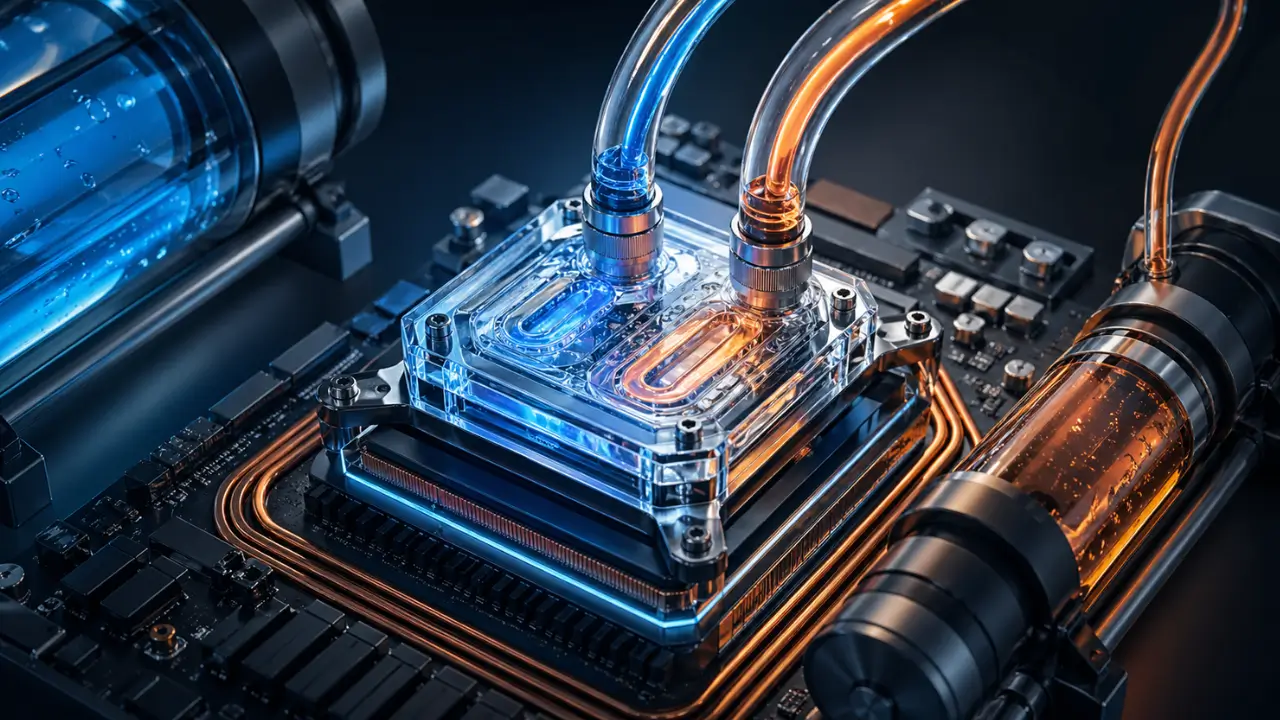
Carrier Global Corporation is tightening its grip on the future of AI infrastructure with a deeper financial and strategic commitment to ZutaCore. The move comes through its investment arm, Carrier Ventures, which has expanded its stake to accelerate next-generation cooling deployments. The development signals a deliberate shift toward owning more of the thermal lifecycle as AI compute density surges. It also reflects a broader industry pivot where cooling architecture is becoming as critical as compute itself.

Carrier is not simply investing in a vendor relationship but aligning with a technology layer that directly addresses one of AI’s most urgent bottlenecks. The partnership strengthens Carrier’s ability to deliver integrated thermal solutions across hyperscale and enterprise environments. As AI clusters push beyond traditional thermal limits, infrastructure providers are rethinking cooling from first principles. Carrier’s strategy positions it at the intersection of hardware evolution and energy efficiency demands.
Strategic Push Into High-Density AI Infrastructure Cooling
The expanded investment builds on Carrier’s earlier 2025 backing of ZutaCore, reinforcing a long-term roadmap rather than a one-off capital injection. AI-driven chip power densities continue to rise sharply, forcing operators to adopt advanced cooling architectures beyond air-based systems. Liquid cooling, particularly direct-to-chip models, is quickly transitioning from niche deployment to mainstream necessity. This investment ensures Carrier remains embedded in that transition curve.
Carrier is also expanding its capabilities across interoperable single-phase and two-phase cooling systems. These technologies integrate into its broader QuantumLeap™ suite, which focuses on thermal orchestration and energy optimization across data center environments. The emphasis is no longer just on cooling capacity but on system-wide efficiency and scalability. Therefore, Carrier is building a platform approach rather than a fragmented product portfolio.

Executive Perspective on AI-Driven Thermal Constraints
“AI is fundamentally reshaping data center architecture, with thermal management emerging as a key constraint to scale,” said Christian Senu, Vice President, Global Data Centers, Carrier. “This investment strengthens our ability to deliver advanced liquid cooling solutions that help customers scale high-density AI infrastructure efficiently and with improved energy performance for today’s chip thermal densities and next-generation architectures.”
Carrier’s leadership is clearly framing cooling as a limiting factor in AI growth rather than a supporting function. The statement underscores a structural shift where thermal engineering directly influences compute scalability and cost efficiency. As workloads intensify, the margin for thermal inefficiency continues to shrink. This positions liquid cooling not as optional innovation but as foundational infrastructure.
ZutaCore’s Waterless Cooling Technology Gains Strategic Backing
ZutaCore brings a differentiated approach through its direct-to-chip, waterless liquid cooling architecture. Headquartered in Foster City, California, the company has built its reputation around eliminating water dependency while maintaining high thermal efficiency. Its HyperCool® system uses a closed-loop, two-phase mechanism that removes heat directly at the processor level. This design enables higher compute density while reducing energy overhead.
“Our expanded partnership with Carrier reflects the need for new approaches to data center cooling,” said Erez Freibach, Chairman and CEO, ZutaCore. “By combining ZutaCore’s waterless, direct-to-chip technology with Carrier’s system-level expertise, we are enabling the next generation of high-density AI data centers.”
The collaboration merges ZutaCore’s component-level innovation with Carrier’s large-scale system integration capabilities. This combination creates a vertically aligned solution that addresses both micro and macro thermal challenges. Moreover, it positions both companies to compete in an increasingly crowded liquid cooling market.
Industry Implications: Cooling Becomes Core Infrastructure Layer
The expansion reflects a broader recalibration across the data center ecosystem. Cooling is no longer a secondary consideration but a primary design constraint influencing architecture decisions. AI workloads, particularly those driven by GPUs and custom accelerators, are redefining acceptable thermal thresholds. Consequently, companies that control advanced cooling technologies gain a strategic advantage in infrastructure deployment.
Carrier’s investment signals confidence that liquid cooling will dominate the next phase of data center evolution. It also highlights a shift toward integrated solutions that combine hardware, software, and thermal intelligence into unified platforms. As hyperscalers and enterprises race to deploy AI at scale, partnerships like this will shape how efficiently that scale becomes achievable.











