
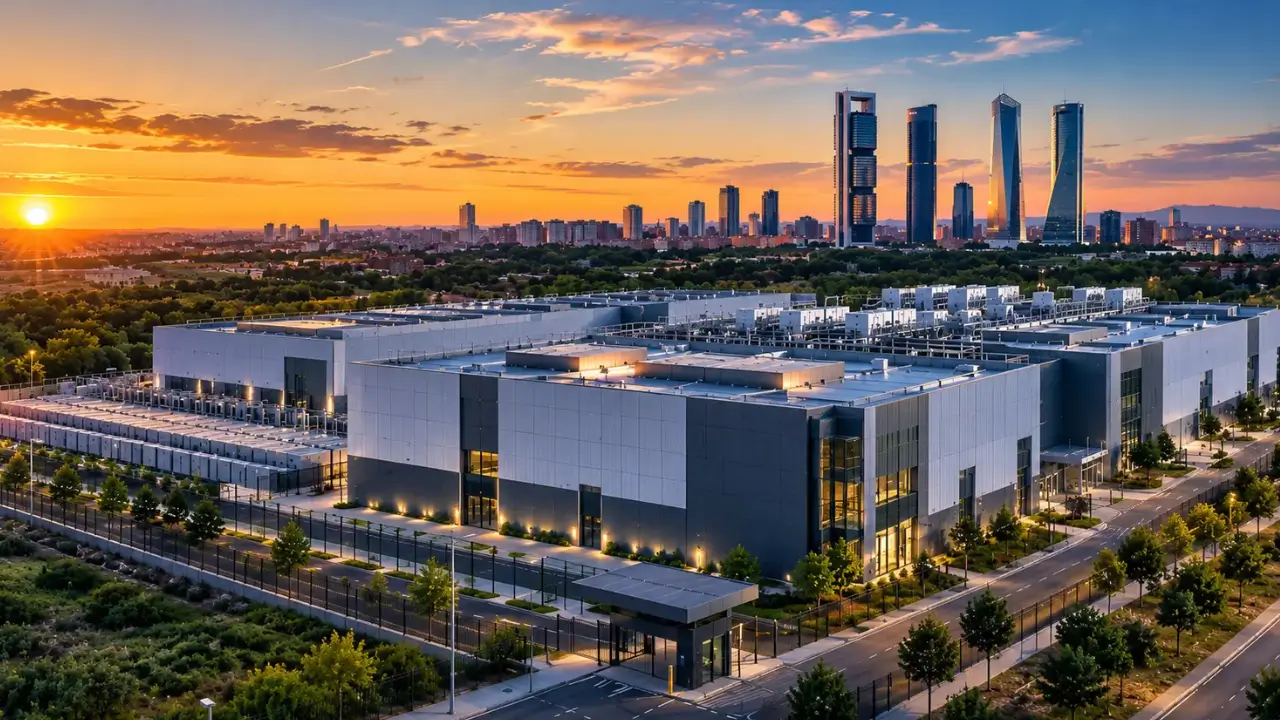
Spain’s digital infrastructure market continues attracting increasingly ambitious investment as construction and infrastructure companies reposition themselves for the artificial intelligence era. Ferrovial has become the latest major infrastructure developer to deepen its exposure to digital assets, announcing plans to invest €1 billion in a hyperscale data center campus in Madrid that will support Europe’s accelerating demand for AI and cloud computing capacity. The project signals more than another large-scale data center announcement. It illustrates how traditional infrastructure specialists are steadily transforming into digital infrastructure developers as artificial intelligence reshapes capital allocation across global technology markets. Companies that once concentrated on highways, airports, and public works now view hyperscale computing facilities as long-term infrastructure assets capable of generating sustained demand.

Ferrovial Enters the Next Phase of Digital Infrastructure
Through its subsidiary, Ferrovial Digital Infrastructure (FDI), the company will develop the campus in Alcobendas, one of Madrid’s established technology districts. Development will occur in multiple phases, beginning with MAD01, a 60MW facility that will deliver 40MW of IT capacity for hyperscale cloud operators, enterprise customers, and AI-driven workloads. The first phase represents an investment of approximately €153 million and will occupy a 32,000-square-meter site. Construction activities can begin after the company secured the permits required for earthworks, allowing the project to move into execution.=
Moreover, the Community of Madrid has designated the development as a project of “Special Interest,” enabling it to benefit from the Regional Investment Accelerator. The designation streamlines administrative processes and shortens approval timelines for strategically important investments, reducing one of the biggest obstacles facing large digital infrastructure developments across Europe. The investment reflects accelerating demand created by artificial intelligence, enterprise digital transformation, cloud adoption, and expanding data sovereignty requirements. Those structural trends continue driving hyperscale operators toward markets capable of supporting long-term compute expansion.
From Transport Builder to AI Infrastructure Developer
Although Ferrovial built its reputation through transportation infrastructure, the company already possesses significant experience constructing mission-critical facilities. Previous projects for technology companies including Microsoft and Telefónica provide a foundation for expanding into data center ownership and development rather than remaining solely a construction partner. The strategy mirrors a broader evolution taking place throughout Europe’s infrastructure sector. Engineering firms increasingly recognize that digital infrastructure offers attractive long-term growth opportunities as AI workloads demand larger, more sophisticated computing environments.

Madrid Strengthens Europe’s Hyperscale Data Center Landscape
Madrid has emerged as one of Europe’s fastest-growing data center markets because of its strategic geographic location, expanding fiber connectivity, improving power availability, and supportive regional policies. Consequently, hyperscale cloud providers, colocation operators, and infrastructure investors continue increasing their commitments across the region. Once completed, Ferrovial’s €1 billion campus will expand Madrid’s AI-ready capacity while reinforcing Spain’s ambition to become a leading European destination for hyperscale investment. More importantly, the announcement highlights an increasingly important industry shift.
Competitive advantage in tomorrow’s infrastructure economy will depend not only on roads, airports, or logistics networks but also on the digital foundations powering artificial intelligence. Moreover, As AI investment accelerates worldwide, the boundary between physical infrastructure and digital infrastructure continues to disappear. Ferrovial’s latest commitment demonstrates that the companies shaping tomorrow’s economy may be those capable of building both.











