
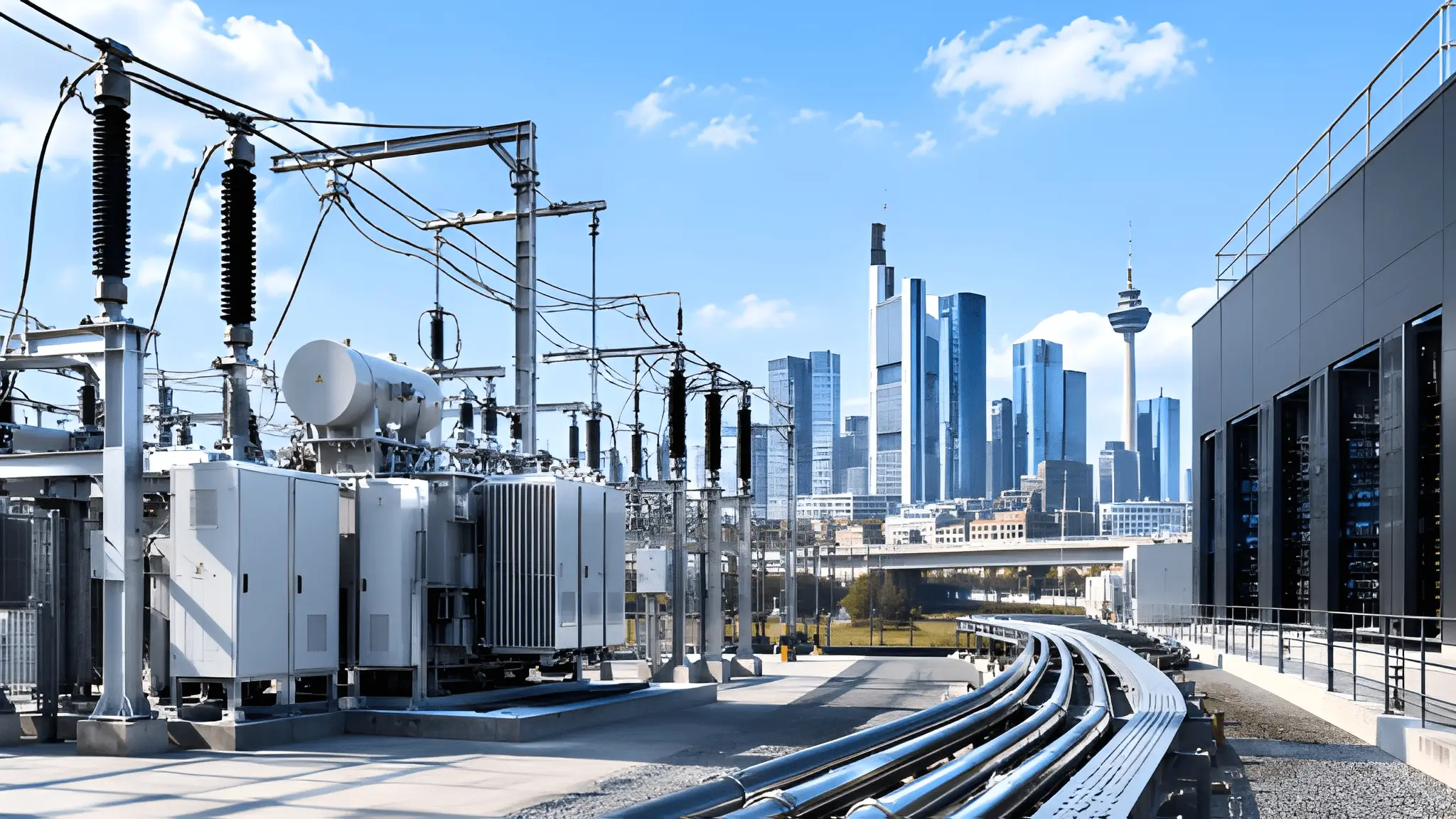
Germany’s fast-growing data center market continues to reshape how utilities and infrastructure providers approach urban power delivery. Hitachi Energy has secured a contract to build a dedicated 110kV grid connection for a Kauri CAB Digital Infrastructure data center in Frankfurt, reinforcing the city’s ability to support new digital capacity while addressing increasingly complex grid constraints. The project reflects a broader industry shift toward purpose-built electrical infrastructure designed for hyperscale facilities operating in dense metropolitan environments. As AI-driven workloads accelerate electricity consumption across Europe, reliable grid integration has become as critical as the data centers themselves.

Hitachi Energy To Supply Compact Urban Grid Infrastructure
Hitachi Energy will deliver a dedicated 110kV grid connection specifically engineered for Kauri CAB’s Frankfurt data center project. The company said the solution combines high operational reliability with a compact physical footprint, making it suitable for space-constrained urban environments where conventional substations often face land limitations. The new infrastructure will strengthen the connection between transmission and distribution networks, helping utilities manage rising electricity demand from digital infrastructure while maintaining grid stability. However, neither company disclosed a deployment schedule for the project.
The announcement highlights a growing trend across Europe’s largest data center markets, where developers increasingly require customized high-voltage connections instead of relying solely on existing utility infrastructure. Frankfurt, one of the continent’s busiest digital hubs, continues to experience strong demand for new capacity despite mounting pressure on land availability and electrical networks. Consequently, compact grid technologies are becoming an important component of new developments seeking faster integration into constrained power systems. The agreement positions Hitachi Energy deeper within Europe’s expanding digital infrastructure ecosystem.
Grid Resilience Becomes Central To Data Center Expansion
The company says reinforcing the interface between transmission and distribution grids will enable more reliable accommodation of expanding electricity loads generated by modern data centers. Rather than focusing only on supplying power, the project is designed to improve overall system resilience while supporting increasingly dynamic electricity flows associated with large-scale digital facilities. The approach reflects how utilities and technology providers are adapting infrastructure to meet the operational requirements of AI, cloud computing, and enterprise workloads. Data center developers now view electrical resilience as a competitive advantage alongside location and connectivity.

“Power systems are evolving faster than at any point in recent history, shifting from stable, centrally planned networks to highly dynamic systems that must integrate concentrated new demand, variable power flows, and rising resilience requirements. The edge of the grid is increasingly where many of these pressures converge,” said Marco Berardi, head of grid and power quality solutions and service at Hitachi Energy. “By delivering compact and advanced grid connections, we help customers such as Kauri CAB move forward with confidence, while strengthening the resilience of the broader electricity system and further reinforcing our strong position in the data center market.”
Project Likely Supports Kauri CAB’s Frankfurt Development
Although Hitachi Energy did not identify the exact facility receiving the new connection, the project is widely expected to support Kauri CAB’s data center currently under development in Hochheim, near Frankfurt. The site occupies approximately 55,000 square meters (592,000 square feet), a property acquired by the German asset manager earlier this year. Reports following the acquisition indicated Kauri paid €24 million (approximately $28.2 million) for the land parcel located between Frankfurter Strasse and the B40. Upon completion, the campus is expected to deliver around 40MW of IT capacity.
Industry observers have linked the newly announced grid connection to this development because of its location and expected power requirements. While official confirmation has not yet been provided, the technical specifications closely align with the electrical needs of a 40MW facility operating within Frankfurt’s highly constrained power environment. The project underscores how early coordination between utilities and developers is becoming increasingly important as available grid capacity tightens across major European markets. Reliable access to electricity is emerging as one of the defining factors influencing future data center investment decisions.
Kauri CAB Strengthens Its Digital Infrastructure Portfolio
Berlin-based Kauri has traditionally focused on real estate development, with projects including Wasserstadt Mitte and Berlin Spandau residential developments. Its expansion into digital infrastructure signals how property developers are increasingly diversifying toward high-growth sectors supported by long-term digital demand. Data centers offer an opportunity to combine strategic land holdings with infrastructure investments that generate sustained value over extended operating lifecycles. Therefore, partnerships with established grid technology providers have become essential to executing these projects successfully.
For Hitachi Energy, the agreement also reinforces its growing presence in the global data center market. Demand for specialized high-voltage grid infrastructure continues to increase as operators pursue larger facilities while navigating tightening grid capacity, stricter reliability expectations, and limited urban space. Across Europe, developers are placing greater emphasis on electrical architecture that supports both operational resilience and long-term scalability. The Frankfurt project illustrates how grid innovation is becoming a foundational element of next-generation digital infrastructure rather than simply a supporting utility connection.











