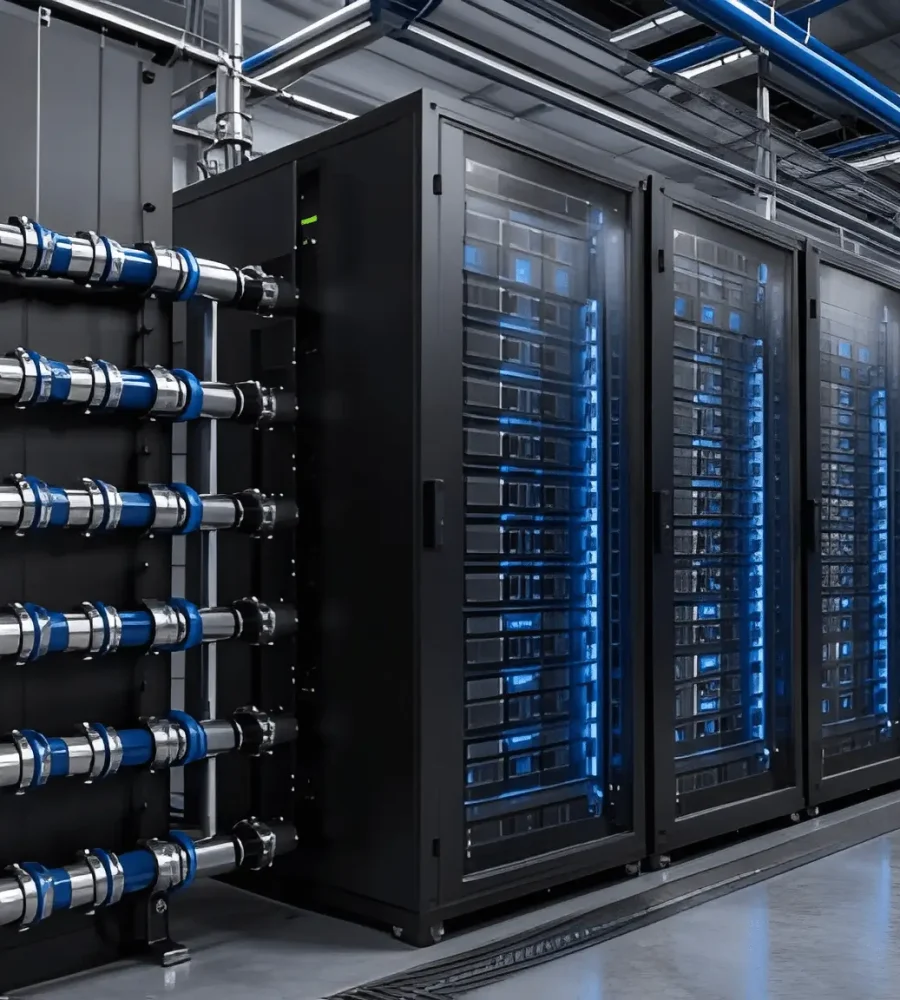
Trane®, a brand of Trane Technologies, has launched a new locally developed Coolant Distribution Unit aimed squarely at the rapidly evolving data center market in Asia-Pacific. The newly introduced DCDA series marks the company’s first CDU engineered specifically for regional requirements, as liquid cooling shifts from niche deployment to a core infrastructure strategy for AI-era facilities.
The announcement comes as data center operators across Asia-Pacific confront escalating thermal density driven by AI training clusters, accelerated computing, and increasingly compact server designs. Traditional air cooling architectures now face structural limits. As a result, liquid cooling has moved from experimentation into mainstream planning for hyperscale and enterprise operators alike.
Against this backdrop, Trane positions the DCDA series as a response to both heat dissipation and system integration challenges that accompany liquid-cooled environments. The company emphasized that the product focuses not only on cooling capacity, but also on operational flexibility, space efficiency, and long-term sustainability.
“The launch of our new CDU marks a technological breakthrough and a significant step in advancing high-density data centers in Asia Pacific,” said Bruce Zhongping Gu, vice president, Engineering and Technology, Trane Technologies Asia Pacific.
“Building on more than a century of climate expertise and deep regional insights, our CDU series delivers outstanding efficiency, flexibility and customization to meet the evolving needs of the market, further reinforcing our position as a leading innovator and trusted partner in the region.”
Addressing Space, Density, and Serviceability Constraints
Unlike global CDU designs retrofitted for regional use, the DCDA series has been engineered around Asia-Pacific data center constraints, particularly floor space limitations and mixed deployment models. The unit aligns with standard server racks and supports both in-row and in-room installation. Moreover, its full-front-access maintenance architecture allows operators to install units against walls or in back-to-back configurations.
According to Trane, this design eliminates the need for rear maintenance aisles and can free up to 20% of room floor space—an increasingly critical metric in high-density builds. Rail-mounted pumps and angled filters further enable online maintenance, reducing service disruption while maintaining continuous operations.
At the same time, the DCDA platform adopts a modular design philosophy. Multiple pipe connection directions are supported, while optional sensor packages enable monitoring of temperature, pressure, turbidity, pH, and conductivity. These capabilities allow operators to precisely track coolant conditions and dynamically adjust system behavior.
The unit can also integrate ATS, UPS, and APF modules depending on power and harmonic control requirements. As a result, data center operators can tailor configurations to specific application scenarios, balancing capital expenditure with operational performance.
Performance Headroom for AI and Hyperscale Growth
From a performance standpoint, the DCDA series builds on Trane’s refrigeration and thermal management expertise. The platform launches with three rated configurations 400kW, 800kW, and 1350kW, while customizable designs support expansion up to 1700kW. This scalability targets both current AI deployments and future growth trajectories.
High-efficiency variable-frequency water pumps, combined with intelligent control algorithms, allow the system to dynamically respond to workload fluctuations. Cooling output adjusts in real time based on demand, which significantly reduces energy consumption during partial-load operation.
Trane stated that liquid cooling systems built around the DCDA series can achieve Power Usage Effectiveness levels as low as 1.1. For CXOs managing energy exposure and sustainability targets, that performance threshold represents a meaningful reduction in operational cost and carbon intensity.
Cluster Control and System-Level Integration
For large-scale deployments, the DCDA series supports coordinated cluster control of up to 16 units operating in parallel. This capability addresses reliability and redundancy requirements in hyperscale and AI-focused data centers, where localized thermal instability can cascade into system-wide risk.
Integration with existing infrastructure also remains a priority. The platform supports standard building automation and data center management protocols, including Modbus, BACnet, SNMP, and Ethernet TCP/IP. Consequently, operators can integrate the CDU into existing monitoring and orchestration frameworks without introducing proprietary complexity.
Trane also highlighted its proprietary TSAP selection platform as a differentiator. Unlike traditional sizing approaches that rely on individual component specifications, TSAP generates system-level performance reports and visually simulates compatibility with existing environments. This approach enables more informed planning decisions and reduces deployment risk during design and expansion phases.
Market Validation and Regional Momentum
The DCDA series has secured CE and RoHS certifications and underwent validation under extreme operating conditions at Trane Technologies’ Asia-Pacific Engineering and Technology Center. Since its launch, the product has drawn significant interest from regional operators navigating the transition toward liquid-cooled infrastructure.
The first batch of orders from China is scheduled for delivery in the first quarter of 2026, signaling early market adoption and reinforcing Trane’s regional strategy. Industry analysts have pointed to strong momentum in direct liquid cooling adoption globally, with UBS forecasting rapid market expansion through the end of the decade.