Skip to content
A Continent of Buildings Designed for a Different Decade
Europe’s data centre estate was not built for the workloads now arriving inside it. The roughly 3,400 operational facilities spread across the continent, concentrated heavily around Frankfurt, London, Amsterdam, Paris, and Dublin, were designed and constructed during a period when cloud computing defined the upper limit of density planning, when a server rack drawing ten to fifteen kilowatts represented the high end of what facility engineers needed to accommodate. Air handling units, raised floor plenums, hot and cold aisle containment, and chilled water loops feeding computer room air handlers were not compromises. They were the correct engineering answer to the thermal loads that cloud-era racks actually generated, and operators who built to that standard built rationally for the demand they could see.

The demand that has arrived since does not resemble that baseline in any dimension that matters for facility design. Modern AI training clusters are now pushing rack power densities into the range of one hundred and twenty to one hundred and fifty kilowatts, an order of magnitude beyond what the air-cooled infrastructure governing most of Europe’s existing data halls was engineered to dissipate. Industry analysis describing the physical limits of this transition is direct about the threshold: air alone cannot remove that heat fast enough once densities cross into this territory, and the cooling technology that can, liquid cooling delivered through cold plates attached directly to chips or through full immersion, requires plumbing, coolant chemistry, leak containment, and structural provisions that a facility built around air movement simply does not have.
The hardware required to make this transition is now genuinely available in Europe at a scale that did not exist even twelve months ago. Vertiv’s expansion of its CoolChip portfolio across the EMEA region in May 2026, unveiled at the Datacloud Global Congress in Cannes, brought coolant distribution units rated at 2.3 megawatts and fluid network row manifolds engineered for compatibility across direct-to-chip cooling, immersion cooling, and rear-door heat exchangers into the European market. Panasonic’s entry into the same market in March 2026, launching coolant distribution units at four hundred and eight hundred kilowatts alongside free-cooling chillers, marked a Japanese industrial conglomerate’s deliberate pivot from consumer air conditioning toward generative AI data centre infrastructure, building on its 2023 acquisition of the Italian manufacturer Tecnair.
The arrival of this hardware answers one question and immediately raises a more difficult one. The supply side of Europe’s liquid cooling transition is no longer the binding constraint it was even a year ago. What remains genuinely unresolved is whether the demand side, the thousands of existing facilities that this hardware would need to be installed inside, can absorb that installation at anything resembling the pace the AI compute migration requires, or whether Europe is constructing, almost by default rather than by design, a data centre market with two fundamentally different tiers, one capable of hosting AI workloads and one that is not.

Why a Building Designed for Air Resists Liquid
The Physical Mismatch Between Legacy Halls and Cooling Loops
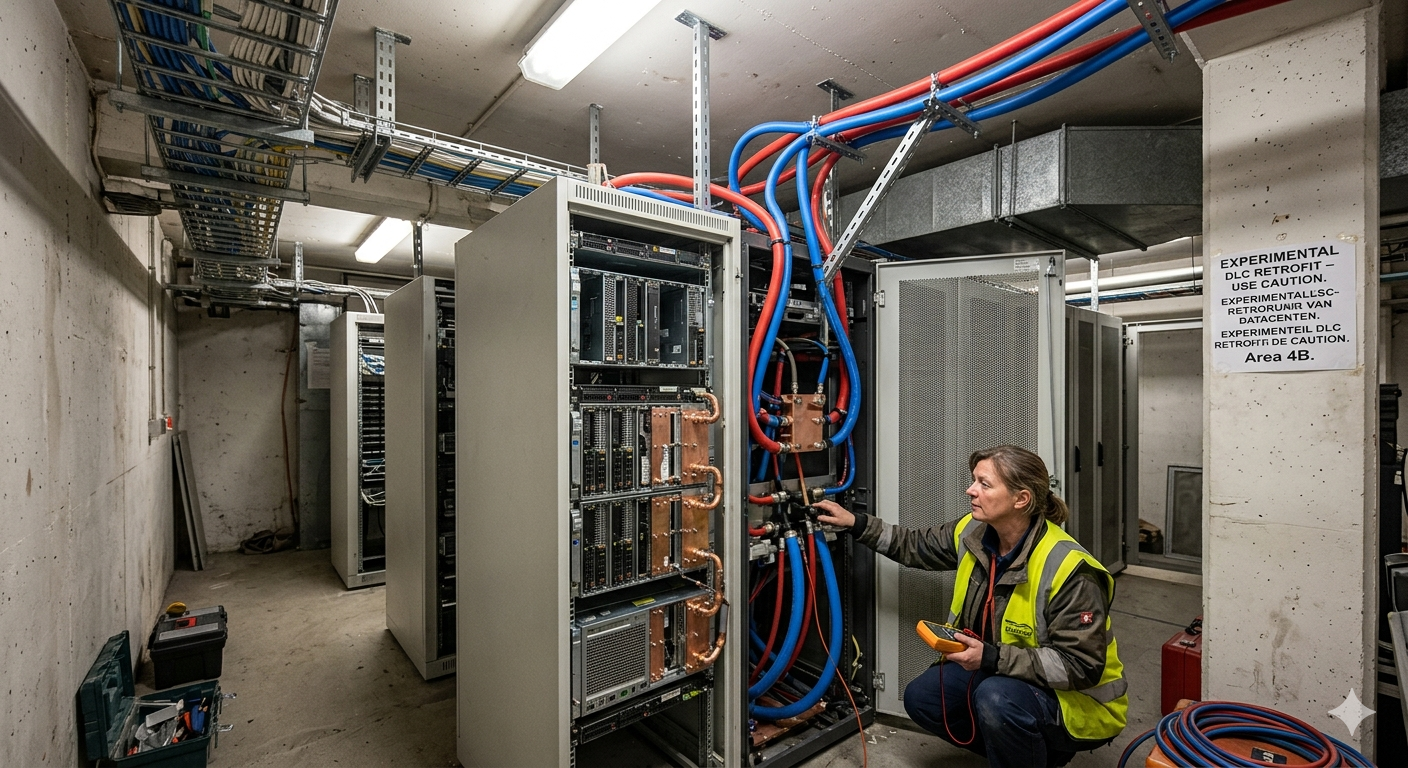
The challenge of retrofitting liquid cooling into an existing data centre begins with a structural reality that has nothing to do with the cooling technology itself and everything to do with the building that technology must occupy. A facility designed around air cooling organises its entire physical layout, raised floor height, ceiling plenum depth, aisle spacing, and structural load paths, around the requirements of moving large volumes of air efficiently through a data hall. Liquid cooling does not share these requirements. It introduces an entirely different set of physical demands: coolant piping that must run to and from each rack, leak detection and containment systems beneath and around that piping, secondary containment for the dielectric or water-glycol fluids involved, and structural provisions for the coolant distribution units themselves, which in their higher-capacity configurations represent substantial floor-standing equipment that the original facility design did not allocate space for.
Industry analysis of the European cooling market describes the consequence of this mismatch with appropriate bluntness: retrofitting legacy European facilities, often housed in historic or space-constrained buildings, presents significant engineering and logistical hurdles, and the total cost of ownership, including installation and potential facility modifications, can represent a major barrier to widespread adoption. The phrase historic or space-constrained buildings understates the scale of the issue for a meaningful share of Europe’s data centre estate. Many facilities across the FLAPD markets occupy converted industrial buildings, telecommunications exchanges, or purpose-built structures from the 1990s and early 2000s whose floor-to-floor heights, column spacing, and load-bearing capacities were never designed with the possibility of a future liquid cooling retrofit in mind, because that possibility did not exist at the time of construction.
The plumbing problem extends beyond the data hall itself into the building’s core infrastructure. Coolant distribution units require connections to facility-level heat rejection systems, whether cooling towers, dry coolers, or chiller plants, and retrofitting these connections into a building where the existing chilled water infrastructure was sized and routed for computer room air handlers rather than direct-to-chip loops often means running entirely new piping runs through occupied space, frequently requiring penetrations through fire-rated walls and floors that were not designed with future penetrations in mind. Each of these interventions carries its own permitting, fire safety certification, and structural engineering review requirements, layering regulatory timeline on top of physical construction timeline in ways that a greenfield design, where all of this is specified before the building exists, simply avoids.
The downtime dimension compounds all of this. A greenfield data centre under construction has no tenants, no live workloads, and no service level agreements to maintain while the cooling infrastructure is installed. A retrofit, by definition, takes place inside a facility that is, in most cases, operational and generating revenue from existing tenants whose workloads cannot simply be paused for the duration of a multi-month plumbing and electrical project. STL Partners’ June 2026 analysis of liquid cooling retrofit economics makes this point with precision, noting that the full investment case looks very different once operators factor in customer workload migration, downtime, and lost tenancy revenues, and that the central question is not simply whether a facility can be retrofitted, but whether it should be, because a site may have the right power profile while still struggling to support the physical, operational, and commercial changes that liquid cooling requires.
The Economics That Look Good on a Slide and Different in Practice
The headline economics of liquid cooling retrofits, when presented in vendor marketing materials and industry conference panels, tend to emphasise the capital efficiency case in terms that make the decision sound straightforward. Retrofit projects, the argument runs, can leverage existing power infrastructure, existing site permissions, existing connectivity, and existing structural shells, avoiding the multi-year greenfield development timeline entirely and concentrating capital expenditure on the cooling system itself rather than the full facility. STL Partners’ analysis found that retrofit could in principle cut data centre upgrade costs by a substantial margin compared to greenfield AI-ready construction, a figure that, presented in isolation, makes retrofit sound like the obviously rational path for any operator sitting on an existing facility with available power capacity.
The qualification that Alice Awdry, the report’s author, attached to this headline figure is the part of the analysis that the industry has been slower to internalise. AI demand is changing the economics of data centre cooling, and retrofit can look very attractive on headline capital expenditure, especially where operators already hold scarce power connections, a genuinely valuable asset in the grid-constrained European markets discussed elsewhere in current infrastructure analysis. But the real question, in her framing, is whether the customer demand, the physical asset, and the operational plan are collectively strong enough to justify the disruption that a retrofit project necessarily introduces into an operating facility.
This is where the type of operator matters enormously, and where the market is beginning to bifurcate in ways that prefigure the two-tier outcome this analysis is examining. Hyperscalers and well-capitalised AI scale-ups occupy a different position than traditional colocation landlords serving a diverse tenant base. A hyperscaler retrofitting its own facility, or contracting an entire data hall to a single AI tenant, can underwrite the disruption because it controls both sides of the equation: it bears the retrofit cost and it captures the full benefit of the resulting AI-ready capacity, without needing to coordinate around the competing interests of multiple existing tenants whose workloads occupy adjacent space in the same building.
A traditional colocation operator serving dozens or hundreds of enterprise tenants across a single facility faces a fundamentally harder coordination problem. Retrofitting a portion of that facility for liquid cooling to serve a new AI tenant means disrupting existing tenants’ operations during construction, potentially relocating workloads temporarily, and absorbing the commercial risk that the new AI tenant’s contract does not materialise on the timeline the retrofit was predicated on. Mordor Intelligence’s analysis of the European cooling market describes the response this coordination problem is generating among colocation landlords: marketing liquid cooling as a service, recovering the investment through a premium charged for higher-density allocations, an approach that effectively treats liquid-cooled capacity as a distinct, premium product line within an otherwise air-cooled facility rather than attempting a wholesale facility-wide conversion.
The Hybrid Compromise and Its Limits
Rear-Door Heat Exchangers as the Bridge Technology
Between the two extremes of leaving a legacy facility entirely air-cooled and undertaking the full structural retrofit that direct-to-chip liquid cooling at scale requires, the market has converged on an intermediate technology that is doing much of the practical work of extending the useful life of Europe’s existing data centre stock. Rear-door heat exchangers, mounted on the back of server racks and using liquid-cooled coils to remove heat from the air exiting the rack before it enters the room, can deliver cooling capacity in the region of thirty kilowatts per rack without requiring the floor-level plumbing changes, raised floor modifications, or facility-wide coolant distribution infrastructure that full direct-to-chip deployment demands.
Mordor Intelligence’s market analysis identifies this technology specifically as the mechanism bridging the gap for legacy halls, and the broader pattern it describes, hybrid environments combining selective liquid retrofits for AI tenants with conventional computer room air handler rows for general-purpose racks, is becoming the dominant operational reality across Tier 3 facilities, which the same analysis notes represent close to two-thirds of the European data centre cooling market by share. The practical effect of this approach is that a single legacy facility can host a mixed population of workloads, with rear-door heat exchangers serving as a localised retrofit applied to specific racks or rows hosting AI tenants, while the remainder of the facility continues operating under its original air cooling design without modification.
Dell’Oro Group’s December 2025 predictions for data centre physical infrastructure through 2026 describe this hybrid pattern as a defining architectural shift for the year, with facilities increasingly hosting forty to eighty kilowatt air-cooled racks supported by extremely high-performance thermal systems alongside sixty to one hundred and fifty kilowatt liquid-cooled racks equipped with liquid-to-air sidecars, producing hybrid thermal profiles within the same facility that introduce genuinely complex challenges for operators managing uneven heat loads and airflow dynamics across a single data hall. Far from liquid cooling simply displacing air cooling across the European estate, the more accurate description of what is happening is that air cooling and liquid cooling are being layered into the same buildings, with rack-level and row-level interventions serving as the connective tissue between a legacy air-cooled shell and pockets of liquid-cooled, AI-ready capacity within it.
The limitation of this hybrid approach, and the reason it represents a bridge rather than a permanent solution, is that rear-door heat exchangers and similar localised interventions have a ceiling. They extend the viable density range of a legacy facility from the ten to fifteen kilowatt baseline up toward thirty kilowatts per rack, a meaningful improvement but still well below the sixty to one hundred and fifty kilowatt range that the most demanding current-generation AI training racks require, and further still below the trajectory toward rack densities approaching six hundred kilowatts that some forward-looking industry forums are already discussing for the latter part of the decade. A facility that has reached the practical ceiling of what rear-door heat exchangers and similar interventions can deliver, and that cannot undertake the deeper structural retrofit that higher densities require, has effectively reached the ceiling of what AI workloads it can host, regardless of how much liquid cooling hardware the global supply chain can now deliver.
Regulation Adds a Deadline the Market Did Not Set for Itself
The retrofit decision facing European operators is not purely a commercial calculation between the cost of conversion and the revenue premium that AI-ready capacity commands. It is increasingly a regulatory calculation as well, with timelines set by legislation rather than by market demand alone. Germany’s Energy Efficiency Act, one of the more stringent national implementations of the EU’s broader energy efficiency framework, mandates a power usage effectiveness ratio of 1.3 or below for new data centres from 2027 onward and requires waste heat recovery where technically and economically feasible, a combination of requirements that, for facilities operating at the power densities AI workloads demand, effectively necessitates liquid cooling rather than treating it as one option among several.
The EU Code of Conduct for Data Centres, which operates as a voluntary but increasingly influential framework across the broader European market, has been pushing operators toward power usage effectiveness targets below 1.5 across the continent, creating a regulatory direction of travel that applies pressure on legacy facilities regardless of whether those facilities are currently hosting AI workloads. An operator running an older facility at a power usage effectiveness ratio in the range of 1.6 or higher, a figure not unusual for air-cooled facilities built in the 2000s and 2010s, faces a widening gap between its operational efficiency profile and the regulatory direction the European market is moving toward, independent of whether that operator has any AI tenants at all.
This regulatory dimension changes the retrofit calculation in a way that pure market analysis tends to understate. An operator deciding whether to retrofit is not simply weighing the cost of conversion against the AI tenant revenue that conversion might attract. They are also weighing the cost of conversion against the cost of continuing to operate a facility whose efficiency profile drifts further from regulatory expectation with each passing year, a drift that, even absent any AI-specific pressure, would eventually require capital investment to address. For some operators, this means the AI-driven retrofit decision and the efficiency-driven regulatory compliance decision point toward the same investment, making the case for liquid cooling retrofit stronger than a pure AI-tenant-revenue analysis alone would suggest. For others, particularly smaller operators of older facilities where the efficiency gap is large and the capital required to close it through retrofit is substantial relative to the facility’s overall value, the regulatory direction of travel may instead accelerate a decision to exit the market entirely, selling the facility, repurposing the building for non-data-centre use, or allowing the asset to be decommissioned rather than invested in.
The Two-Tier Market Taking Shape
What New Builds Are Doing Differently From the Start
While the retrofit conversation dominates discussion of Europe’s existing estate, the new construction happening in parallel is establishing a baseline that makes the gap between old and new facilities increasingly stark. Digital Realty’s campuses in markets including Paris are now being delivered with what the industry describes as liquid-ready suites, designed from the outset with the structural provisions, coolant distribution infrastructure, and heat rejection capacity that AI and machine learning workloads require, built into the facility design rather than retrofitted afterward. The distinction matters because a facility designed for liquid cooling from the start can integrate coolant loops into its structural floor plan, size its electrical infrastructure for the power densities liquid cooling enables, and avoid the compromises that retrofitting into an existing structural envelope necessarily imposes.
Vertiv’s own framing of its CoolChip portfolio explicitly acknowledges this distinction, describing how the configurable manifold design enables fast deployment for new builds or retrofits, with the technology helping operators deploy liquid cooling infrastructure within weeks rather than months, a timescale that applies meaningfully differently depending on which side of the new-build and retrofit divide a given project sits on. For a new build, weeks rather than months refers primarily to the installation of cooling hardware into a structure already designed to receive it. For a retrofit, the weeks-rather-than-months timeline for the cooling hardware itself may be accurate while understating the months or years required for the structural modifications, permitting, and tenant coordination that must precede that installation in a legacy facility.
The consequence of this divergence is that Europe’s new data centre construction, concentrated in the emerging secondary markets across Spain, the Nordics, and parts of Central and Eastern Europe where land and power are more available than in the saturated FLAPD hubs, is establishing a generation of facilities that are AI-ready by design, while the legacy stock concentrated in the established hubs faces the retrofit challenge this analysis has described. This creates a geography of AI readiness that does not map neatly onto the existing geography of European data centre market maturity. The markets with the deepest existing data centre stock, the FLAPD hubs whose decades of accumulated infrastructure represent their traditional competitive advantage, are also the markets where that accumulated infrastructure is least suited to the densities AI workloads require without substantial retrofit investment.
The Datacloud Global Congress in Cannes, where Vertiv unveiled its EMEA liquid cooling expansion, and the Europe Data Center Cooling and Thermal Management Forum scheduled for Frankfurt in November 2026, both reflect an industry that is actively organising itself around exactly this transition, with conference programming explicitly addressing the question of scaling liquid cooling from pilot deployments to industrial-scale implementation across the existing estate, and forum sessions specifically framed around whether prefabricated modular data centres represent a viable answer to the delivery challenges that retrofit projects face. The fact that this question is now a headline conference topic, rather than a niche engineering discussion, is itself a signal of how central the retrofit problem has become to the European industry’s near-term strategic conversation.
The Cultural and Workforce Dimension Nobody Budgets For
Beyond the structural engineering and the regulatory timeline, the retrofit transition involves a workforce dimension that industry analysis increasingly identifies as a genuine barrier, distinct from but compounding the physical and financial challenges already described. Facility operations teams across Europe’s existing data centre estate have, for the most part, spent their careers managing air-cooled environments, with operational protocols, maintenance procedures, and emergency response plans all built around the failure modes that air cooling systems present. Liquid cooling introduces an entirely different set of operational considerations, including coolant chemistry management, leak detection response procedures, and the handling of pressurised fluid systems in proximity to live electrical equipment, that require training and certification that the existing workforce, in many cases, does not yet have.
Industry analysis of the broader liquid cooling transition describes this cultural barrier directly, noting that facility operators trained on air systems must learn new service protocols, and that vendors are responding with certification programmes and hands-on training courses specifically designed to address this gap. The existence of dedicated vendor training programmes is itself an acknowledgement that the technology transition cannot simply be solved by procuring the right hardware, because the hardware requires an operational workforce capable of maintaining it safely, and that workforce does not currently exist at the scale the transition requires across the thousands of facilities involved.
This workforce dimension interacts with the retrofit timeline in a way that compounds rather than simply adds to the other constraints already discussed. A facility that successfully completes the structural retrofit required for liquid cooling, navigates the regulatory permitting process, and installs the coolant distribution infrastructure from Vertiv, Panasonic, or another supplier, still requires an operational team trained and certified to run that infrastructure safely on an ongoing basis. For operators managing portfolios of facilities across multiple European markets, this means the retrofit pace is constrained not only by how quickly construction projects can be sequenced, but by how quickly a sufficient pool of trained liquid cooling technicians can be developed, a constraint that, unlike hardware supply, cannot be addressed simply by placing larger orders with equipment manufacturers.
The combination of structural retrofit complexity, regulatory deadlines that apply regardless of AI tenant demand, the emergence of a new-build standard that legacy facilities cannot match without substantial investment, and a workforce transition that operates on its own timeline independent of hardware availability, together describe a European data centre market in which the question is no longer simply whether liquid cooling will be deployed at scale. The hardware exists, the vendors are present, and the demand from AI workloads is unambiguous. The question is whether the deployment happens predominantly through the retrofit of Europe’s existing estate, preserving the geographic and competitive structure of the market that decades of accumulated infrastructure investment established, or predominantly through new construction in markets where greenfield development faces fewer of the structural, regulatory, and workforce constraints that retrofit entails, in which case the geography of AI-capable European data centre capacity may end up looking considerably different from the geography of European data centre capacity overall.
The Retrofit Decision That Every Operator Now Faces
The European data centre industry has, over the past year, solved the problem that appeared most urgent twelve months ago, the availability of liquid cooling hardware capable of supporting AI-scale rack densities. Vertiv’s EMEA expansion and Panasonic’s market entry, alongside the broader activity from established players like Schneider Electric, Rittal, Stulz, and nVent that collectively account for the majority of the European cooling market, mean that an operator who decides to retrofit a facility for liquid cooling today faces a fundamentally different procurement environment than an operator making the same decision in 2024, when the relevant coolant distribution units and fluid network infrastructure were considerably scarcer and less standardised.
What this hardware availability has not solved, and what no amount of vendor product launches can solve directly, is the underlying physical reality of the buildings that hardware needs to go into. A facility built in 2008 with a floor-to-floor height calculated for air handling units and raised floor plenums, located in a dense urban site where expansion footprint is constrained, serving a tenant base of dozens of enterprises whose workloads cannot be paused for a multi-month construction project, faces a retrofit calculation that no improvement in coolant distribution unit specifications meaningfully changes. The constraint for that facility was never the absence of suitable cooling hardware. It was, and remains, the building itself.
The two-tier outcome this analysis has been examining is not a prediction about a single dramatic market event, a wave of facility closures or a sudden bifurcation that industry observers will be able to point to as the moment the European data centre market split in two. It is better understood as a description of a process already underway, visible in the divergence between liquid-ready new construction in Spain, the Nordics, and emerging Central European markets, and the hybrid, partially-retrofitted reality of legacy facilities across Frankfurt, London, Amsterdam, Paris, and Dublin, where rear-door heat exchangers and selective liquid retrofits extend the useful life of existing buildings for AI tenants whose density requirements fall within what those interventions can deliver, while tenants whose requirements exceed that ceiling look toward the newer facilities being built elsewhere.
Whether this divergence resolves into a genuinely two-tier market, with a meaningful share of Europe’s existing 3,400 facilities effectively excluded from hosting frontier AI workloads on a permanent basis, or whether the retrofit pace accelerates enough over the coming years to bring a substantial share of the legacy estate up to AI-ready standards, is a question that the hardware supply chain, now genuinely capable of meeting demand, cannot answer on its own. The answer depends on civil engineering timelines, regulatory deadlines, workforce development, and the commercial willingness of operators to absorb the disruption that retrofit entails, none of which move at the pace that AI infrastructure announcements suggest the market expects. The hardware has arrived. The buildings have not caught up, and for a meaningful share of Europe’s data centre estate, they may not.