
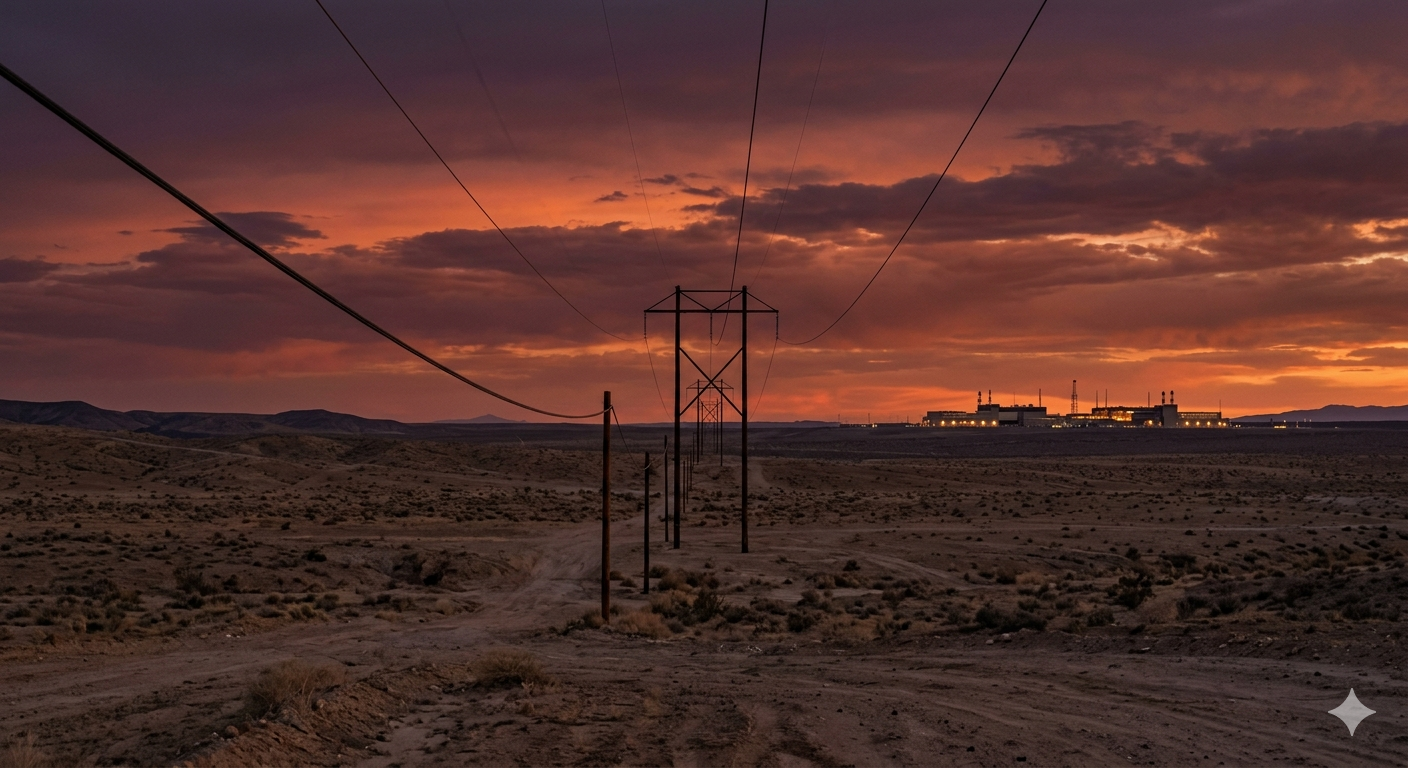
Every few weeks, the technology press runs the same story with a different name in the headline. A new model scores higher on a reasoning benchmark. A frontier lab releases a system that outperforms its predecessor on code generation, mathematical problem-solving, or multimodal comprehension. Analysts update their competitive rankings. Investors read the tea leaves of capability releases to determine who is pulling ahead in what the industry has taken to calling the AI race. It is a compelling narrative, and it is almost entirely the wrong thing to pay attention to if you want to understand who actually wins. The real competition is not happening on a leaderboard. It is happening in substation upgrade queues, land acquisition files, grid connection applications, and capital expenditure decisions that were made in 2019, 2020, and 2021, when the term “AI infrastructure” belonged in specialist conference agendas rather than national policy documents. The countries and companies that treated AI as a physical infrastructure problem before it became a benchmark problem are the ones announcing campuses today. Everyone else is managing a pipeline backlog and calling it a strategy.

What the Benchmark Conversation Misses
There is nothing wrong with tracking model capability. Reasoning performance, inference efficiency, and multimodal quality all matter to the products that run on top of AI infrastructure, and the companies building those products make consequential decisions based on capability assessments. The problem is not that benchmarks are irrelevant it is that benchmark coverage has crowded out the infrastructure conversation to the point where the industry reads capability releases as competitive signals while the actual competitive moat is being poured in concrete.
Consider what Sam Altman’s stated ambition building a gigawatt of new AI infrastructure every week reveals about where the leverage in AI actually sits. The World Economic Forum noted in March 2026 that this ambition exposes a mismatch between AI ambitions and energy reality already visible in delayed projects, constrained power access, and idle compute waiting on the grid. That is not a software problem. No amount of model optimisation resolves the constraint that a grid connection queue imposes on a facility that has not yet received power. The benchmark scores of the model intended to run in that facility are, in the interim, completely academic.
The US power grid carries this tension most visibly. Approximately 70% of it was built between the 1950s and 1970s and is approaching the end of its design life, a fact that Clift Pompee of Compass Datacenters noted in April 2026 analysis as creating an infrastructure reality that unprecedented AI load growth is exposing rather than creating. The grid was not designed for the load profile that AI campuses impose, and the pace at which it can be modernised is governed by civil engineering, regulatory process, and equipment manufacturing not by how quickly a lab can release the next model version.
Infrastructure Was Always the Competition
The insight that infrastructure determines AI competitive position is not new, and it is not obscure. It was visible to anyone paying attention to the physical requirements of AI training at scale — the tens or hundreds of megawatts per training cluster, the heat densities that exceed air cooling limits, the millisecond-scale power dynamics that strain grid interfaces from the moment those requirements became clear. What was missing was not the information. It was the willingness to treat civil engineering as a strategic matter worthy of the same analytical attention that model architecture receives.
BigDATAwire’s December 2025 analysis of AI infrastructure predictions for 2026 made this explicit: AI is entering a phase where choices about infrastructure quietly decide outcomes long before models ever reach users or their performance gets evaluated on benchmarks. Those choices determine which projects get funded, which products ship, and which regions and companies are allowed to scale. The decision-making is already happening, and most of it has to do with infrastructure rather than algorithms. That framing deserves to be the default lens through which competitive AI analysis is conducted not a caveat buried in the infrastructure section of a broader technology review.

The companies that understood this earliest are not necessarily the ones that built the best models. They are the ones that secured power purchase agreements when renewable energy markets were less contested, that acquired land in Northern Virginia and Iowa and Phoenix before those markets compressed, and that built relationships with grid operators and utilities at a moment when data centres were still regarded as industrial tenants rather than as the largest new load class on the national grid. That early positioning is now a durable competitive moat that no benchmark-driven narrative can adequately explain.
The Physical Stack Is the Strategic Stack
When analysts assess competitive AI positioning, the typical framework examines training compute, model architecture, data quality, and talent concentration. These are legitimate variables. The physical infrastructure stack that underpins all of them grid connections, substation capacity, cooling architecture, transmission headroom rarely receives equivalent treatment, and the asymmetry produces systematically incomplete competitive analysis. The countries pulling ahead in global AI infrastructure in 2026 share a single characteristic that precedes any policy intervention or model development programme: they made grid and energy investment decisions that created physical capacity before AI demand arrived to consume it. Spain is capturing hyperscaler investment because its renewable energy portfolio and grid headroom exist at a moment when other European markets have exhausted theirs. The Nordic markets attract AI training infrastructure because hydropower and ambient cooling economics create a cost and carbon profile that no policy incentive package in a thermally or electrically constrained market can replicate. Neither of these competitive positions was designed as an AI infrastructure strategy. Both were physical infrastructure investment cycles that the AI demand wave arrived to find already in place.
The same logic applies at the company level. The hyperscalers that can announce new AI campus capacity on compressed timelines are not doing so because they have superior permitting relationships or more efficient construction management. They are doing so because they secured grid connections and land positions years in advance, absorbing the option cost of capacity they did not yet need against the certainty that they would eventually need all of it. That discipline treating physical infrastructure as a strategic asset requiring long lead-time investment rather than a procurement decision triggered by immediate demand is the competitive behaviour that the AI era rewards most directly.
What the Coverage Should Look Like
The argument here is not that model releases should receive less coverage, or that capability research is strategically unimportant. It is that the coverage ratio between software capability announcements and physical infrastructure decisions is badly misaligned with their actual competitive significance at this stage of the AI industry’s development. A new benchmark result from a frontier lab will be superseded in months. A grid connection secured in a constrained market, or a substation upgrade that adds reliable capacity to a campus that was power-limited, compounds over years. The former generates press releases. The latter generates structural competitive advantage.
Infrastructure is the unsexy part of the AI story, and the industry’s communications apparatus understands this perfectly well. Facility announcements in megawatts attract a fraction of the coverage that model releases generate, despite representing commitments of capital and physical resource that dwarf the cost of model training runs. The result is a media environment in which the executives and analysts who read about AI most carefully know the parameter count and benchmark performance of every significant model released in the last year, but could not reliably name the grid operator serving the three largest AI campuses in the country or the connection lead times facing new entrants in the markets they cover.
That information asymmetry is not neutral. It shapes investment decisions, policy attention, and strategic planning in ways that systematically underweight the physical constraints that will determine AI’s actual trajectory. The capacity to run the most capable model in the world is worth nothing without the power to run it at the density the model requires, in a facility connected to a grid that can absorb the load without triggering a queue that stretches three years into the future. The power cable is not the footnote to the AI story. It is the first paragraph. The benchmark is the last.











