 Skip to content
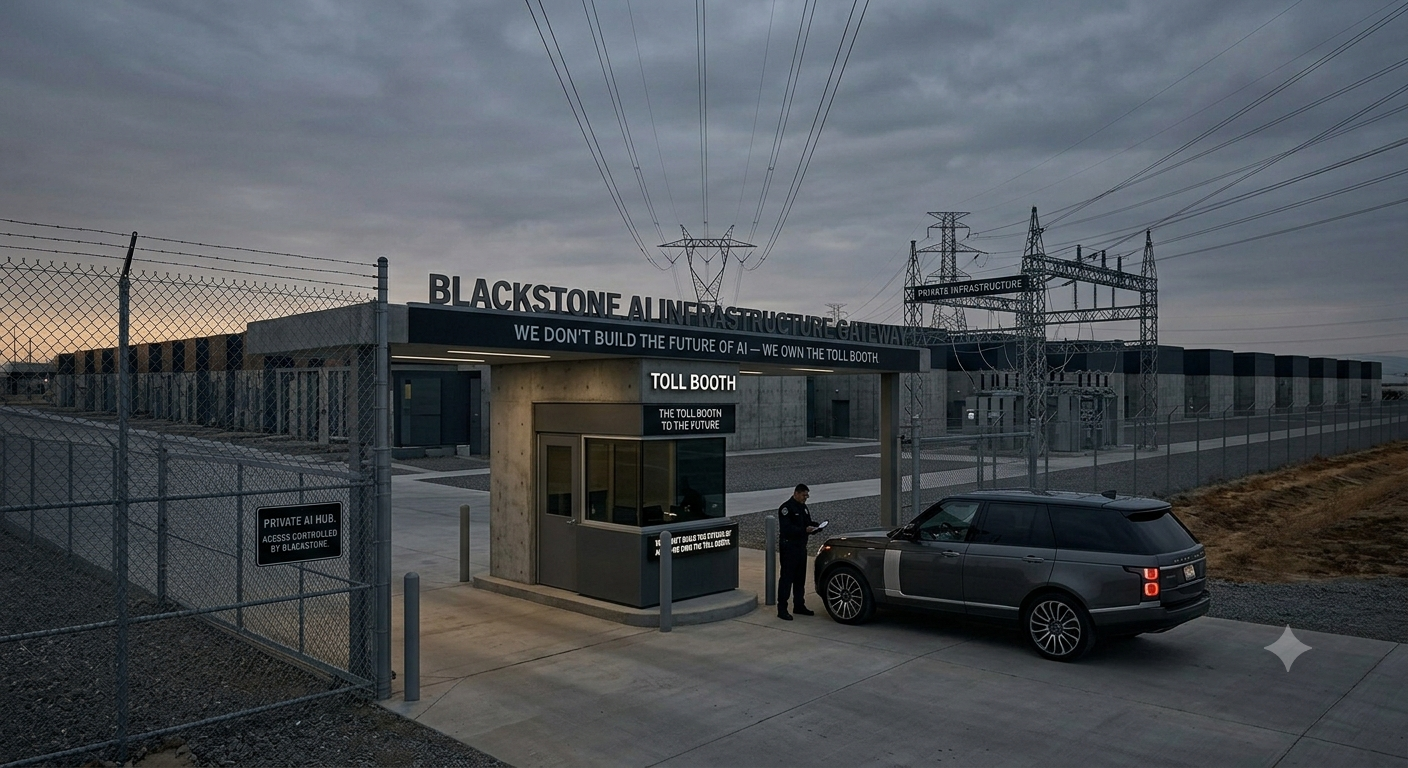
Stephen Schwarzman said it plainly on an earnings call, and nobody blinked. Blackstone is the largest data center provider in the world, with holdings across the U.S., Europe, India, and Japan. A private equity firm not a cloud company, not a chipmaker, not a government now controls more AI infrastructure capacity than anyone else on the planet. We should sit with that sentence longer than the market did. The numbers are not subtle. A $70 billion operating portfolio. A pipeline exceeding $100 billion. Combined exposure approaching $170 billion, built across six years through one acquisition after another: QTS in 2021, AirTrunk in 2024, stakes in Vnet, Lumina CloudInfra, Copeland, Winthrop. Most coverage of this treats it as a financial story a smart firm spotting a megatrend early. I think that framing misses what is actually happening. Blackstone is not betting on AI. It is positioning itself to be the thing AI cannot function without, regardless of who wins the model race.

The Strategy Nobody Is Naming Correctly
Here is what should unsettle us: Blackstone figured out that the real chokepoint in AI is not compute, not talent, not even chips. It is power. Grid interconnection queues stretch seven to ten years in Europe and have hit eight years in PJM. Whoever controls reliable, deliverable electricity controls the pace at which AI scales full stop. So Blackstone stopped renting power and started owning it.
The Pennsylvania Digital and Energy Hub is the clearest evidence. A $25 billion joint venture between QTS and PPL Corporation builds dedicated natural gas plants explicitly to bypass the interconnection queue. Not improve it. Bypass it. The $11.5 billion acquisition of TXNM Energy extends the same logic into Texas and New Mexico. This is not a real estate company anymore. This is a company assembling vertical control over land, power generation, and computing capacity simultaneously, in a market where no regulator has yet decided whether that concentration is a problem.
I do not think it is illegal. I think it is something more interesting and more concerning: it is legal, rational, and exactly the kind of consolidation that markets reward right up until the moment it becomes a liability for everyone who depends on it. We have seen this pattern before in other infrastructure categories railroads, telecom backbone, undersea cables where early consolidation looked like efficient capital allocation until it hardened into structural dependency that took decades and considerable political will to unwind, if it was unwound at all. There is no reason to assume AI infrastructure will be different simply because the underlying technology is newer.
“Diversification” That Isn’t
Blackstone’s defenders will point to its geographic spread the U.S., Spain, Germany, Australia, India, Japan as evidence of resilience, not risk. I’d push back on that. Diversification protects Blackstone’s balance sheet. It does nothing to protect the hyperscalers, enterprises, and governments who increasingly depend on Blackstone-controlled infrastructure across multiple continents simultaneously. Spreading concentrated control across more countries is not the same as reducing concentration. It is exporting the same dependency to more jurisdictions, each of which now has a single dominant landlord for its most strategically important infrastructure category.
Look at India. Six weeks after entering the market through the Lumina CloudInfra acquisition, AirTrunk announced $30 billion in planned investment and 5 gigawatts of capacity by 2030 more than triple the country’s entire current installed base. Prime Minister Modi welcomed it as a landmark commitment to India’s digital future, and politically, I understand why. But pause on the dependency being created. A country is effectively outsourcing a meaningful share of its sovereign AI infrastructure capacity to a single American private equity vehicle, on a four-year delivery promise, in a market that added only 371 megawatts of capacity in all of 2025. That is not a partnership of equals. That is a country making a bet that Blackstone’s execution will outpace its own historical delivery rate by a factor of fourteen.

This is not unique to India, either. It is simply the most visible instance because the numbers are so dramatic. Smaller versions of the same arrangement are playing out in Spain’s Aragon region and across Blackstone’s German commitments, where local governments and grid operators are similarly tying long-term infrastructure planning to a single firm’s delivery promises. The cumulative effect, across enough markets, starts to look less like investment and more like dependency by design.
The Question We Should Be Asking Instead
Most of the financial press is asking whether Blackstone’s thesis will pay off whether AI demand justifies the capital, whether the leasing volumes hold, whether the dry powder gets deployed efficiently. Those are fine questions for an earnings call. They are not the questions that matter for the rest of us. The question that matters is this: what happens when one private company’s balance sheet decisions become a binding constraint on national AI strategy, hyperscaler expansion plans, and grid policy across a dozen countries at once? What recourse does a government have if Blackstone’s India delivery timeline slips, or its Pennsylvania gas plants face local opposition, or its Aragon campuses run into Spanish permitting friction it didn’t fully anticipate? Right now, the answer is: not much, beyond hoping the contracts hold and the capital keeps flowing on schedule. There is no regulatory body currently tasked with assessing what happens if a single private capital allocator becomes the load-bearing infrastructure provider for multiple national AI strategies at once and by the time that gap becomes obvious, the dependency will likely already be irreversible.
I am not arguing Blackstone is acting in bad faith. Everything described here the QTS platform strategy, the power-plus-data-center integration model, the AirTrunk acquisition, the India commitment is rational capital allocation in response to a genuine, massive infrastructure gap. Somebody had to step into that gap, and Blackstone had the dry powder and the conviction to move first and move fastest. But rational and unaccountable are not opposites. A firm that controls this much of the physical substrate AI runs on across this many countries, with this little regulatory scrutiny of the consolidation itself deserves more public attention than a quarterly earnings beat. We have spent years debating who should control the most powerful AI models. We have spent almost no time debating who should be allowed to control the buildings, the power plants, and the land those models actually run on. Blackstone has already answered that question for us. I think it’s worth asking whether we’re comfortable with the answer.












