
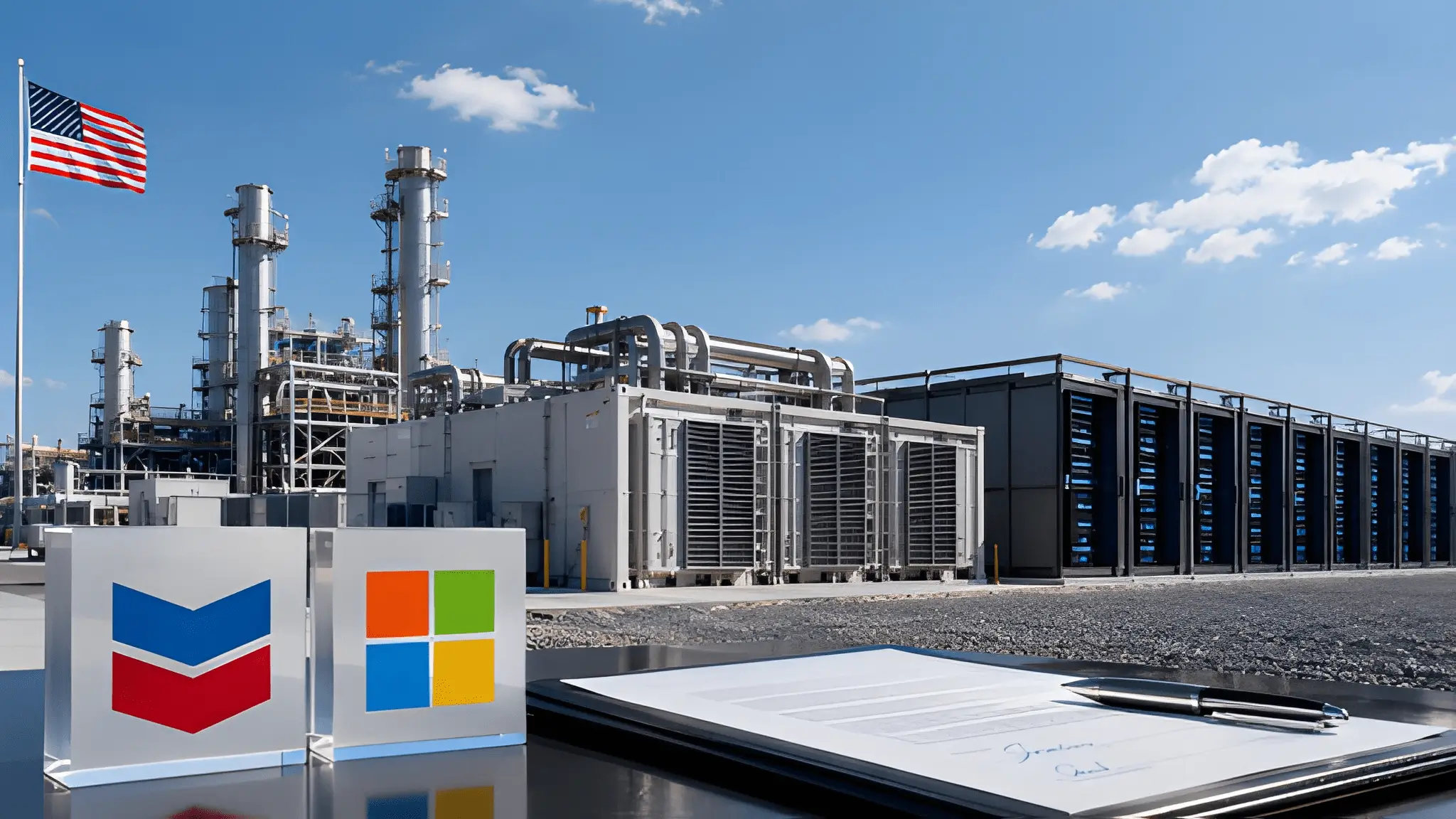
Chevron Corp. has signed a 20-year power purchase agreement with Microsoft Corp. to supply dedicated electricity from a new co-located power facility planned in West Texas, marking one of the largest energy commitments tied directly to artificial intelligence infrastructure in the United States. Energy Forge One LLC, a wholly owned Chevron subsidiary, will execute the agreement, which centers on Project Kilby, a large-scale power development Chevron and Engine No. 1 are advancing together. Moreover, the facility will provide electricity directly to a Microsoft-operated data center, creating a dedicated energy source outside the traditional utility procurement model.

The arrangement reflects a growing shift across the AI industry as hyperscale operators seek greater control over energy availability amid rising compute demand. Technology companies increasingly view power access as a strategic constraint rather than a simple operating expense, particularly in regions experiencing rapid data center growth. Project Kilby places Chevron at the center of that transition. The energy giant is leveraging its access to Permian Basin natural gas resources and large-scale infrastructure expertise to serve a market that increasingly values speed, reliability and long-term supply certainty.
“AI is reshaping the global economy, and abundant, affordable, reliable energy is essential to fueling that transformation,” said Jeff Gustavson, Chevron president of New Energies. “Chevron is uniquely positioned to deliver power to customers with certainty, speed and at a competitive cost, leveraging Permian natural gas and our proven execution capabilities. This project links Chevron’s traditional strengths to emerging demand, creating differentiated value for our shareholders and the communities where we operate.”
Project Kilby Targets 2.67 GW of Dedicated Capacity
Project Kilby is expected to deliver approximately 2.67 gigawatts of generating capacity through a phased development strategy that allows expansion over time. Once completed, the facility will rank among the largest co-located natural gas-powered data center developments in the country. Most of the project’s generation capacity will come from large turbines supplied by GE Vernova alongside associated electrical infrastructure. Additional generation assets will be provided by Solar Turbines, a subsidiary of Caterpillar Inc., creating a diversified generation portfolio designed for continuous operation.
The scale of the project highlights how AI infrastructure is reshaping energy investment priorities across the United States. Large language models, advanced cloud platforms and next-generation compute clusters require significantly more power than previous generations of digital infrastructure, driving demand for dedicated energy resources. As a result, developers are increasingly pairing new generation assets directly with data center campuses to accelerate deployment schedules and reduce dependence on constrained regional power systems.
“The rapid growth we’re experiencing in AI and cloud, driven by customer demand, requires energy infrastructure that can scale quickly and reliably,” said Noelle Walsh, Microsoft president of Cloud Operations + Innovation. “Our agreement with Chevron helps ensure we’ll have dedicated, large-scale power to support the evolution and reliability of advanced compute. Through this partnership, we’re delighted to grow with and become a deeper part of the West Texas community.”

Co-Located Generation Reduces Pressure on Regional Grid
The project has been designed around a co-location model that places power generation and data center operations in the same development footprint. That approach allows electricity to flow directly to Microsoft’s facility while reducing reliance on transmission networks that serve residential and commercial customers. Energy availability has emerged as one of the defining challenges for AI infrastructure deployment. In several major U.S. markets, data center developers face lengthy timelines for grid interconnection, creating delays for projects requiring hundreds of megawatts of power.
Project Kilby seeks to address that challenge by adding new dispatchable generation capacity rather than drawing heavily from existing grid resources. The model has gained attention across the sector because it offers a pathway for rapid expansion without significantly increasing pressure on local electricity systems. Meanwhile, the agreement provides Microsoft with long-term energy certainty at a time when hyperscale operators are competing aggressively for available power resources across North America.
The Microsoft agreement represents a major step toward Chevron’s planned Final Investment Decision for the project, which the company expects to reach by the end of 2026, subject to required approvals and conditions. The company anticipates first power delivery in 2028. Chevron also expects the development to generate mid-teen returns while creating a revenue stream that remains less exposed to traditional oil and natural gas commodity cycles.
For investors, the project illustrates how major energy producers are expanding into infrastructure segments linked to AI growth. Long-term contracted power sales offer predictable cash flow profiles that differ from conventional upstream energy investments. Furthermore, projects such as Kilby create opportunities for energy companies to monetize fuel resources through electricity generation rather than direct commodity sales, potentially increasing value capture across the supply chain.
Economic Impact and Water Strategy Shape Regional Benefits
Chevron expects Project Kilby to deliver substantial economic benefits across West Texas. According to company projections, the development could generate more than $10 billion in state and local tax revenue while supporting nearly 2,000 jobs and broader regional economic activity. The company also outlined several environmental and operational measures intended to reduce resource impacts. Rather than relying on freshwater supplies, the facility plans to use non-potable brackish groundwater for power plant operations.
Chevron is simultaneously exploring opportunities to reuse produced water generated from oil and gas activities. The approach aligns with broader industry efforts to identify alternative water sources for large-scale industrial and energy projects in water-stressed regions. Plant designs will incorporate Selective Catalytic Reduction systems to lower nitrogen oxide emissions, alongside technologies intended to reduce noise and light impacts on neighboring communities. Those measures reflect increasing scrutiny of how large energy and AI infrastructure projects integrate with local environmental and community priorities.











