Skip to content
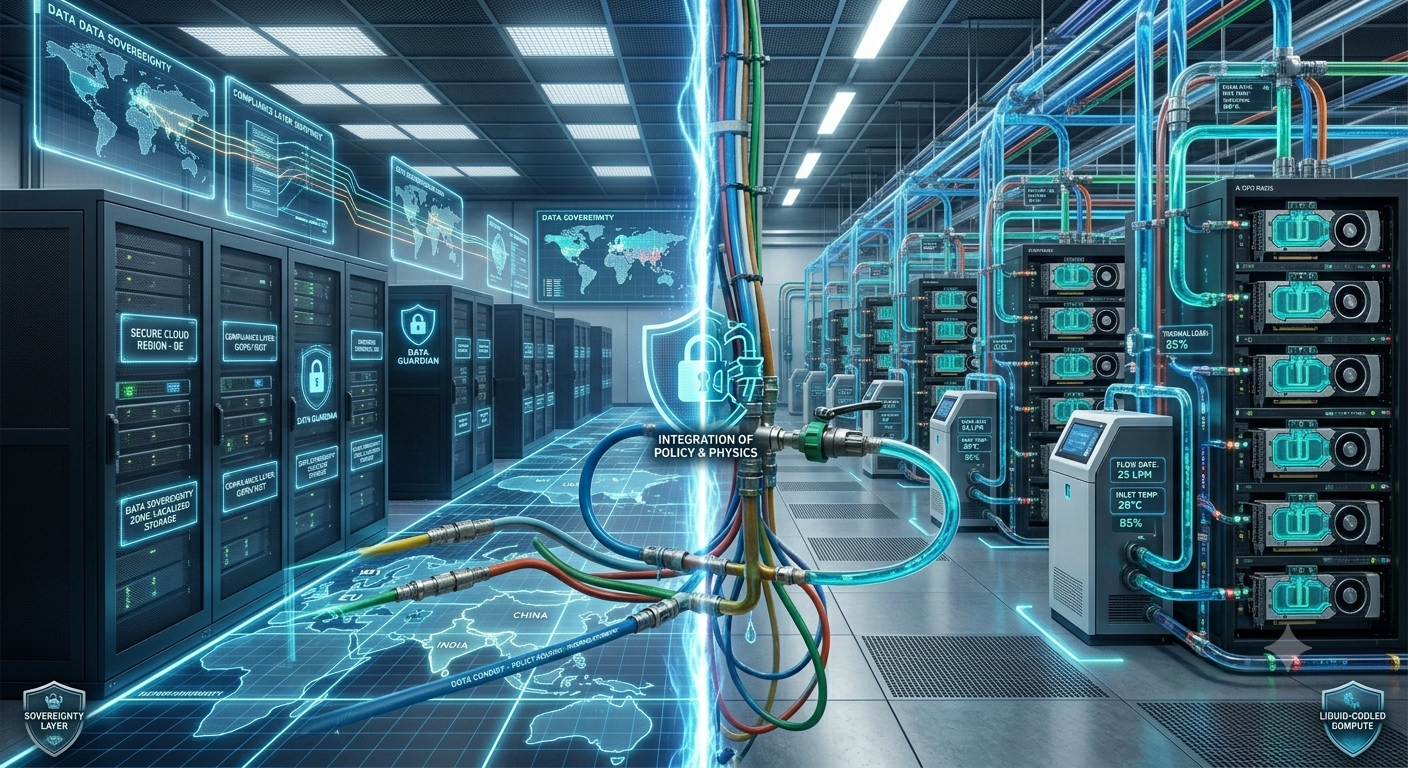
As governments redefine digital sovereignty beyond data location, liquid cooling infrastructure is becoming part of the trusted computing boundary.
For nearly two decades, digital sovereignty debates revolved around a relatively simple question: where is the data stored? Policymakers, regulators, and enterprise customers focused on geographic location, cloud ownership, and legal jurisdiction as the primary determinants of control. If sensitive information remained within national borders and was processed according to local laws, sovereignty concerns were largely considered addressed. This logic shaped everything from the European Union’s GDPR framework to the emergence of sovereign cloud initiatives across Europe, Asia, and the Middle East. Data residency became the dominant metric for measuring digital independence, influencing cloud procurement decisions, public sector modernization programs, and national technology strategies. The assumption was straightforward: control the data, and sovereignty follows.

Artificial intelligence is forcing governments to rethink that assumption. Modern AI infrastructure bears little resemblance to the traditional enterprise data centers that informed earlier regulatory frameworks. Training and operating advanced AI models requires massive concentrations of compute power, unprecedented energy consumption, and entirely new approaches to thermal management. The result is a new generation of facilities that function less like conventional IT environments and more like industrial infrastructure complexes. Power systems, cooling networks, telemetry platforms, automation software, and operational control systems now work together as a tightly integrated ecosystem. In this environment, the question of sovereignty extends far beyond storage locations and cloud regions. It increasingly encompasses the physical systems that enable digital services to function in the first place.
This shift is occurring at the same time governments are elevating AI infrastructure to the status of strategic national assets. Across Europe, North America, the Gulf region, and parts of Asia, policymakers view AI capabilities as critical to economic competitiveness, technological leadership, and national security. As a result, regulators are beginning to examine not only where data resides but also who controls the infrastructure supporting that data. Ownership structures, operational governance, supply chains, facility management, and infrastructure resilience are becoming part of broader sovereignty discussions. The focus is moving away from geography alone and toward a more comprehensive understanding of digital control. In practice, that means sovereignty is increasingly defined by the entire operational environment surrounding critical workloads.
Few technologies illustrate this transformation more clearly than liquid cooling. At first glance, cooling infrastructure appears unrelated to sovereignty concerns. Coolant does not store personal information, transmit customer records, or process sensitive workloads. Yet modern liquid cooling systems are no longer simple mechanical installations hidden behind data center walls. They are sophisticated operational platforms equipped with sensors, monitoring systems, automated controls, telemetry networks, and software-driven optimization tools. These systems continuously collect information about facility performance, communicate with infrastructure management platforms, and influence the availability and reliability of AI workloads. As cooling evolves into an intelligent operational layer, it becomes increasingly difficult to separate thermal infrastructure from the broader computing environment it supports.

This creates what can be described as the sovereignty paradox of AI infrastructure. The same liquid cooling technologies required to support sovereign AI ambitions are simultaneously introducing new forms of operational dependency. Governments want domestically controlled AI capabilities, but those capabilities depend on increasingly interconnected infrastructure systems. Organizations seek isolation, yet efficiency often favors shared cooling plants, centralized monitoring platforms, and campus-wide utility networks. Regulators are demanding greater control over critical digital infrastructure at the exact moment that infrastructure is becoming more integrated and complex. The challenge is not that liquid cooling violates data residency rules. The challenge is that sovereignty itself is expanding beyond data, pulling physical infrastructure into the regulatory conversation.
The End of the Traditional Data Sovereignty Era
To understand why cooling systems are entering sovereignty discussions, it is necessary to understand how dramatically the concept of sovereignty has evolved. During the early cloud computing era, concerns were primarily legal and jurisdictional. Organizations worried that data stored outside national borders could become subject to foreign laws, surveillance programs, or regulatory regimes. The solution appeared relatively straightforward: keep data local, use approved cloud providers, and ensure compliance with relevant regulations. This approach influenced major legislative frameworks around the world and became the foundation for many enterprise cloud strategies. Data location served as the primary indicator of sovereignty because digital infrastructure remained relatively simple compared with today’s AI ecosystems.
Over time, however, policymakers began to recognize that data location alone did not guarantee meaningful control. A cloud service could operate within national borders while still relying on foreign ownership structures, external management systems, or operational dependencies beyond the reach of local authorities. As a result, sovereignty discussions expanded to include governance, transparency, accountability, resilience, and operational independence. European initiatives such as Gaia-X reflected this broader perspective, emphasizing not only where information is stored but also who controls access, manages infrastructure, and governs critical digital services. The conversation gradually shifted from storage geography to infrastructure governance, creating a much more complex understanding of what sovereignty actually means.
This evolution accelerated as digital services became increasingly important to economic and governmental operations. Cloud platforms now support healthcare systems, financial institutions, public administration, transportation networks, and national security functions. The consequences of losing operational control over these systems are significantly greater than they were a decade ago. Governments therefore began examining the full chain of dependencies surrounding digital infrastructure. Questions emerged about software supply chains, operational technology, infrastructure ownership, foreign access rights, and incident response capabilities. Sovereignty was no longer viewed solely as a legal issue. It became an operational issue centered on the ability to maintain independent control during periods of disruption, crisis, or geopolitical tension.
Artificial intelligence has pushed this transformation even further. Unlike traditional enterprise applications, AI systems require specialized infrastructure stacks that combine computing, networking, power delivery, and cooling technologies at unprecedented scale. These systems cannot be separated into neat categories of hardware, software, and facilities. Instead, they function as integrated environments where physical infrastructure directly influences computational capability. This convergence is forcing regulators to examine components that historically existed outside the scope of digital governance. Cooling systems, power infrastructure, telemetry platforms, and facility control networks are becoming relevant because they now play a direct role in enabling strategic AI operations. In effect, the trusted computing boundary is expanding beyond servers and software to include the physical systems that sustain them.
The result is a profound shift in how sovereignty is defined. Future sovereignty frameworks are likely to focus less on the location of information and more on the control of infrastructure ecosystems. Governments increasingly want assurance that critical AI capabilities can operate independently, remain resilient during disruptions, and avoid excessive reliance on external actors. Achieving those objectives requires visibility into every layer of infrastructure supporting sensitive workloads. In this emerging model, cooling systems are not merely utilities. They become part of the operational foundation upon which sovereign digital capabilities depend. That realization is beginning to reshape how both regulators and infrastructure architects think about the future of AI.
How AI Forced the Liquid Cooling Revolution
The growing importance of liquid cooling cannot be understood without first understanding the unprecedented thermal demands of artificial intelligence infrastructure. For decades, data center design followed relatively predictable patterns. Enterprise applications, web hosting environments, and traditional cloud workloads generated manageable amounts of heat that could be removed using air-based cooling systems. Operators optimized airflow, deployed hot and cold aisle containment strategies, and expanded HVAC capacity as demand increased. While cooling represented a significant operational cost, it rarely dictated the fundamental design of a facility. Computing infrastructure and cooling infrastructure existed in a relatively stable relationship, allowing data centers to scale without dramatically changing their architectural assumptions.
Artificial intelligence has disrupted that balance. Modern AI training clusters rely on highly specialized accelerators containing billions of transistors operating simultaneously across thousands of interconnected systems. These processors consume extraordinary amounts of power and generate corresponding amounts of heat. A rack that might have consumed 10 kilowatts a decade ago can now exceed 100 kilowatts when populated with advanced GPUs. Some infrastructure roadmaps already anticipate rack densities reaching 250 kilowatts or more within the next several years. At those levels, traditional air cooling becomes increasingly inefficient, requiring enormous energy expenditure simply to move sufficient volumes of air through the facility. The challenge is no longer incremental optimization. It is a fundamental physics problem.
Liquid cooling emerged as the industry’s answer because liquids are significantly more efficient at transferring heat than air. Instead of relying on large volumes of chilled air circulating through data halls, liquid cooling systems deliver coolant directly to high-performance components where heat is generated. This approach dramatically improves thermal efficiency while enabling higher compute densities within a smaller physical footprint. For hyperscalers racing to deploy AI infrastructure, the advantages are compelling. More compute can be installed in the same facility, energy efficiency improves, and performance remains stable under extreme workloads. What began as an emerging technology is rapidly becoming a requirement for next-generation AI deployments rather than a premium option reserved for specialized environments.
As adoption accelerates, cooling infrastructure is becoming far more sophisticated than many policymakers realize. Modern liquid-cooled facilities rely on extensive networks of Coolant Distribution Units, pumps, heat exchangers, sensors, monitoring platforms, and control systems. These components operate continuously to maintain precise thermal conditions across thousands of servers. Unlike traditional mechanical systems that function largely in the background, modern cooling infrastructure actively responds to changing workload demands, adjusts operating parameters in real time, and generates large volumes of operational data. The cooling layer increasingly resembles a digital platform as much as a physical utility. This transformation is significant because digital platforms naturally attract governance and oversight concerns.
The scale of investment further reinforces cooling’s strategic importance. Around the world, governments and private investors are committing hundreds of billions of dollars toward AI infrastructure expansion. New data center campuses are being designed specifically around liquid cooling requirements from the outset. Power delivery systems, facility layouts, and operational procedures are all being reconfigured to support high-density AI deployments. Cooling is no longer an auxiliary function attached to computing infrastructure. It is becoming one of the primary design constraints shaping how AI facilities are built. When an infrastructure component becomes indispensable to national AI ambitions, it inevitably attracts attention from regulators, policymakers, and sovereignty advocates.
This transformation marks a fundamental departure from earlier generations of digital infrastructure. Historically, cooling was viewed as a facilities issue delegated to engineers and operations teams. Sovereignty discussions focused on cloud providers, software vendors, and telecommunications networks because those were the systems perceived to influence data control. AI changes that equation by making thermal management directly responsible for computational capability. Without effective cooling, advanced AI hardware cannot operate at scale. In practical terms, cooling systems now influence the availability, performance, and resilience of strategic digital assets. Once infrastructure reaches that level of importance, it becomes difficult to argue that it exists outside the boundaries of sovereignty considerations.
The Hidden Telemetry Layer Inside Modern Cooling Systems
One of the least understood aspects of modern liquid cooling is the extent to which it depends on data collection and operational visibility. Discussions about cooling often focus on pipes, pumps, and coolant loops, creating the impression that these systems are primarily mechanical. In reality, contemporary liquid cooling deployments rely heavily on telemetry networks that continuously monitor infrastructure performance. Thousands of sensors measure temperature, pressure, flow rates, coolant quality, equipment health, and system efficiency in real time. This information is collected, analyzed, and integrated into broader facility management platforms to ensure optimal operation. Without these monitoring capabilities, maintaining stable conditions across large AI deployments would be virtually impossible.
The importance of telemetry grows as facilities become larger and more complex. A hyperscale AI campus may contain multiple cooling plants, hundreds of liquid-cooled racks, and extensive heat rejection infrastructure operating simultaneously. Human operators cannot manually manage such environments at scale. Instead, automated systems analyze sensor data and make adjustments to maintain thermal stability. Flow rates are modified, pumps are optimized, temperatures are balanced, and maintenance requirements are identified before failures occur. These capabilities improve efficiency and reliability, but they also create an additional layer of operational technology that sits between the physical cooling system and the workloads it supports. In effect, liquid cooling introduces a new digital control plane inside the data center.
This development becomes particularly relevant when viewed through the lens of sovereignty. Traditional sovereignty frameworks focused primarily on customer data and application workloads. Operational telemetry was often treated as a separate category with limited strategic significance. However, as AI facilities become critical infrastructure, operational information itself gains importance. Detailed telemetry can reveal infrastructure utilization patterns, capacity constraints, operational vulnerabilities, maintenance schedules, and performance characteristics. While this information may not contain personal data, it provides valuable insight into the operation of strategically important facilities. Governments increasingly recognize that control over critical infrastructure includes control over the information generated by that infrastructure.
The challenge becomes even more complicated when telemetry platforms integrate with external vendors and service providers. Many modern infrastructure systems rely on remote monitoring capabilities, software updates, predictive maintenance services, and vendor-supported management tools. These arrangements improve operational efficiency and reduce downtime, but they can also introduce additional dependencies into sovereign environments. Questions emerge regarding who has visibility into infrastructure performance, who controls software updates, and who can access operational data during maintenance activities. These concerns are not unique to cooling systems, but liquid cooling amplifies them because thermal management has become central to AI operations. The more critical the infrastructure becomes, the more scrutiny its operational ecosystem receives.
This is where the concept of the trusted computing boundary begins to evolve. Traditionally, the trusted boundary encompassed servers, storage systems, networking equipment, and security controls directly responsible for processing information. AI infrastructure is expanding that definition. Cooling systems, power networks, telemetry platforms, and facility control systems increasingly influence whether critical workloads can function effectively. As a result, policymakers are beginning to view infrastructure through a more holistic lens. The question is no longer limited to where data resides. The question is whether the entire environment supporting that data remains transparent, resilient, and under trusted control. Cooling infrastructure, once considered an invisible utility, is gradually becoming part of that conversation.
The implications extend beyond regulation and compliance. Infrastructure architects are already beginning to design facilities with greater attention to operational separation, telemetry governance, and management isolation. Some sovereign cloud deployments require dedicated operational technology networks, localized management systems, and stricter controls around infrastructure monitoring. These measures reflect a broader recognition that sovereignty depends not only on computing resources but also on the systems responsible for sustaining those resources. As AI continues to drive infrastructure complexity, the boundary between digital governance and physical infrastructure will become increasingly difficult to distinguish. The cooling layer sits directly at that intersection, making it one of the most overlooked yet strategically important components of the modern AI stack.
Shared Cooling Loops and the New Infrastructure Boundary Problem
The sovereignty debate becomes significantly more complicated when AI infrastructure scales beyond individual data halls and evolves into multi-building campuses. Across Europe, North America, the Middle East, and Asia, operators are increasingly developing AI-focused facilities measured not in megawatts but in hundreds of megawatts. These campuses often function as integrated ecosystems where power generation, cooling infrastructure, networking systems, and operational services are shared across multiple buildings. From an engineering perspective, this approach makes perfect sense. Centralized infrastructure reduces costs, improves efficiency, simplifies maintenance, and enables operators to scale rapidly as demand grows. However, the very efficiencies that make campus-scale infrastructure attractive are also creating new questions about where the sovereign boundary actually begins and ends.
Consider a future sovereign AI deployment operated on behalf of a national government. The servers may be located entirely within national borders. The data may never leave the country. Access controls, security procedures, and compliance frameworks may satisfy every traditional sovereignty requirement. Yet the facility itself could rely on a centralized cooling plant that serves multiple tenants across the broader campus. Government workloads might share thermal infrastructure with commercial AI companies, multinational cloud providers, or private research organizations. The cooling systems remain physically local, but the operational environment supporting those systems becomes significantly more interconnected. In this scenario, sovereignty is no longer determined solely by where information resides. It becomes influenced by how infrastructure dependencies are organized and governed.
This issue is not unique to cooling, but cooling provides one of the clearest examples of the challenge. Modern liquid cooling architectures frequently depend on shared resources such as heat rejection systems, cooling towers, pumping stations, water treatment facilities, and centralized monitoring platforms. These components may support multiple buildings simultaneously, creating efficiencies that are difficult to replicate through fully isolated designs. The problem is that shared infrastructure introduces shared operational dependencies. If a cooling plant experiences disruption, the effects may extend across multiple facilities. If operational management is centralized, governance decisions may influence multiple stakeholders simultaneously. As AI infrastructure becomes strategically important, these dependencies attract greater scrutiny from governments seeking stronger control over critical systems.
The challenge resembles earlier debates surrounding public cloud adoption. When cloud computing first emerged, many governments worried about multi-tenancy and shared infrastructure. Organizations questioned whether sensitive workloads could coexist safely alongside other customers in the same environment. Over time, cloud providers developed isolation technologies, compliance certifications, and governance frameworks that demonstrated how shared infrastructure could support secure and regulated workloads. AI infrastructure may be entering a similar phase. The technical challenge is no longer whether workloads can be isolated. The emerging challenge is whether physical infrastructure can provide the same level of transparency, accountability, and governance that sovereign cloud frameworks increasingly demand.
One reason this issue remains underexplored is that most regulatory frameworks were developed before liquid-cooled AI campuses became commonplace. Existing sovereignty regulations generally focus on data protection, access controls, cloud governance, and operational accountability. They rarely address thermal infrastructure because cooling systems historically existed outside the scope of digital policy discussions. Yet AI is blurring the distinction between digital and physical infrastructure. A cooling outage can disable thousands of GPUs. A thermal management failure can interrupt critical AI services. Decisions involving cooling architecture can influence the resilience and availability of strategically important workloads. As a result, infrastructure once considered peripheral is moving closer to the center of sovereignty conversations.
The question regulators increasingly face is not whether shared cooling infrastructure should be prohibited. Such an approach would be economically impractical and technically unnecessary. Instead, the focus is likely to shift toward governance and operational transparency. Policymakers may ask who controls cooling infrastructure, who has visibility into operational systems, who can access telemetry data, and how dependencies are managed during disruptions. These questions mirror broader trends in digital sovereignty policy, where control and accountability often matter more than strict physical isolation. The objective is not complete separation but confidence that critical infrastructure remains transparent, resilient, and aligned with national interests.
This evolution reflects a broader transformation in how sovereignty is understood. Historically, sovereignty discussions concentrated on the assets being protected. In the AI era, attention is expanding toward the systems that enable those assets to function. Servers, storage arrays, and applications remain important, but they represent only part of a much larger ecosystem. Power networks, cooling plants, operational technology platforms, and facility management systems all contribute to the ability of AI infrastructure to deliver services reliably. As governments invest heavily in domestic AI capabilities, they are increasingly evaluating the entire ecosystem rather than individual components. The result is a more comprehensive view of sovereignty that extends beyond digital assets into the industrial infrastructure supporting them.
Why Sovereign Cloud Frameworks Are Quietly Expanding the Definition of Control
The growing importance of infrastructure governance can already be observed in the evolution of sovereign cloud initiatives around the world. Early sovereignty efforts focused heavily on data residency requirements and legal jurisdiction. Customers wanted assurances that information would remain within specific geographic boundaries and that foreign governments could not easily compel access. While these concerns remain important, modern sovereign cloud frameworks increasingly emphasize operational control, governance structures, access management, and infrastructure transparency. In many cases, providers are being asked not only where data resides but also who operates the systems, who manages updates, who responds to incidents, and who controls the broader service environment.
This shift is particularly visible across Europe. Initiatives such as Gaia-X emerged from a recognition that digital sovereignty cannot be achieved solely through geographic localization. European policymakers increasingly argue that meaningful sovereignty requires transparency, interoperability, accountability, and independent governance. Our objective is not just to create local data storage options; it’s to build trusted infrastructure ecosystems that support critical services without relying too heavily on external actors. As AI becomes a strategic priority, these principles are beginning to influence discussions around the physical infrastructure supporting digital services. The trusted environment extends beyond software platforms and into the operational systems that sustain them.
Major cloud providers have responded by introducing increasingly sophisticated sovereign cloud offerings. These services often include dedicated operational models, localized personnel, enhanced governance controls, and restricted administrative access. The underlying message is revealing. Customers are no longer satisfied with assurances that data remains in a specific location. They want visibility into how the entire environment is managed. They want confidence that critical systems can continue operating under local authority during periods of disruption or geopolitical tension. Sovereignty, in this context, becomes a question of operational independence rather than simple geographic placement. This broader definition naturally extends toward infrastructure components that influence service availability and resilience.
Liquid cooling infrastructure intersects with this trend in a subtle but important way. As cooling systems become increasingly software-defined, monitored, and automated, they become part of the operational ecosystem supporting AI workloads. Decisions involving maintenance procedures, telemetry platforms, remote management capabilities, and infrastructure governance can influence the reliability of critical services. The cooling layer itself may not process sensitive information, but it contributes directly to the ability of sovereign workloads to function. In environments where governments are scrutinizing every dependency surrounding strategic AI capabilities, it becomes difficult to exclude cooling infrastructure from broader discussions about trust, control, and operational accountability.
This does not mean sovereign cloud frameworks will suddenly begin mandating dedicated cooling loops or banning shared thermal infrastructure. Such outcomes remain unlikely. However, it does suggest that infrastructure architects will increasingly need to demonstrate how operational dependencies are managed. Transparency, observability, resilience, and governance may become as important as technical performance. Operators may be required to document control structures, explain management responsibilities, and provide greater visibility into supporting infrastructure systems. The cooling layer is unlikely to become a regulatory target on its own, but it may become part of a broader evaluation of whether critical AI environments can truly be considered sovereign.
What makes this trend significant is that it represents a shift from digital sovereignty toward infrastructure sovereignty. The distinction may appear subtle, but its implications are profound. Digital sovereignty focuses on information and applications. Infrastructure sovereignty focuses on the systems that make those applications possible. AI is accelerating this transition because advanced computing depends on increasingly complex ecosystems of power, cooling, networking, and operational technology. The more critical these ecosystems become, the more likely governments are to treat them as strategic assets requiring oversight and governance. Cooling infrastructure sits directly within this emerging landscape, making it one of the most unexpected yet important components of the future sovereignty debate.
How Data Center Architects Are Redesigning Facilities for Sovereignty
The data center industry is not waiting for regulators to issue formal rules before responding to these emerging sovereignty concerns. Across Europe, the Middle East, and parts of Asia, infrastructure architects are already beginning to design facilities with greater attention to operational separation, governance controls, and infrastructure transparency. While the primary drivers remain reliability and security, sovereignty considerations are increasingly influencing architectural decisions that would have seemed purely technical only a few years ago. The result is the gradual emergence of facilities designed not only for performance and efficiency but also for demonstrable control. In many ways, the industry is applying lessons learned from sovereign cloud computing to the physical infrastructure layer that supports AI workloads.
One of the most notable developments is the growing interest in dedicated infrastructure domains. Rather than treating an entire campus as a single operational environment, some operators are exploring ways to create more clearly defined infrastructure zones for specific customers or workload categories. These zones may maintain separate operational procedures, management systems, monitoring platforms, and support teams even when they remain physically connected to larger facilities. The objective is not necessarily complete physical isolation but rather operational clarity. By creating well-defined boundaries within complex environments, operators can provide greater transparency regarding who controls critical infrastructure and how dependencies are managed. This approach mirrors the logic that sovereign cloud providers use when creating dedicated governance frameworks for regulated customers.
Cooling infrastructure is becoming part of this broader segmentation strategy. Modern liquid cooling systems offer significantly greater flexibility than traditional cooling architectures because they can be organized into discrete cooling domains. Dedicated CDU deployments, separate coolant loops, independent monitoring systems, and localized control mechanisms allow operators to create more clearly defined thermal environments within larger campuses. These architectures are not being deployed solely because of sovereignty concerns. Reliability, maintenance flexibility, and customer requirements also play important roles. However, the ability to demonstrate operational separation is becoming an increasingly valuable feature as governments and enterprises seek stronger assurances regarding infrastructure governance.
The concept of the sovereign AI zone is beginning to emerge from these developments. In such environments, organizations attempt to create a comprehensive trust boundary that extends beyond servers and storage. Compute resources, networking systems, operational technology, management platforms, and supporting infrastructure are all considered part of a unified operational domain. The goal is to ensure that critical workloads remain supported by systems operating under clearly defined governance structures. This does not necessarily require complete isolation from external infrastructure. Rather, it emphasizes transparency, accountability, and documented control over every major dependency influencing service delivery. Cooling systems become relevant because they directly affect the availability and performance of the workloads residing within those zones.
Another important trend involves the localization of operational technology. Historically, many infrastructure systems relied on centralized management platforms capable of monitoring and controlling multiple facilities from a single location. While this model improves efficiency, some organizations now prefer more localized approaches for sensitive environments. Dedicated monitoring systems, region-specific operational teams, and locally governed infrastructure management platforms are becoming more common in sovereign deployments. The rationale is straightforward. If sovereignty increasingly depends on operational control, then critical infrastructure should ideally be observable and manageable within the same governance framework that oversees the workloads themselves. Cooling systems, because of their growing reliance on telemetry and automation, naturally fall within this discussion.
Perhaps the most important change, however, is conceptual rather than technical. Data center architects are beginning to think about infrastructure through the lens of trust boundaries rather than physical assets alone. Traditional design methodologies focused on performance, resilience, and efficiency. Those objectives remain essential, but AI infrastructure is introducing additional considerations related to governance, accountability, and strategic control. Every major infrastructure component is now evaluated not only for what it does but also for how it fits into a broader operational ecosystem. Cooling systems, power networks, and management platforms are increasingly viewed as interconnected elements of a trusted environment. This shift reflects a deeper recognition that sovereignty is becoming an infrastructure challenge as much as a legal or regulatory one.
The Economic Cost of Infrastructure Sovereignty
While greater operational separation may strengthen perceptions of control, it also introduces an unavoidable challenge: cost. The economic success of modern cloud computing was built largely on shared infrastructure. Multi-tenancy, centralized operations, and large-scale resource pooling enabled providers to achieve levels of efficiency that individual organizations could rarely match. Many of the same principles now underpin AI infrastructure development. Shared cooling plants, centralized management systems, common utility infrastructure, and campus-scale operations allow operators to deploy capacity more efficiently while reducing operational expenses. These economies of scale are particularly important given the enormous capital requirements associated with building advanced AI facilities.
Sovereignty considerations can sometimes pull in the opposite direction. Dedicated infrastructure domains, localized management systems, and enhanced operational separation may improve governance and accountability, but they often reduce efficiency. Separate cooling loops require additional equipment. Independent monitoring platforms create operational complexity. Dedicated support teams increase staffing costs. Greater segmentation can also reduce the flexibility that operators rely on to optimize resources across large facilities. None of these trade-offs are necessarily prohibitive, but they illustrate an important reality. Sovereignty is not free. Every additional layer of control introduces costs that must be justified by corresponding benefits in resilience, trust, or strategic independence.
This tension is becoming increasingly visible as governments invest heavily in domestic AI capabilities. Policymakers often seek infrastructure that delivers both maximum efficiency and maximum sovereignty. In practice, those objectives do not always align perfectly. The most efficient infrastructure designs frequently emphasize integration and resource sharing, while the strongest sovereignty models emphasize transparency, governance, and controlled dependencies. Data center operators therefore face a balancing act. They must design environments capable of supporting advanced AI workloads while also satisfying growing expectations around operational control. The challenge is not choosing one objective over the other but finding architectures that reconcile both priorities effectively.
The cooling layer provides a useful illustration of this trade-off. From a purely engineering perspective, centralized thermal infrastructure often represents the most efficient solution. Large cooling plants can achieve economies of scale, improve resource utilization, and simplify maintenance. However, centralized systems may also create governance questions when multiple stakeholders depend on shared infrastructure. Dedicated cooling domains can provide clearer operational boundaries, but they may increase capital expenditures and reduce overall efficiency. As sovereignty requirements evolve, infrastructure architects will increasingly need to evaluate these competing considerations rather than focusing exclusively on technical performance metrics.
Importantly, the future is unlikely to involve a binary choice between complete isolation and unrestricted sharing. Most organizations will operate somewhere between those extremes. The objective will be to identify which infrastructure components require stronger governance controls and which can continue benefiting from shared operational models. In many cases, transparency and accountability may prove more important than physical separation. A shared cooling plant governed through well-defined operational procedures could satisfy sovereignty requirements more effectively than a dedicated system lacking adequate oversight. The debate, therefore, is not fundamentally about pipes, pumps, or coolant loops. It is about how trust is established within increasingly complex infrastructure ecosystems.
As AI infrastructure continues expanding, these economic considerations will become more significant. Governments want sovereign AI capabilities, cloud providers want scalable infrastructure, and enterprises want reliable services delivered at competitive costs. Reconciling these objectives will require new approaches to infrastructure governance that preserve efficiency while providing confidence in operational control. The organizations that succeed will likely be those capable of demonstrating not only technical excellence but also clear and transparent management of critical infrastructure dependencies. In the emerging era of infrastructure sovereignty, governance may become just as important as performance.
The Next Sovereignty Battle Will Be Physical Infrastructure
For years, sovereignty debates focused on software because software appeared to be where power resided. Cloud platforms controlled access to data. Applications determined how information was processed. Regulatory frameworks therefore concentrated on legal jurisdiction, ownership structures, and digital governance. That approach made sense in a world where physical infrastructure functioned largely as a passive foundation beneath digital services. AI is changing that assumption. The infrastructure supporting advanced AI workloads is becoming increasingly active, intelligent, and strategically important. Power systems, cooling networks, telemetry platforms, and operational technology now influence whether national AI ambitions succeed or fail.
The significance of this shift extends far beyond cooling alone. Similar questions are emerging around electrical grids, renewable energy integration, networking infrastructure, semiconductor supply chains, and industrial automation systems. Governments are gradually recognizing that digital sovereignty depends on a broader ecosystem than previously assumed. Data may remain local, but meaningful sovereignty also requires confidence in the infrastructure supporting that data. The trusted computing boundary is expanding outward, encompassing systems that were once considered outside the scope of digital governance. Cooling infrastructure is simply one of the first areas where this transition becomes visible.
This evolution helps explain why AI infrastructure is increasingly being discussed alongside national industrial policy. Countries are no longer competing solely to attract cloud regions or enterprise workloads. They are competing to build complete AI ecosystems capable of supporting advanced computing at scale. These ecosystems require energy, cooling, networking, talent, manufacturing capacity, and operational expertise working together as an integrated whole. Sovereignty, in this context, becomes inseparable from infrastructure strategy. The ability to control critical digital services increasingly depends on the ability to govern the physical systems that sustain them.
For policymakers, the challenge will be developing frameworks that recognize this reality without unnecessarily restricting innovation. Excessive regulation could slow infrastructure development at a time when countries are racing to expand AI capabilities. Insufficient oversight, however, could leave critical dependencies unexamined. The most effective approaches will likely focus on transparency, resilience, accountability, and operational governance rather than rigid technical mandates. Such frameworks would allow infrastructure innovation to continue while ensuring that strategically important systems remain understandable and controllable. Cooling infrastructure provides a useful case study because it highlights how quickly previously overlooked technologies can become strategically significant.
The sovereignty paradox at the heart of liquid cooling ultimately reflects a broader transformation occurring across the digital economy. The technologies enabling sovereign AI capabilities are simultaneously making infrastructure more interconnected, more intelligent, and more dependent on complex operational ecosystems. Governments seeking greater control must therefore navigate a landscape where efficiency often favors integration while sovereignty often favors clarity and accountability. The future will not be defined by a choice between these priorities but by the ability to balance them effectively.
In the years ahead, debates about digital sovereignty may look very different from those that dominated the cloud era. The conversation will no longer focus exclusively on where data resides. Instead, it will increasingly examine who controls the infrastructure that powers, cools, monitors, and operates that data. The most important sovereignty questions may not involve databases or cloud regions at all. They may involve power grids, cooling systems, telemetry networks, and industrial infrastructure hidden beneath the surface of modern AI facilities. As governments redefine sovereignty beyond data location, liquid cooling infrastructure is quietly becoming part of the trusted computing boundary—and that may prove to be one of the most consequential shifts in the future of AI infrastructure.