 Skip to content
AI’s Biggest Questions Extend Beyond Technology
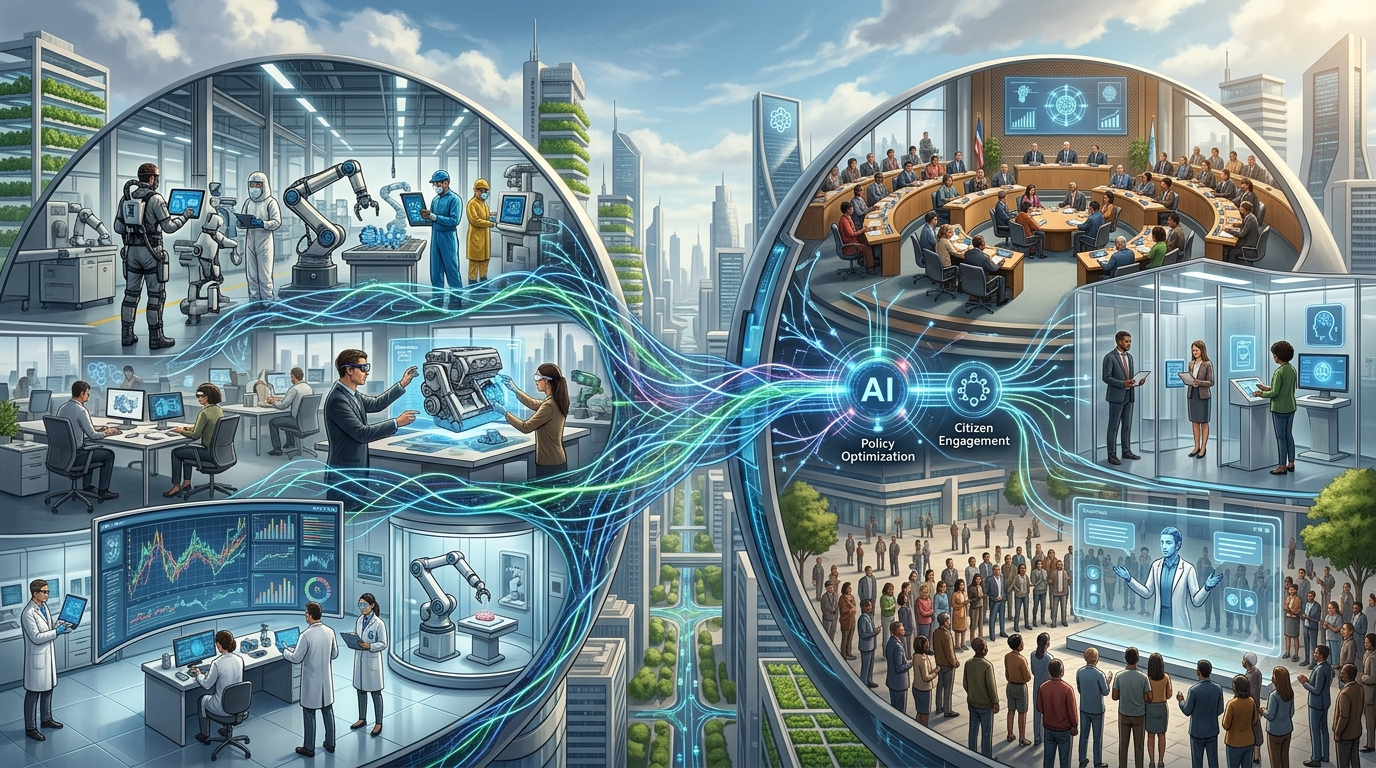
Artificial intelligence discussions often focus on model performance, computing infrastructure, and commercial adoption. Yet as AI systems become increasingly embedded in daily life, questions about their broader societal impact are moving to the forefront. Issues involving employment, democratic institutions, public trust, and human decision-making are becoming as important as technical innovation itself. These concerns formed the foundation of MIT’s recent AI and Society Forum, which brought together researchers from multiple disciplines to examine how artificial intelligence may reshape society in the coming years. The event reflected a growing recognition that technological progress cannot be separated from its social consequences.

The forum was organized by MIT’s School of Humanities, Arts, and Social Sciences alongside the Social and Ethical Responsibilities of Computing initiative. Researchers from economics, computer science, political science, engineering, and public policy participated in discussions covering the future of work, election systems, democratic processes, and AI governance. Rather than focusing exclusively on technological capabilities, the event examined how artificial intelligence interacts with existing institutions and social structures. The discussions highlighted a central theme emerging across academia and industry: the future of AI will depend as much on human choices as on technical breakthroughs.
The Debate Over Jobs Is Becoming More Nuanced
Concerns about AI replacing workers have become common across industries. However, economist David Autor argued that the impact of automation depends less on whether jobs disappear and more on how technology changes the value of human expertise. According to Autor, the critical question is whether AI removes routine support tasks or begins replacing highly specialized expert functions. The distinction matters because different forms of automation create different labor market outcomes. Understanding those differences may determine whether AI expands economic opportunity or concentrates value within a smaller group of workers.
Autor suggested that AI could create entirely new categories of specialized work, much as previous technological revolutions generated occupations that did not previously exist. Historical examples show that labor markets often adapt through the creation of new forms of employment rather than through permanent contraction. However, successful adaptation typically requires supportive policies. Worker retraining, wage protection programs, and broader participation in capital ownership may become increasingly important as AI adoption accelerates. The discussion highlighted that technological progress alone does not determine economic outcomes. Public policy and institutional choices play an equally important role.
Human Judgment Remains Central
While AI systems continue demonstrating impressive capabilities, researchers repeatedly emphasized the importance of human oversight. Daniela Rus, director of MIT’s Computer Science and Artificial Intelligence Laboratory, described a future in which AI functions as an assistant rather than a replacement for human decision-makers. She argued that AI systems can enhance productivity by helping people perform tasks more efficiently while leaving critical judgments in human hands. This vision positions AI as a collaborative technology rather than a fully autonomous actor. Such an approach aligns with many enterprise AI deployments currently emerging across industries.
The concept of human-AI collaboration has become increasingly important as organizations integrate AI into operational workflows. Systems may generate recommendations, automate repetitive tasks, or analyze large datasets, but final accountability often remains with people. Maintaining that balance requires careful system design and governance. Researchers at the forum stressed that productivity gains should not come at the expense of transparency or responsibility. Human judgment continues to serve as a safeguard against errors, bias, and unintended consequences.

Work Will Change Even If Jobs Survive
Several participants argued that the nature of work itself may undergo significant transformation regardless of whether large-scale job losses occur. David Mindell, professor of Aeronautics and Astronautics and the History of Engineering, noted that economic systems have continuously evolved throughout history. New technologies often alter workflows, skill requirements, and professional responsibilities without eliminating entire industries. The challenge lies in supporting workers as those transitions occur. Future success may depend on society’s ability to create opportunities that allow individuals to adapt alongside technological change.
Sendhil Mullainathan, who holds appointments in economics and computer science, emphasized the uncertainty surrounding AI’s long-term effects on organizations. While productivity improvements appear likely, the broader economic impact remains difficult to predict. Companies may restructure operations, redefine roles, and adopt entirely new business models as AI capabilities expand. Such changes could create significant variability across industries and labor markets. The period ahead may therefore be characterized by experimentation rather than clear outcomes.
AI Is Also Challenging Democratic Institutions
The forum’s second major theme focused on democracy and governance. As AI systems become more sophisticated, researchers are increasingly concerned about how automated technologies influence public discourse, elections, and political participation. Chara Podimata presented research examining how large language models provide election-related information to users. Her work highlights the growing role AI systems play in shaping how citizens access and interpret political information. The findings suggest that algorithmic behavior may have meaningful implications for democratic processes.
A longitudinal study examining major AI models during the 2024 U.S. presidential election cycle found substantial variations in responses depending on user characteristics and political preferences. These differences raise important questions about personalization, neutrality, and transparency. As conversational AI systems become more widely used, understanding how information is delivered may become increasingly important for policymakers and researchers. Election-related applications represent one area where algorithmic accountability carries particularly high stakes. Public trust depends on confidence that information systems operate fairly and consistently.
Efficiency And Democracy Are Not Always Aligned
One of the forum’s most important observations involved the tension between technological efficiency and democratic processes. Bailey Flanigan, a political scientist at MIT, cautioned against assuming that faster decision-making automatically improves governance. Democratic systems often rely on deliberation, debate, and procedural safeguards that can appear inefficient from a purely technological perspective. However, those processes help build legitimacy, accountability, and public trust. Replacing them with automated alternatives may create unintended consequences. Democratic institutions serve purposes that extend beyond producing outcomes quickly. Elections, public consultations, and legislative debates provide opportunities for citizens to participate in collective decision-making. AI systems may streamline certain administrative processes, but researchers warned against overlooking the social value of these democratic rituals. Preserving participation and transparency remains essential even as governments explore new technologies. The challenge is determining where automation can support democratic processes without undermining them.
Election Integrity Faces New Risks
Election administration emerged as one of the areas generating the greatest concern among researchers. Charles Stewart III, founder of MIT’s Election Data and Science Lab, highlighted the potential for AI-generated misinformation and procedural confusion to disrupt electoral systems. Elections depend heavily on public confidence in results and processes. Technologies that introduce uncertainty or amplify false narratives could weaken that confidence. The risks become particularly significant during periods of political polarization.
Researchers noted that election misinformation existed long before artificial intelligence. However, AI systems can increase both the scale and speed of information manipulation. Deepfakes, synthetic content, and automated communication tools may complicate efforts to verify information during critical periods. If election outcomes become widely disputed because of AI-driven misinformation campaigns, democratic institutions could face substantial challenges. Preventing such outcomes will likely require collaboration among policymakers, technology companies, researchers, and election officials.
Designing AI Around Democratic Values
Despite these concerns, participants also identified opportunities for AI to strengthen democratic engagement. Lily Tsai, director of MIT GOV/LAB, emphasized the importance of embedding democratic principles into AI design. Concepts such as political equality, autonomy, inclusion, mutual respect, and individual agency should influence how systems are developed and deployed. Technology does not operate independently of values. Design decisions often determine whether AI supports or undermines democratic objectives.
Tsai highlighted research involving a “Socratic dialogue chatbot” that encourages users to explain the reasoning behind their beliefs and policy positions. Early findings suggest that structured conversations with AI systems may help individuals reflect more deeply on complex issues. Such applications demonstrate that AI can potentially contribute to healthier civic engagement when developed responsibly. Rather than viewing AI solely as a source of risk, researchers are exploring ways to align technological capabilities with democratic goals.
The Future Of AI Depends On More Than Algorithms
The discussions at MIT’s AI and Society Forum underscored a reality that is becoming increasingly difficult to ignore. Artificial intelligence is not simply a technological development. It is a societal force capable of influencing labor markets, institutions, governance systems, and public trust. The choices made today regarding design, regulation, deployment, and education will shape how those impacts unfold. Technical innovation alone cannot answer questions about fairness, accountability, or democratic legitimacy. As AI adoption accelerates across economies and governments, interdisciplinary collaboration will become increasingly important. Economists, political scientists, engineers, policymakers, and industry leaders all have a role in shaping outcomes. The forum highlighted both optimism and caution, reflecting the complexity of the challenges ahead. Artificial intelligence may transform how societies work and govern themselves, but its long-term impact will ultimately depend on human decisions rather than machine capabilities alone.












