
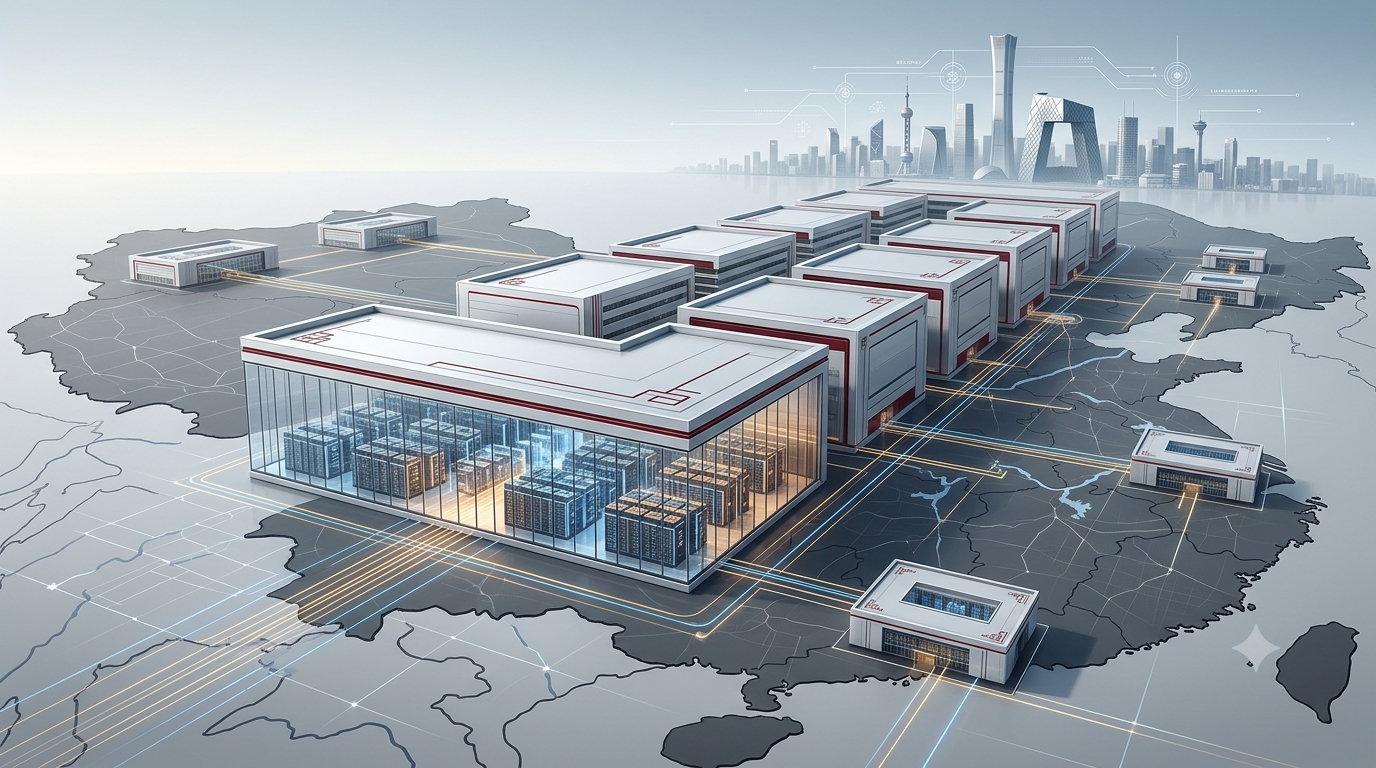
China is preparing one of the world’s largest artificial intelligence infrastructure initiatives, reinforcing its ambition to become a global AI powerhouse while reducing dependence on foreign technology. According to multiple reports, Beijing is considering a nationwide investment plan worth approximately 2 trillion yuan ($295 billion) over the next five years to expand AI computing infrastructure and build a unified national computing network.If implemented, the initiative would dramatically increase China’s AI computing capacity while strengthening domestic companies across semiconductors, networking, cloud infrastructure, data centers, and telecommunications. More importantly, the strategy reflects Beijing’s broader goal of creating a self-sufficient AI ecosystem that relies primarily on Chinese technology suppliers instead of international vendors. The proposal arrives as AI infrastructure has become one of the world’s fastest-growing investment categories.

AI Infrastructure Becomes a National Priority
Rather than building isolated data centers, China reportedly plans to create an integrated nationwide computing network. The proposed project would connect AI infrastructure across multiple provinces, allowing computing resources to be shared more efficiently while improving workload distribution and reducing regional capacity shortages. The reported initiative would be led by China’s National Development and Reform Commission (NDRC), with major state-owned telecommunications companies expected to play central roles. China Mobile and China Telecom would reportedly oversee much of the infrastructure deployment while managing network connectivity between AI facilities.
Such an approach aligns with China’s long-term strategy of treating computing power as critical national infrastructure. Instead of relying on fragmented private deployments, the country aims to establish a coordinated AI backbone capable of supporting research institutions, enterprises, manufacturers, healthcare organizations, and government agencies. As AI adoption accelerates, centralized infrastructure could also improve resource utilization while reducing operational inefficiencies across China’s rapidly expanding digital economy.
Domestic Suppliers Stand to Benefit
One of the proposal’s most significant aspects is its emphasis on domestic technology. Reports suggest that at least 80 percent of the hardware and software deployed across the new infrastructure would come from Chinese suppliers. That requirement could reshape procurement across multiple technology segments. Chinese semiconductor companies, networking vendors, server manufacturers, storage providers, cloud platforms, and AI software developers could all benefit from increased government-backed demand. The strategy also supports China’s long-standing objective of reducing dependence on imported technologies following years of export restrictions affecting advanced semiconductor equipment and AI processors. If implemented, companies such as Huawei could strengthen their position within China’s AI infrastructure ecosystem by supplying processors, networking technologies, cloud platforms, and integrated AI solutions. Meanwhile, domestic software providers may receive greater opportunities to develop enterprise AI platforms optimized for Chinese infrastructure.

Foreign Chipmakers Face New Challenges
The reported procurement strategy could create additional obstacles for international chip companies seeking access to China’s rapidly expanding AI market. Although firms including NVIDIA and AMD remain global leaders in AI acceleration, the proposed infrastructure reportedly prioritizes locally developed alternatives wherever possible. Export controls introduced by the United States have already limited China’s access to certain advanced AI chips. Consequently, Chinese technology firms have accelerated investments in domestic semiconductor design, AI accelerators, networking equipment, and software ecosystems. The proposed infrastructure expansion appears consistent with that broader strategy. Rather than depending on overseas suppliers, Beijing increasingly seeks to develop complete domestic supply chains capable of supporting future AI growth regardless of geopolitical uncertainties. Such an approach could gradually strengthen China’s domestic semiconductor ecosystem while encouraging additional research and manufacturing investments.
AI Models Continue Closing the Performance Gap
China’s infrastructure ambitions also coincide with rapid improvements in its AI model ecosystem. During the past year, several Chinese AI developers have introduced increasingly competitive foundation models capable of supporting coding, reasoning, enterprise automation, and agentic AI applications. Open-source development has further accelerated adoption by reducing deployment costs for enterprises and researchers. Improved infrastructure could provide domestic developers with greater computing resources for model training, inference, and large-scale deployment. Unlike previous generations of AI development, future competitiveness may depend as much on compute availability as algorithmic innovation. Expanded national AI infrastructure therefore becomes a strategic advantage extending well beyond hardware alone. It also strengthens China’s ability to commercialize AI across manufacturing, finance, healthcare, logistics, education, and public services.
Data Center Operators Could Become Major Beneficiaries
China’s proposed AI infrastructure expansion extends well beyond semiconductor companies. Data center operators could also emerge as long-term beneficiaries as demand for AI-ready facilities continues to accelerate. Unlike conventional enterprise data centers, AI infrastructure requires significantly higher rack densities, advanced cooling systems, high-speed networking, and resilient power delivery. These requirements create larger investment opportunities for operators capable of building next-generation facilities. Industry analysts have already identified companies such as GDS Holdings and VNET Group as potential beneficiaries because both firms continue expanding AI-ready capacity across China.
GDS has reported strong booking momentum as cloud providers and AI companies seek additional compute capacity. Similarly, VNET has continued adding new customer commitments as enterprise AI adoption accelerates. If Beijing formally launches its nationwide AI infrastructure strategy, demand for hyperscale facilities could increase even further, creating additional opportunities for operators specializing in high-density computing environments. The broader ecosystem would also benefit. Server manufacturers, liquid cooling suppliers, optical networking companies, and power infrastructure providers could all experience higher demand as construction accelerates.
Telecommunications Firms Will Form the Digital Backbone
The proposed initiative places China’s state-owned telecommunications companies at the center of the infrastructure rollout. China Mobile and China Telecom are expected to play leading roles in deploying and operating nationwide AI infrastructure. Their responsibilities would likely extend beyond connectivity to include data center operations, cloud services, and nationwide workload distribution. This model differs from many Western AI infrastructure deployments, where hyperscalers largely build independent computing ecosystems. China instead appears focused on creating a coordinated national platform capable of distributing computing resources across multiple provinces while improving utilization and reducing regional capacity constraints. Such integration could improve efficiency while enabling enterprises and research institutions to access AI computing regardless of physical location. It also strengthens China’s broader objective of treating computing power as strategic national infrastructure, similar to transportation, telecommunications, and electricity networks.
AI Remains Central to China’s Economic Strategy
The proposal also reinforces how deeply artificial intelligence has become embedded within China’s long-term economic planning. Recent policy documents place AI at the center of industrial modernization, digital transformation, advanced manufacturing, healthcare innovation, robotics, and scientific research. Rather than viewing AI solely as a technology sector, Beijing increasingly treats it as foundational infrastructure capable of improving productivity across the wider economy. This approach supports continued investment in computing capacity, semiconductor manufacturing, networking technologies, cloud platforms, and enterprise AI applications. It also creates stronger incentives for private technology companies to align product development with national AI priorities. As AI adoption expands across industries, infrastructure investment becomes increasingly important for sustaining future economic growth.
Competition With the United States Enters a New Phase
China’s proposed investment reflects the changing dynamics of global AI competition. While U.S. technology companies continue leading frontier model development, China has rapidly narrowed the gap through open-source innovation, domestic semiconductor development, and expanding compute capacity. Rather than attempting to replicate Silicon Valley’s approach, Beijing is pursuing a state-supported infrastructure strategy designed to strengthen every layer of the AI ecosystem simultaneously. That includes chips, networking, cloud infrastructure, software platforms, telecommunications, and data centers. Such an integrated approach could improve supply chain resilience while reducing dependence on foreign technologies that remain subject to export restrictions. However, significant challenges remain. Chinese developers continue facing limitations in accessing the most advanced semiconductor manufacturing technologies, while domestic chipmakers still trail global leaders in several high-performance computing categories. Despite those obstacles, infrastructure investment could narrow competitive gaps over time by providing developers with substantially larger domestic computing resources.
Market Outlook
If Beijing formally approves the proposed 2 trillion yuan investment plan, the effects would likely extend across China’s entire digital infrastructure ecosystem. Domestic AI companies would gain greater access to computing capacity. Data center operators could accelerate expansion. Telecommunications providers would strengthen their role as national infrastructure partners. Semiconductor companies could receive significant procurement opportunities, while energy and utility providers would support one of the world’s largest computing buildouts. The initiative would also reinforce an important industry trend. Artificial intelligence is no longer driven solely by model innovation. Increasingly, competitive advantage depends on the ability to build, power, and operate massive computing infrastructure. If the proposal moves from planning to implementation, it could become one of the defining AI infrastructure investments of the decade, reshaping domestic technology markets while further accelerating global competition for computing leadership.











