 Skip to content
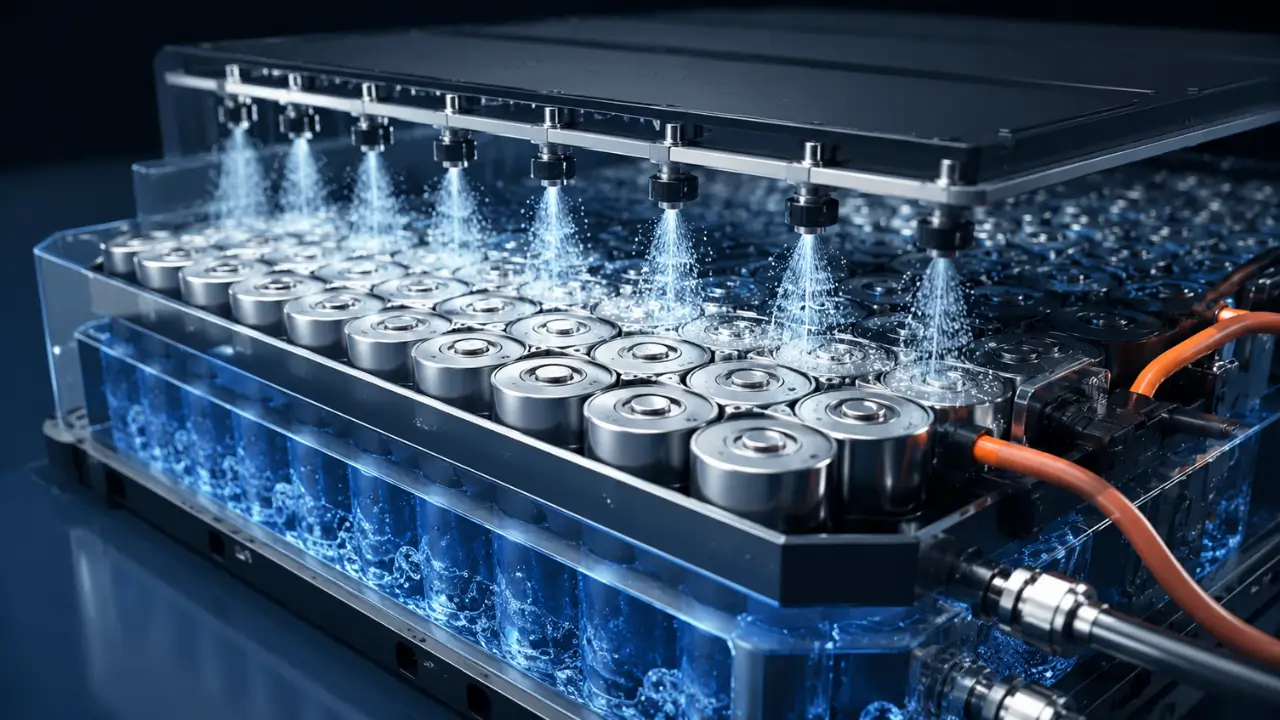
South Korea’s Korea Institute of Machinery and Materials (KIMM) has introduced what it describes as the world’s first spray-based immersion cooling technology for lithium-ion battery packs, signaling a potential shift in how high-performance batteries are cooled across transportation, energy storage, and digital infrastructure markets. The research addresses one of the industry’s most persistent engineering challenges: delivering high-rate charging and discharging while controlling heat generation without significantly increasing system weight or complexity. As battery-powered systems continue scaling across electric vehicles, marine vessels, grid storage, and AI infrastructure, thermal management has become a strategic design consideration rather than simply an operational requirement. Instead of relying on complete immersion, KIMM’s architecture combines two thermal management techniques within a single enclosure. Dielectric liquid is sprayed directly onto the upper surface of battery cells while the lower section remains partially submerged in the same electrically non-conductive coolant. This hybrid configuration allows direct liquid cooling where heat generation is greatest while leveraging forced convection through the immersed section to stabilize temperatures across the pack.

Lower Coolant Requirements Could Improve Commercial Battery Economics
The approach represents a departure from conventional immersion cooling systems that require battery modules to remain fully submerged throughout operation. Although those systems deliver effective heat removal, they also demand large volumes of dielectric fluid, increasing weight, packaging complexity, and overall system cost. According to KIMM, testing on a lithium-ion battery pack operating under a 4C charge-discharge cycle—a condition representative of aggressive fast-charging environments—kept cell temperatures below 35°C, a threshold widely regarded as important for limiting thermal degradation and reducing the likelihood of thermal runaway. Perhaps the most commercially significant outcome lies in coolant efficiency. The institute reports that the new architecture reduces dielectric-liquid requirements by approximately 85%, consuming only 10% to 20% of the coolant required by conventional immersion cooling systems while maintaining comparable—or potentially improved—thermal performance.
Electric Vehicles and Data Centers Could Benefit from the Technology
That reduction could materially influence battery system economics across weight-sensitive industries. Electric vehicles, commercial marine vessels, ferries, offshore platforms, and heavy-duty transport operators continue pursuing faster charging cycles without compromising battery lifespan or safety. Lower coolant volumes not only reduce system mass but also simplify enclosure design and improve packaging flexibility for manufacturers. Beyond transportation, the technology may have implications for stationary battery energy storage and digital infrastructure. As hyperscale data centers deploy increasingly large battery installations to support uninterrupted operations, battery safety has become a growing concern alongside energy density. Because the dielectric liquid used in the system is non-flammable, the cooling medium may also help suppress fire propagation during a thermal event, adding another layer of protection beyond conventional cooling architectures.
Artificial Intelligence Will Guide Future Cooling Fluid Development
Unlike traditional air-cooled or liquid-cooled battery packs that depend on cold plates or heat exchangers to remove heat indirectly, KIMM’s solution brings the coolant into direct contact with battery cells. Consequently, thermal resistance decreases while heat transfer efficiency improves during high-power operation. The institute also views the technology as a platform for future optimization rather than a finished solution. Researchers plan to incorporate artificial intelligence into materials discovery, using AI models to identify dielectric fluids with enhanced thermophysical characteristics capable of delivering even greater cooling efficiency.

Battery Cooling Innovation Aligns With Growing Infrastructure Demands
The timing reflects broader industry trends. Battery systems continue increasing in both capacity and power density as AI computing, electrified transportation, renewable integration, and maritime decarbonization accelerate simultaneously. Each trend places greater emphasis on thermal management technologies capable of supporting higher energy throughput while maintaining safety and operational reliability. Rather than competing solely on cooling performance, next-generation battery architectures will increasingly compete on efficiency, weight, safety, and lifecycle economics. KIMM’s hybrid spray-based immersion approach suggests that reducing coolant volume may become just as important as improving heat removal itself.
Hybrid Battery Cooling Could Shape Future Energy Infrastructure
If the technology scales successfully into commercial deployments, it could influence the design of future battery systems well beyond electric vehicles, extending into data centers, utility-scale storage, and high-power marine applications where thermal stability increasingly defines operational resilience.












