
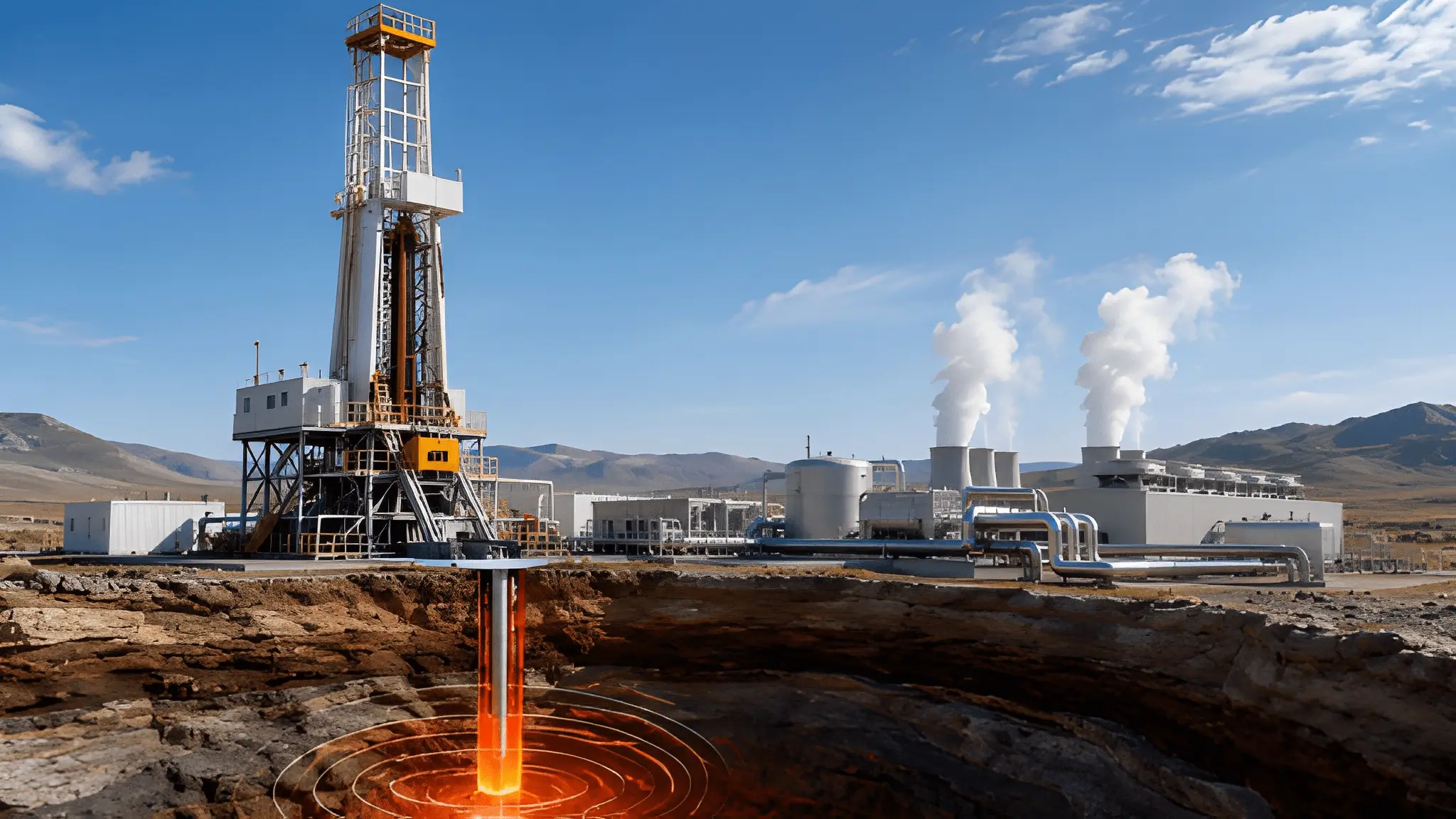
The race to develop firm, carbon-free electricity is entering a new phase as Quaise Energy secures fresh capital to move beyond technology validation and into commercial deployment. Quaise Energy announced the initial close of a $134 million Series B financing round to build what it describes as the world’s first commercial superhot geothermal power plant while accelerating its proprietary deep-drilling platform. Prelude Ventures led the Series B, while Japanese energy companies JERA and Idemitsu joined as strategic investors. Nearly all existing investors, including Safar Partners, also participated in the financing round, reinforcing continued backing for the company’s commercialization roadmap. According to Quaise, the latest funding brings its total capital raised to $230 million, while the company expects to close additional equity and debt financing tied to project development later this year.

Series B Funding Advances Project Obsidian
The newly raised capital will primarily finance Project Obsidian, which Quaise is developing as the world’s first commercial superhot geothermal power plant. The funding will also support continued engineering, commercialization, and scaling of the company’s proprietary millimeter wave drilling system designed to reach depths exceeding five kilometers. Alongside corporate financing, the company is pursuing project-level equity and debt funding as it prepares for commercial operations. Quaise said first revenues are expected to come from commercial power off-take agreements, although the company has not yet disclosed the identities of those customers. “Our ambition is to power civilization with Earth’s most compelling energy source. This round takes us from field-proven technology to first commercial revenues,” said Carlos Araque, CEO and President of Quaise Energy.
Unlike conventional drilling systems that rely on mechanical drill bits, Quaise’s approach uses millimeter wave energy originally developed at the Massachusetts Institute of Technology to vaporize rock deep underground. The technology is designed to reach geological zones where temperatures range between 300°C and 500°C, conditions that traditional drilling methods struggle to access economically. If commercialized at scale, those temperatures could allow geothermal facilities to generate electricity with power densities comparable to fossil fuel and nuclear plants while maintaining renewable operating characteristics. The company believes this approach significantly expands the number of viable geothermal locations worldwide, reducing dependence on naturally occurring hydrothermal reservoirs and opening access to deep underground heat resources.
Texas Field Results Support Commercial Scale-Up
Quaise says its technology has already reached several important engineering milestones during field testing in Central Texas. During 2025, the company drilled more than 100 meters through granite, marking what it described as the first successful full-scale penetration of basement rock using millimeter wave drilling under field conditions. The company is now approaching one kilometer of drilling depth at the same location. Achieving that milestone would establish the deepest penetration ever recorded using millimeter wave drilling and the deepest achieved by any non-contact drilling technology.
Those demonstrations form the technical foundation for Project Obsidian and future commercial geothermal developments. Meanwhile, the company continues expanding engineering capabilities needed for utility-scale deployment. “We have backed Quaise since the beginning because we believed accessing superhot rock would unlock geothermal energy at a scale the world has never seen,” said Mark Cupta, Managing Director at Prelude Ventures. “What the team has achieved in the field and what they are now building at Project Obsidian validates that conviction, and we are proud to continue supporting Quaise as they move from proving the technology to powering the grid with clean, reliable energy nearly anywhere on Earth.”
Japanese Energy Investors Expand Strategic Backing
The latest financing also strengthens Quaise’s relationships with major Japanese energy companies seeking long-term low-carbon generation technologies. JERA and Idemitsu joined the round as strategic investors, highlighting growing international interest in advanced geothermal systems capable of delivering dependable electricity. Both companies view deep geothermal as a potential addition to future energy portfolios, particularly as countries pursue energy security alongside decarbonization objectives.

“Quaise’s millimeter wave technology has the potential to redefine what geothermal can deliver — accessing heat at depths and temperatures that were previously out of reach. This investment reflects Idemitsu’s commitment to next-generation energy solutions that can contribute to stable, sustainable power supply at scale,” said Kei Honda, Executive Leader, San Jose Office and Senior Vice President, Head of Corporate Venturing, Idemitsu Americas Holdings Corporation. “As a global energy company, JERA understands both the scale of the challenge ahead and the scale of the opportunity that next-generation geothermal represents. Millimeter wave drilling technology has the potential to make geothermal a truly global baseload resource,” said Takeshi Kodama, Head of JERA Ventures and Managing Partner, JERA Co., Inc. “We look forward to working together with Quaise to advance the development of this promising technology and business.”
Oregon Project Targets Grid Delivery by 2030
Construction is already underway at Project Obsidian, which is located on federal geothermal leases within Oregon’s Deschutes National Forest. The site ranks among the most extensively studied geothermal regions in the United States and offers significant long-term generation potential. Quaise says the project is designed for gigawatt-scale expansion and is expected to begin delivering electricity to the grid by 2030. The company expects the facility to strengthen grid reliability across the Pacific Northwest, where electricity demand continues rising alongside transmission constraints.
Existing investors also increased their commitments as the company moves closer to commercialization. Safar Partners, one of Quaise’s earliest backers, participated in the latest financing round, reflecting continued confidence in the company’s long-term technology strategy. The company views this financing as the first stage of a broader capital program that will combine corporate investment with project-level funding to support commercial expansion. Consequently, Quaise expects to announce additional financing components later this year as development progresses toward revenue-generating operations.
Investors See Transition From Research to Commercial Deployment
“We are proud to be a partner and supporter of Quaise Energy. As the need for power grows exponentially around the world, Safar believes geothermal energy has a critical role to play, and Quaise is uniquely positioned to revolutionize the industry,” said Parinaz Motamedy, Partner at Safar Partners. “By reimagining the drilling process entirely and leveraging millimeter wave technology to reach previously inaccessible depths and temperatures, Quaise is unlocking superhot geothermal energy at a global scale. We’ve been working alongside the team since the beginning, and this round represents an important inflection point as the company transitions from scientific breakthroughs to commercial deployments.” Quaise said the $134 million announced this week represents the initial equity component of a broader financing strategy. The company has now secured $230 million in total funding, while additional project-level equity and debt financing is expected to be announced later this year.











