 Skip to content
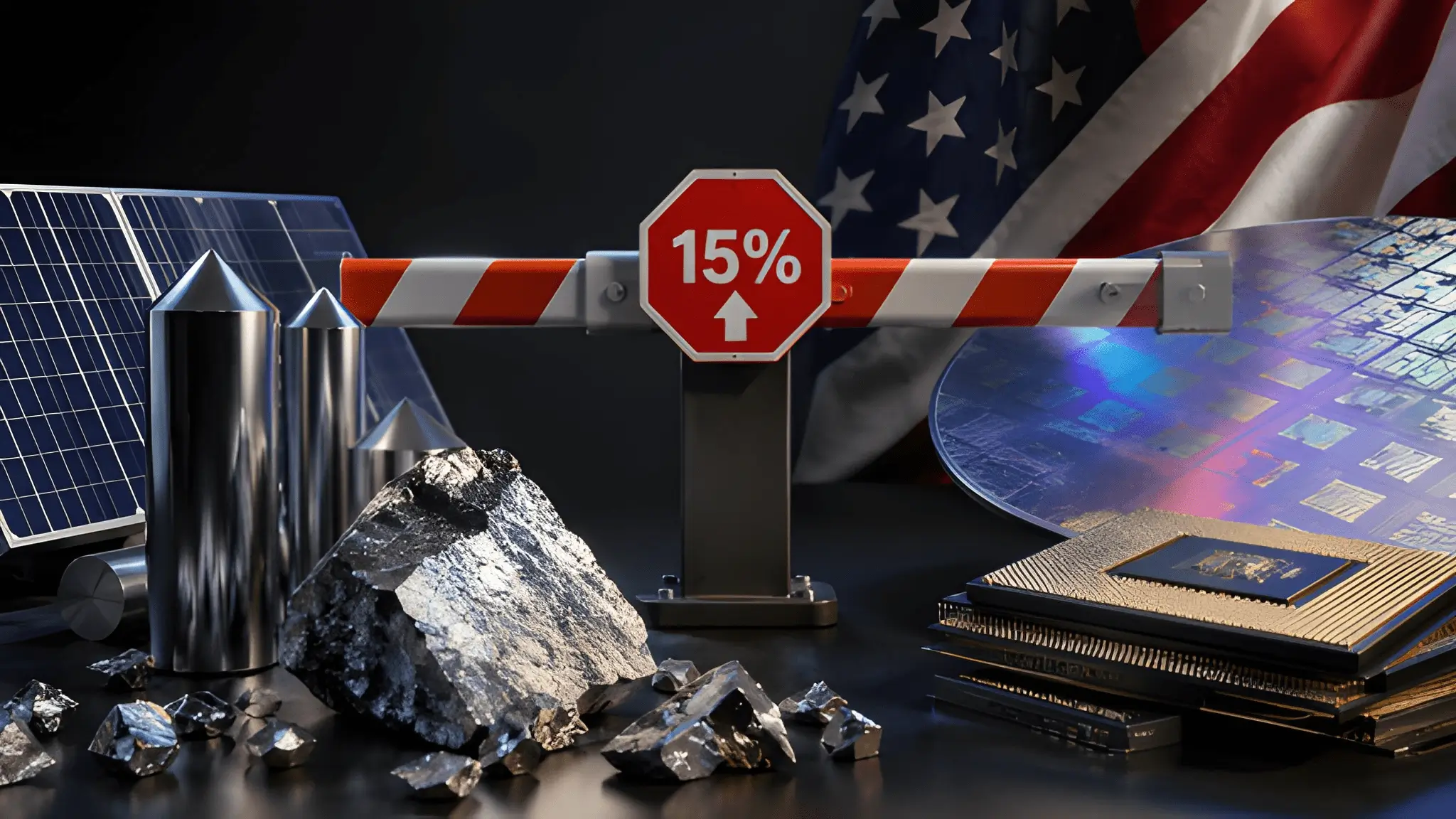
The Trump administration is putting a new price barrier around one of the least visible materials in the technology supply chain: polysilicon. President Donald Trump signed a proclamation on Aug. 6 imposing a 15% additional tariff on specified polysilicon derivatives while establishing minimum import prices across polysilicon, wafers, solar cells and modules. The measures take effect Dec. 4, 2026, giving manufacturers and importers several months to reposition contracts, inventory and sourcing strategies. The policy frames polysilicon not simply as a solar commodity, but as strategic infrastructure for U.S. semiconductor, artificial intelligence and energy ambitions.
Trump Puts A Price Floor Under Polysilicon
Polysilicon sits upstream of two industries Washington increasingly treats as strategic: semiconductors and solar power. The White House describes it as the base material supporting America’s semiconductor and solar-power supply chains, while the proclamation links secure domestic supply to defense systems, digital products and AI innovation. The policy sets a $21-per-kilogram minimum import price for polysilicon, $100 per kilogram for polysilicon ingots and wafers, $0.22 per watt for solar cells, and $0.38 per watt for solar modules. Those thresholds create a new economic floor beneath imported material and give U.S. producers more room to compete against lower-cost global supply.
The administration is pairing that price floor with an additional 15% ad valorem duty on covered polysilicon ingots and derivatives. The new duties will sit alongside other applicable duties unless the proclamation provides otherwise, creating a layered trade regime for affected products. Products from Japan, South Korea, Taiwan, Switzerland, Liechtenstein and the European Union receive a combined treatment that limits the additional Section 232 tariff plus the applicable Column 1 duty rate to 15%. U.K. products receive a 10% Section 232 rate under the proclamation, while other trade arrangements can affect treatment under specified conditions.
Washington Is Rebuilding A Lost Upstream Industry
The administration’s argument rests on a dramatic shift in U.S. polysilicon manufacturing. According to the proclamation, the U.S. share of global polysilicon production capacity fell from 50% in 2005 to less than 2% in 2024. At the same time, global polysilicon production has expanded more than 270% since 2020, while inventories reached 400,000 tons by the end of 2024. The White House says that combination has weakened the commercial foundation required to sustain domestic polysilicon production at scale.
The executive order said that, for decades, “America has allowed foreign countries to weaken United States producers in the polysilicon sector – eroding our economic and national security.” That language captures the administration’s broader argument that low-cost global supply has created a strategic dependency rather than simply delivering cheaper inputs. The proclamation identifies foreign industrial policies and global oversupply as factors that have undermined U.S. production economics. It consequently treats the rebuilding of domestic capacity as a national-security project as much as an industrial-policy initiative.
“For decades, foreign governments – recognizing the strategic importance of polysilicon and polysilicon derivatives – designed policies to increase the production of these products in their countries, which have come at the expense of the United States industry. These policies contributed to global oversupply in polysilicon and polysilicon derivative sectors,” the order read. The White House connects that oversupply to the collapse in U.S. manufacturing share and argues that domestic producers need a commercially viable market before they can rebuild meaningful capacity. The distinction matters because Washington is not simply attempting to make imports more expensive; it is attempting to change the investment economics of the entire upstream chain.
The Supply Chain Is Entering A New Phase
The Dec. 4 implementation date creates a defined transition period for manufacturers, developers, traders and technology companies exposed to polysilicon-derived products. Companies will need to reassess sourcing contracts, inventory strategies and landed costs before the new regime begins. The administration has given Customs and Border Protection responsibility for enforcing importer documentation and monitoring compliance. Importers that materially misrepresent their certifications can face penalties and a permanent prohibition on importing polysilicon and polysilicon derivatives into the United States.
The proclamation further gives Commerce authority to adjust minimum import prices as market conditions change. It can monitor trading partners and modify tariff or minimum-price treatment when another country establishes substantially equivalent import restrictions. The government can scrutinize potential stockpiling ahead of the December deadline and take action when it believes companies are accumulating material to circumvent the new regime. That makes the policy dynamic rather than a static tariff schedule, with enforcement and pricing potentially evolving alongside market behavior.












