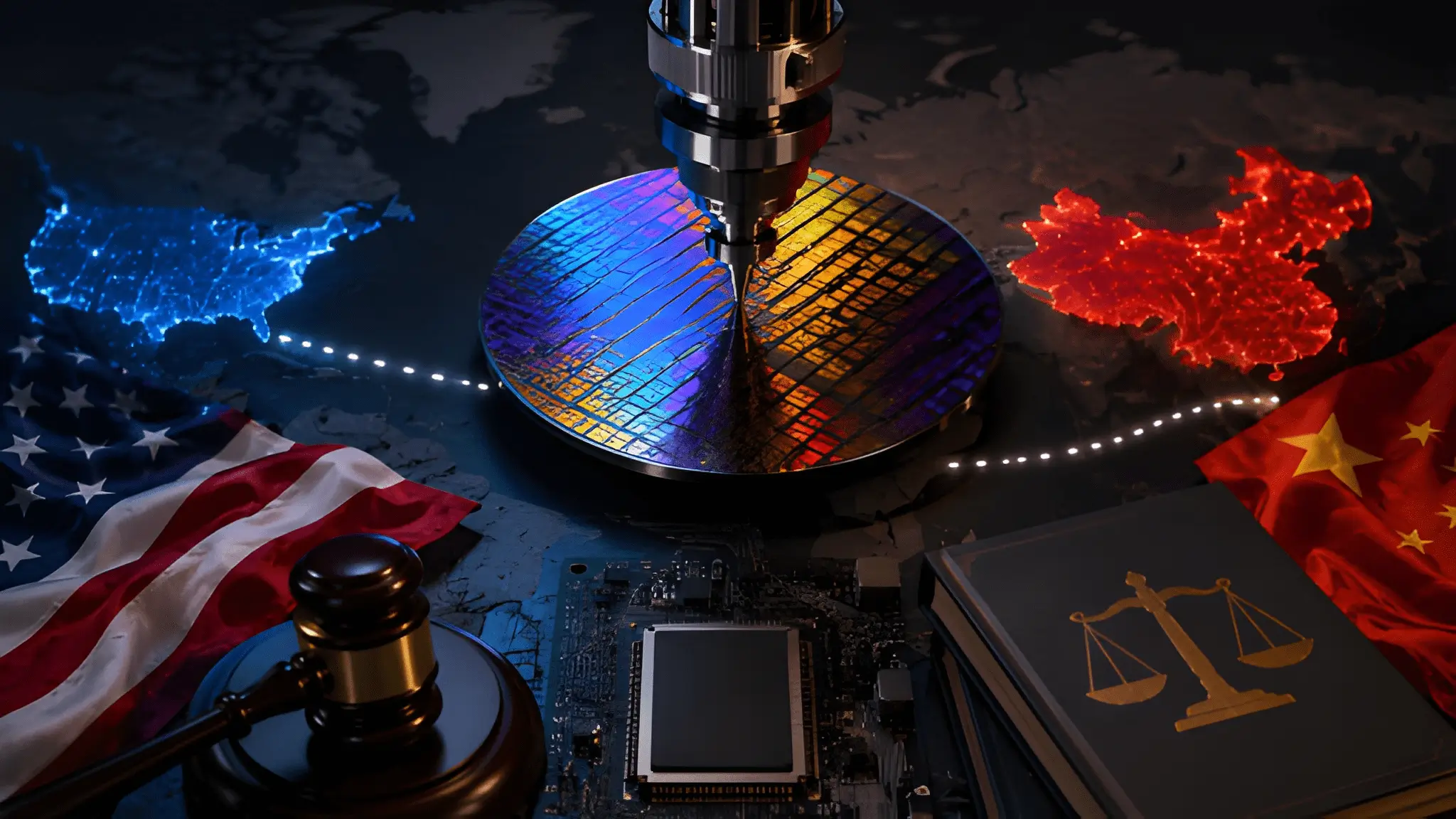
The Semiconductor Industry’s New Vulnerability Is Verification
Export controls are often presented as policy tools designed to provide clear restrictions on the movement of strategically important technologies. Governments announce restrictions, regulators publish compliance frameworks, and policymakers describe technology barriers as if they function like sealed borders. Export-control frameworks are designed to ensure that advanced chips, manufacturing systems, and critical semiconductor tools move in accordance with regulatory requirements.
Yet recent scrutiny surrounding the location and monitoring of advanced chipmaking equipment reveals a different challenge. Alongside discussions about semiconductor technology itself, policymakers and industry stakeholders are increasingly focused on the challenge of monitoring and enforcement. Instead, questions about the effectiveness of systems designed to track strategic technologies have become a more prominent part of the broader policy discussion. fidence in the systems designed to track that technology.
This distinction matters because modern semiconductor policy depends on a simple assumption. Governments must know where strategically important technologies are located, who controls them, and how they are being used. When uncertainty emerges around visibility and enforcement, policymakers may face greater challenges in assessing the effectiveness of export-control measures.
The issue extends far beyond any individual company or machine. It raises questions about whether governments require sufficient visibility into technology flows to effectively enforce restrictions. The conversation surrounding semiconductor sovereignty may therefore be shifting. The challenge is no longer merely restricting access. The challenge is proving that restrictions remain effective after technologies enter a global supply chain.
Complexity Is Outpacing Traditional Control Models
The semiconductor industry does not resemble the industrial ecosystems that shaped earlier generations of export regulation. Advanced manufacturing equipment relies on components sourced from multiple continents. Precision optics, specialized materials, software systems, maintenance services, and manufacturing expertise often originate from different jurisdictions. Even a single tool may involve suppliers operating across dozens of countries.
As semiconductor production expanded globally, efficiency became the industry’s primary organizing principle. Companies optimized around specialization, geographic distribution, and interconnected supply chains. The result delivered extraordinary technological progress. However, that same structure can create visibility challenges for policymakers and regulators seeking to monitor increasingly complex supply chains.
Policymakers increasingly approach semiconductor competition through a national-security framework. Yet the infrastructure they seek to regulate was designed for globalization rather than geopolitical containment. That mismatch creates friction. Regulations may be written within national borders, but semiconductor ecosystems operate across international networks. Monitoring those networks requires a level of transparency that becomes harder to maintain as supply chains grow more complex. In many cases, the challenge may stem as much from the scale and complexity of global supply chains as from questions of compliance.
Verification becomes more difficult when thousands of suppliers, contractors, service providers, and logistics partners participate in the movement and maintenance of advanced technologies. Every additional layer introduces another point where visibility can weaken. As a result, policymakers face an uncomfortable reality. For regulators, continuously tracking strategic technologies across global supply chains can present challenges beyond the implementation of restrictions themselves.
Suspicion Is Becoming A Strategic Instrument
A subtle shift is emerging within technology policy discussions. Historically, enforcement actions relied on evidence of violations. Increasingly, however, concerns can arise from uncertainty itself. Incomplete visibility into technology flows may contribute to strategic concerns among policymakers. That dynamic creates new pressures for semiconductor companies.
In certain situations, stakeholders may seek additional transparency measures beyond formal compliance requirements. Firms may also face expectations to demonstrate ongoing transparency, document equipment locations, verify customer relationships, and provide reassurance that technologies remain where they are expected to be. Companies may face growing expectations to demonstrate both compliance and ongoing transparency regarding regulated technologies.
Such expectations are understandable given the strategic importance of advanced semiconductors. Governments view AI accelerators, lithography systems, and advanced manufacturing capabilities as assets that influence economic competitiveness, military modernization, and national resilience. However, a policy environment characterized by heightened scrutiny may introduce operational and regulatory challenges for both governments and industry participants.
When policymakers act on uncertainty rather than confirmed evidence, such dynamics can create tensions between governments and the companies responsible for implementing policy requirements. Those pressures may complicate cooperation between regulators and industry participants. That shift matters because semiconductor firms now occupy a unique position. They are private enterprises operating at the center of geopolitical competition. Their technologies influence national strategies, yet their operations depend on global commercial networks. Balancing those realities becomes increasingly difficult when trust begins to deteriorate.
The Real Contest Is Institutional Confidence
The semiconductor cold war is often framed as a competition over manufacturing capacity, AI chips, and technological leadership. Those factors remain important. Yet another contest may be unfolding beneath the surface. A growing policy question is how governments can maintain confidence in their ability to oversee increasingly complex technological flows.
Technology restrictions depend on more than legal authority. They depend on institutional credibility. Policymakers must believe enforcement mechanisms work. Industry participants must believe compliance expectations are clear. Allies must believe restrictions can be coordinated across jurisdictions. When confidence in oversight mechanisms comes under pressure, uncertainty can receive greater attention from policymakers and stakeholders.
A missing data point becomes a strategic concern. An incomplete record becomes a policy debate. A visibility gap becomes evidence that larger vulnerabilities may exist elsewhere. The challenge is particularly acute because semiconductor policy increasingly serves broader geopolitical objectives. Export controls are no longer viewed solely as trade measures. They have become instruments of industrial strategy, national security, and technological competition. That elevated role increases the consequences of uncertainty.
If policymakers cannot reliably verify the movement of strategically significant technologies, critics may question whether restrictions achieve their intended outcomes. Some policymakers and stakeholders may advocate for stricter controls, additional reporting requirements, or broader oversight mechanisms in response. Both responses would reflect ongoing concerns about visibility and verification within global technology supply chains.
Chip Sovereignty Depends On More Than Restriction
Much of the public discussion surrounding semiconductor sovereignty focuses on manufacturing independence. Governments invest in domestic fabrication facilities. Policymakers support regional supply chains. Industry leaders discuss resilience, redundancy, and strategic autonomy. These initiatives address important vulnerabilities. However, sovereignty involves more than production capacity.
Effective oversight depends in part on visibility into how strategic technologies move through global supply chains. A government cannot effectively manage technology flows if it lacks confidence in its monitoring systems. Likewise, companies cannot operate efficiently if compliance expectations become increasingly shaped by uncertainty rather than measurable standards.
The next phase of semiconductor competition could place greater emphasis on verification, transparency, and supply-chain visibility alongside traditional restrictions. That means better transparency mechanisms, stronger international coordination, improved supply-chain visibility, and more sophisticated methods for tracking strategic technologies across global networks.
The objective should not be absolute control. Given the scale and interconnected nature of the semiconductor industry, achieving complete visibility and control would be challenging. For many policymakers, the objective is likely to be credible and effective oversight rather than absolute control. That distinction may influence how policymakers assess the long-term effectiveness of export-control frameworks.
The broader lesson emerging from current debates is straightforward. Semiconductor power does not stem solely from who manufactures the most advanced technologies. It also depends on who can reliably understand where those technologies exist, how they move, and whether governance systems remain credible. Questions of trust, verification, and institutional confidence are becoming increasingly important components of semiconductor sovereignty discussions. When verification becomes uncertain, that trust becomes the most strategically important asset in the semiconductor ecosystem.