 Skip to content
India’s Data Center Industry Is Expanding During a Different Technological Era
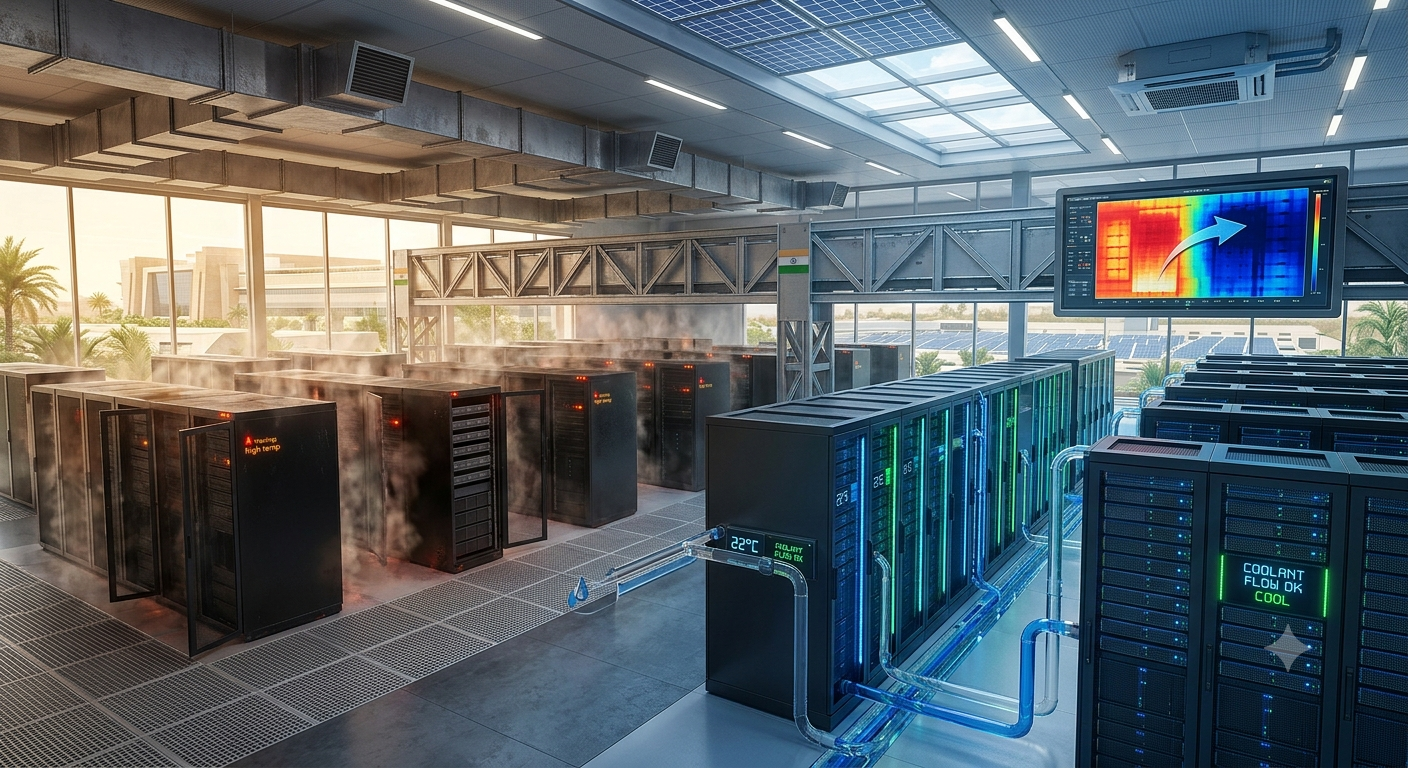
Most mature data center markets evolved gradually. Early facilities relied on relatively low-density computing environments where traditional air-cooling systems could manage thermal loads without major complications. Operators refined airflow management, introduced containment systems, improved cooling efficiency, and incrementally adapted their facilities as computing requirements increased. India is entering the next phase of digital infrastructure under very different circumstances. The country is expanding data center capacity at the same moment artificial intelligence is driving unprecedented increases in rack density and power consumption. Instead of following the traditional progression from low-density environments toward advanced cooling systems, developers increasingly find themselves planning facilities around liquid cooling from the outset. This shift reflects both the demands of AI infrastructure and the realities of operating large-scale facilities in one of the world’s hottest major digital infrastructure markets.

India’s operational data center capacity has expanded rapidly during the past five years, supported by cloud adoption, digital services growth, and government-led digitization initiatives. The next phase of growth is expected to be shaped increasingly by AI workloads that require far greater computing density than traditional enterprise applications. Operators are preparing for environments where rack power levels exceed the capabilities of many conventional cooling architectures. Unlike earlier generations of infrastructure, AI deployments are arriving before India has developed a large installed base of legacy facilities that require extensive retrofitting. This timing creates a unique opportunity for developers to adopt advanced cooling systems during the initial design phase rather than after facilities become operational. As a result, India’s infrastructure buildout increasingly resembles a leap directly into next-generation thermal management.
Air Cooling Faces Unique Challenges in India’s Climate
Cooling has always represented a significant component of data center energy consumption. The challenge becomes more complex in regions where high temperatures and humidity place additional pressure on thermal management systems. India’s climate creates conditions that differ substantially from many traditional hyperscale markets in Northern Europe and North America. Operators must manage sustained periods of elevated ambient temperatures while maintaining stable conditions inside increasingly dense computing environments. As AI accelerators generate more heat per rack, moving that heat efficiently becomes a critical engineering requirement. Traditional air-cooling systems can address some of these challenges, but their efficiency declines as rack densities continue to rise. These factors are pushing operators to consider alternative approaches earlier in the development cycle.
The limitations of air cooling become more pronounced as AI deployments expand. Industry studies indicate that cooling systems can account for a substantial share of total facility energy consumption, particularly when operators rely heavily on airflow-based thermal management. Air is inherently less effective at transferring heat than liquids, creating practical limitations for facilities supporting GPU-intensive workloads. As rack densities move beyond traditional enterprise levels, operators must deploy larger cooling systems and dedicate increasing amounts of infrastructure to heat management. In hot climates, these requirements can significantly affect both operational efficiency and long-term economics. Consequently, thermal design decisions are becoming central to infrastructure planning rather than secondary engineering considerations.
AI Is Changing the Economics of Thermal Infrastructure
Artificial intelligence is altering how operators evaluate cooling technologies. Earlier generations of data centers typically supported workloads with relatively predictable thermal profiles. AI environments behave differently because modern accelerators generate concentrated heat loads that exceed the limits of traditional airflow systems. As organisations deploy larger clusters of GPUs, thermal management becomes a limiting factor for performance and scalability. The challenge is not simply removing heat from a room but removing heat efficiently from specific components operating at extremely high power levels. This distinction is driving increased interest in direct liquid cooling technologies across global markets.
Research examining liquid-cooled and air-cooled AI systems has demonstrated measurable differences in thermal performance and efficiency. Liquid cooling removes heat directly from processors and accelerators rather than relying primarily on airflow throughout the facility. This approach enables more consistent operating temperatures and supports higher-density deployments. Studies have shown that liquid-cooled GPU systems can maintain significantly lower temperatures under load while improving performance and efficiency. As AI infrastructure scales, these advantages become increasingly important because they affect both operational costs and computing output. The economics of AI therefore increasingly favor thermal architectures capable of supporting sustained high-density operation.

India Is Building a Native Liquid-Cooling Ecosystem
Another notable development is the emergence of domestic technologies supporting advanced cooling infrastructure. Indian companies are beginning to develop thermal management systems specifically designed for high-density computing environments. Recent product launches include locally developed coolant distribution units intended for direct-to-chip liquid cooling deployments. These systems represent a shift away from dependence on imported cooling equipment while supporting the broader expansion of AI infrastructure. The emergence of local suppliers suggests that liquid cooling is becoming embedded within India’s digital infrastructure strategy rather than remaining a niche technology. This ecosystem development could help accelerate adoption across multiple segments of the market.
Global infrastructure providers are also responding to growing demand. Several companies have introduced liquid-cooling platforms tailored to AI-focused facilities in India, reflecting expectations that advanced thermal management will play a larger role in future deployments. New systems support both direct liquid cooling and hybrid architectures, enabling operators to accommodate higher rack densities without extensive redesigns. These developments indicate that vendors increasingly view India as a market where liquid cooling will move from pilot deployments to mainstream infrastructure. The transition is occurring at the same time that AI investments accelerate across the country’s digital economy. This combination of demand growth and technology availability is helping reshape facility design standards.
The Opportunity to Skip a Generation of Infrastructure
Many mature markets now face the challenge of retrofitting facilities originally designed around air cooling. Converting existing infrastructure can be expensive and operationally complex because cooling systems are deeply integrated into facility architecture. India’s position is different. A large portion of future capacity has not yet been built, allowing developers to incorporate liquid cooling into initial designs. This reduces the need for costly upgrades later while enabling facilities to support future AI workloads more effectively. Instead of adapting legacy infrastructure to new requirements, operators can align thermal design with anticipated computing demands from the beginning. That advantage may prove increasingly important as AI workloads continue to grow.
Evidence of this shift is already visible. New AI-ready facilities entering service across India increasingly incorporate liquid-cooling capabilities as part of their design strategy. Operators recognize that future competitiveness may depend on supporting high-density deployments without substantial retrofits. As AI adoption expands, facilities capable of delivering greater computing power within constrained footprints are likely to attract greater demand. Thermal management therefore becomes a strategic differentiator rather than a purely operational concern. India’s infrastructure buildout is occurring at a moment when advanced cooling technologies are becoming foundational components of modern data center architecture.
India’s AI Infrastructure Boom May Be Defined by Cooling
The next phase of India’s data center expansion will be shaped by more than land, power, and connectivity. Thermal infrastructure is emerging as one of the most important determinants of long-term scalability. AI workloads are pushing facilities toward densities that challenge conventional cooling approaches, particularly in warmer climates. Rather than following the historical path taken by older markets, India has an opportunity to build infrastructure optimized for the computing demands of the next decade. The country’s rapid growth, combined with the absence of extensive legacy constraints, creates conditions that favor direct adoption of advanced cooling architectures. In that sense, liquid cooling is becoming less a technology choice and more a structural characteristic of India’s AI infrastructure future.












