 Skip to content
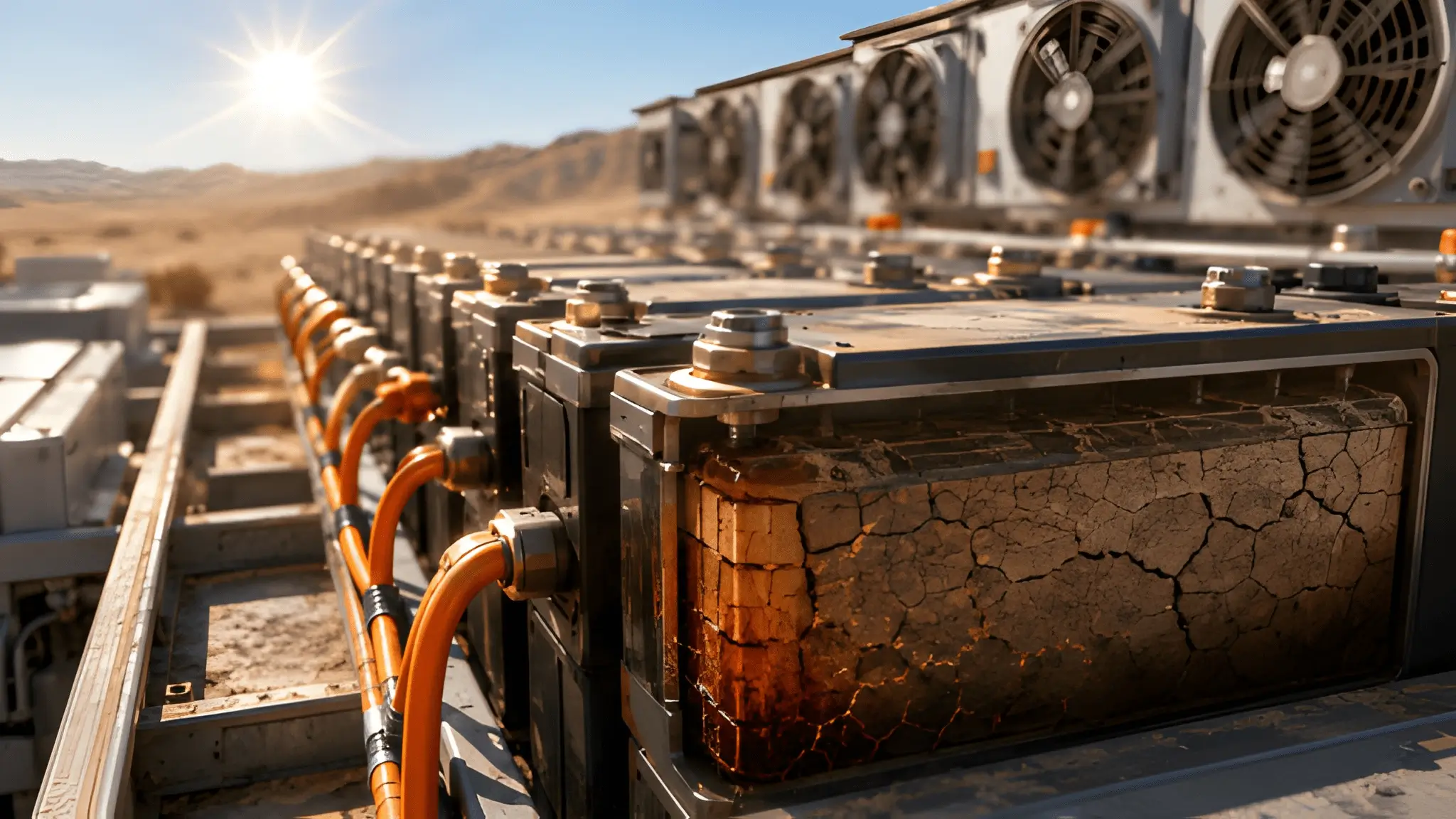
Storage projects across India increasingly confront a problem that rarely appears in vendor brochures. A battery that leaves the factory with a clean warranty curve at 25°C behaves very differently after months of exposure to 40–45°C afternoons, high nighttime temperatures, and repeated thermal cycling. Developers now see capacity fade, cooling limits, and availability guarantees converge into a single commercial risk. Lenders, insurers, and offtakers have started asking a more uncomfortable question: what happens to contracted performance when the climate itself becomes a degradation accelerator? That question is forcing a rewrite of warranty assumptions, financial models, and project bankability across India’s storage market.

The 25°C Lie: Why Indian Site Data Breaks Global Warranty Spreadsheets
Most lithium-ion warranty models originate from standardized laboratory conditions that assume cell temperatures close to 25°C during testing and qualification. Field data from regions such as Rajasthan, Nagpur, and Kutch frequently shows ambient conditions well above those assumptions for extended periods during the year. Battery containers may operate at even higher internal temperatures when solar irradiance, inverter losses, and cooling system constraints interact during peak hours. Manufacturers acknowledge that elevated temperatures accelerate side reactions within cells and reduce long-term capacity retention. Financial models built on global warranty curves therefore struggle to represent actual Indian operating conditions. Site-specific thermal profiles provide a more accurate basis for estimating battery degradation because temperature exposure is a recognized input in lithium-ion aging models.
Laboratory cycle-life figures remain useful for comparing chemistries, but they rarely capture the cumulative effect of hot climates on calendar aging. A battery that experiences thousands of hours above nominal temperatures can lose usable capacity faster than a spreadsheet based on temperate conditions would predict. This gap matters because contracted storage revenues depend on deliverable energy, not on nameplate ratings printed at commissioning. Lenders reviewing Indian projects increasingly request independent degradation assessments that incorporate local weather data and thermal management performance. Technical advisers now spend more time analyzing hourly temperature distributions than headline cycle counts. Consequently, the traditional assumption that a global warranty curve automatically applies to Indian sites has become difficult to defend.
The Derating Cascade: From Cell to DC Block to Contracted AC MW
A small capacity loss at the cell level rarely stays isolated within a storage project. String imbalance, voltage limits, and thermal management constraints can amplify the effect as energy moves through the DC system toward the inverter. Battery management systems often protect weaker strings by limiting charge and discharge behavior across larger portions of the block. Cooling systems may also reduce allowable throughput during high-temperature periods to maintain safe operating conditions. Power conversion systems then introduce their own efficiency losses and clipping behavior near contractual delivery limits. The combined effect can turn a modest cell-level degradation into a materially larger reduction in project-level deliverable energy.

Consider a project designed around a contracted AC capacity target with limited headroom between DC storage capability and inverter output. If effective DC energy falls because of accelerated degradation, the system may lose flexibility to meet dispatch obligations during long-duration discharge events. Operators then face a higher probability of partial shortfalls during peak demand windows when revenues and penalties carry the greatest weight. Availability guarantees become harder to maintain because thermal constraints and degraded capacity often appear simultaneously during hot weather. Revenue models that evaluate degradation, thermal constraints, and inverter limitations together can provide a more realistic representation of battery system performance over time. Moreover, project sponsors increasingly evaluate thermal derating, string balancing behavior, and inverter loading as a single integrated risk rather than as separate engineering issues.
OEMs Quietly Tighten: Decoding the ‘Site Ambient’ Fine Print in 2025-26 Warranties
Battery warranty documents commonly define operating conditions, environmental requirements, and performance obligations that influence how capacity-retention commitments are evaluated. Earlier contracts often presented broad capacity retention commitments with limited discussion of location-specific temperature exposure. Battery warranty agreements commonly reference operating conditions, environmental limits, and compliance requirements that form part of the warranty framework. Some warranties now differentiate between expected degradation under standard conditions and degradation associated with sustained operation above defined temperature thresholds. The shift reflects a growing recognition that identical battery systems can age very differently across geographies. Lender technical due diligence teams therefore spend more time reviewing the exact environmental assumptions embedded in warranty language.
Fine print matters because a warranty can remain valid while still delivering lower economic value than sponsors initially expected. A contract may permit higher degradation within certain ambient exposure bands without classifying the outcome as a defect. Developers who modeled performance using a generic warranty summary can discover that the enforceable obligation is narrower than the marketing presentation suggested. Independent engineering reviews frequently assess environmental operating conditions and thermal-management assumptions because both factors influence battery performance projections. Negotiations now focus on measurement methodology, temperature sensor locations, and the treatment of extreme weather periods. Warranty analysis typically extends beyond headline capacity-retention figures and includes a review of operating conditions, performance requirements, and contractual definitions.
Insurance Won’t Save You: Why Performance Policies Exclude ‘Environmental Derating’
Many project sponsors assume that insurance will offset revenue losses if battery performance deteriorates faster than expected. Performance insurance, property coverage, and business interruption policies often contain exclusions or limitations related to normal wear, gradual deterioration, and environmental conditions. When degradation is attributed to climatic exposure rather than to a manufacturing defect or insured physical damage event, recovery can become far more difficult. Insurers generally distinguish between sudden accidental losses and predictable performance decline associated with operating conditions. Elevated ambient temperatures frequently fall into the latter category unless a separate insured event triggers the claim. The result is a potential gap between the sponsor’s revenue expectations and the protection actually available under insurance contracts.
That gap becomes particularly important when projects carry strict availability guarantees or merchant revenue assumptions. A battery may continue operating safely while still delivering less energy than the financial model projected, leaving sponsors exposed to lower revenues without a clear insurance remedy.Warranty outcomes and insurance coverage determinations depend on the specific contractual definitions, operating conditions, exclusions, and evidence supporting the cause of performance decline. Revenue protection products can address some market risks, but they rarely eliminate the underlying technical exposure created by accelerated degradation. Legal outcomes depend heavily on policy wording, warranty language, and the documented cause of performance decline. Therefore, sophisticated sponsors increasingly analyze warranty, insurance, and offtake agreements together rather than treating them as independent risk-transfer mechanisms.
The Bankability Verdict: Pricing Indian Storage Without a 25°C Safety Net
Financiers increasingly recognize that climate-adjusted degradation assumptions can materially affect storage project economics in India. Debt sizing based on optimistic retention curves may overestimate future cash flows and understate the probability of performance shortfalls. Independent engineers now frequently test downside cases using higher temperature exposure, faster calendar aging, and reduced operational flexibility during extreme weather periods. Those scenarios can lower projected energy delivery, reduce contracted revenue confidence, and increase uncertainty around replacement timing. Lenders evaluate augmentation strategies, reserve accounts, and long-term maintenance assumptions because these factors can materially influence projected project performance and cash flows. The conversation has shifted from whether degradation occurs to how much additional degradation should be embedded in the base case.
Bankability increasingly depends on demonstrating that the project can absorb realistic thermal stress without breaching financing covenants or contractual obligations. DSCR assumptions, contingency reserves, and sponsor equity requirements can be adjusted during project financing when technical risks are expected to affect long-term performance projections. Some developers also evaluate earlier augmentation schedules to preserve contracted capacity over the project life. These measures raise upfront capital requirements, but they can improve lender confidence in long-term cash-flow stability. The broader implication is that Indian storage projects are being priced using local operating realities rather than imported laboratory assumptions. A market that once relied heavily on standardized global warranty curves is gradually moving toward climate-specific underwriting, financing, and performance modeling.










