
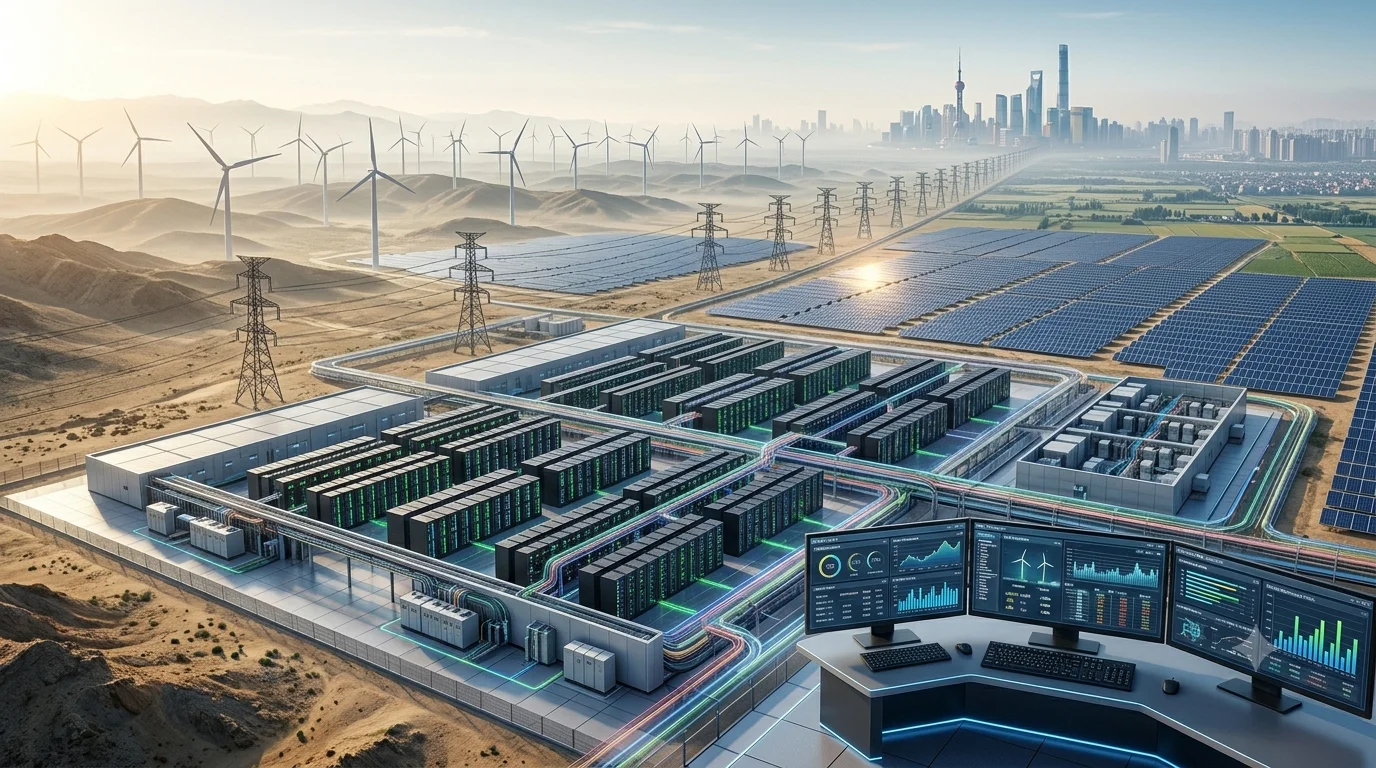
China wants to become the world’s largest AI infrastructure market while simultaneously accelerating its clean-energy transition. Those two goals increasingly collide. Beijing has directed national computing hubs to source a growing share of electricity from renewable energy. Under China’s national data center strategy, major computing clusters are expected to reach 80% renewable power consumption by 2030. At the same time, AI developers are deploying increasingly power-hungry GPU clusters that demand uninterrupted electricity around the clock. The result is a structural conflict. Renewable energy developers want direct access to data center customers. Grid operators want electricity to continue flowing through state-controlled transmission networks. AI operators need reliable power regardless of weather conditions. As these priorities collide, China’s AI infrastructure strategy is revealing the challenges of building a low-carbon compute economy at national scale.

Beijing’s Vision For Green AI Infrastructure
China’s “East Data, West Computing” initiative represents one of the largest digital infrastructure projects ever attempted. The strategy seeks to relocate compute-intensive workloads from eastern population centers to western provinces such as Inner Mongolia, Ningxia, Gansu, Guizhou, and Qinghai. These regions offer abundant renewable resources, lower land costs, and greater room for infrastructure expansion. Officials view the plan as a way to solve several challenges simultaneously. Renewable energy generation can be utilized more efficiently. Congested eastern power grids can be relieved. Data center development can stimulate regional economic growth. Government targets increasingly tie new computing capacity to renewable energy consumption. Several national computing hubs now face requirements to increase renewable energy utilization while improving energy efficiency metrics. Yet the practical implementation has proven more complicated than the policy vision suggests.
Why Grid Operators Push Back
The resistance does not stem from opposition to renewable energy itself. Instead, it revolves around economics. China’s state-owned grid operators have invested hundreds of billions of dollars in transmission infrastructure designed to move electricity across vast distances. Ultra-high-voltage transmission networks connect renewable-rich western provinces to major consumption centers in eastern China. Direct renewable power arrangements between developers and data centers threaten part of that business model. If large AI campuses secure dedicated renewable power through direct agreements, less electricity flows through traditional transmission networks. Lower utilization can reduce revenue opportunities and weaken the economic rationale for future grid investments. Consequently, grid operators often prefer renewable energy to move through centralized transmission systems rather than through dedicated supply arrangements between generators and major compute customers. The conflict illustrates a broader reality. AI infrastructure increasingly sits at the center of competing industrial interests rather than purely technological considerations.
AI Workloads Are Not Like Traditional Industrial Loads
The challenge becomes even more complex when AI workloads enter the equation. Many industrial facilities can adjust electricity consumption based on energy availability or pricing signals. AI training clusters operate differently. Large language model training runs often continue for weeks or months. Interruptions can create substantial inefficiencies and increase operational costs. High-density GPU infrastructure generates maximum value when utilization remains consistently high. This creates what infrastructure analysts increasingly describe as an “inflexible baseload” demand profile. Wind generation in Inner Mongolia may fluctuate. Solar generation falls after sunset. AI clusters cannot simply pause whenever renewable output declines. As a result, operators frequently require grid-backed reliability even when renewable energy forms the primary power source. That reality creates additional pressure on transmission systems and backup generation resources. The problem becomes particularly significant as model sizes continue growing and inference demand expands across industries.

The Latency Problem Behind East Data, West Computing
On paper, western China appears ideal for AI infrastructure. The region offers inexpensive land, abundant renewable resources, and significant room for expansion. However, infrastructure decisions depend on more than electricity costs. Many AI applications require low-latency connectivity to users, enterprises, and cloud ecosystems concentrated along China’s eastern seaboard. Beijing, Shanghai, Shenzhen, Hangzhou, and Guangzhou remain the country’s primary centers of digital activity. Moving workloads hundreds or thousands of kilometers west introduces operational complexities. Training workloads can often tolerate geographic distance. Inference workloads increasingly cannot. As generative AI adoption expands, many developers prefer locating compute resources closer to demand centers. The result is a growing tension between government planning objectives and commercial deployment realities. Several operators continue investing in eastern regions despite stronger policy incentives to expand westward.
Renewable Targets Meet Infrastructure Reality
China’s renewable ambitions remain substantial. The country leads the world in solar deployment, wind generation, battery manufacturing, and transmission infrastructure development. It continues adding renewable capacity faster than any other market globally. However, integrating AI infrastructure into that energy system introduces unique challenges. Unlike conventional cloud workloads, AI clusters create concentrated power demand measured in hundreds of megawatts. Future AI campuses may require gigawatt-scale power capacity comparable to large industrial complexes. Meeting renewable targets therefore requires more than generation capacity alone. Grid flexibility, storage deployment, transmission expansion, and workload management all become critical. The challenge is no longer simply producing green electricity. It is delivering reliable green electricity to infrastructure that cannot tolerate interruptions.
What This Means For China’s AI Future
The debate surrounding green AI mandates reveals a larger truth about the next phase of AI infrastructure development. Compute capacity is becoming a physical infrastructure challenge rather than a software challenge. Electricity networks, renewable energy systems, cooling infrastructure, transmission corridors, and geographic constraints increasingly determine where AI can scale. China’s experience may offer an early preview of issues other countries will soon confront. The United States faces similar tensions between AI demand and grid capacity. Europe continues debating data center energy consumption. Gulf nations are investing heavily in renewable-powered AI campuses. China simply happens to be confronting these questions first and at larger scale. The success of its AI ambitions may ultimately depend not on GPUs or algorithms alone, but on whether policymakers, grid operators, renewable developers, and data center operators can align around a common infrastructure strategy.











