
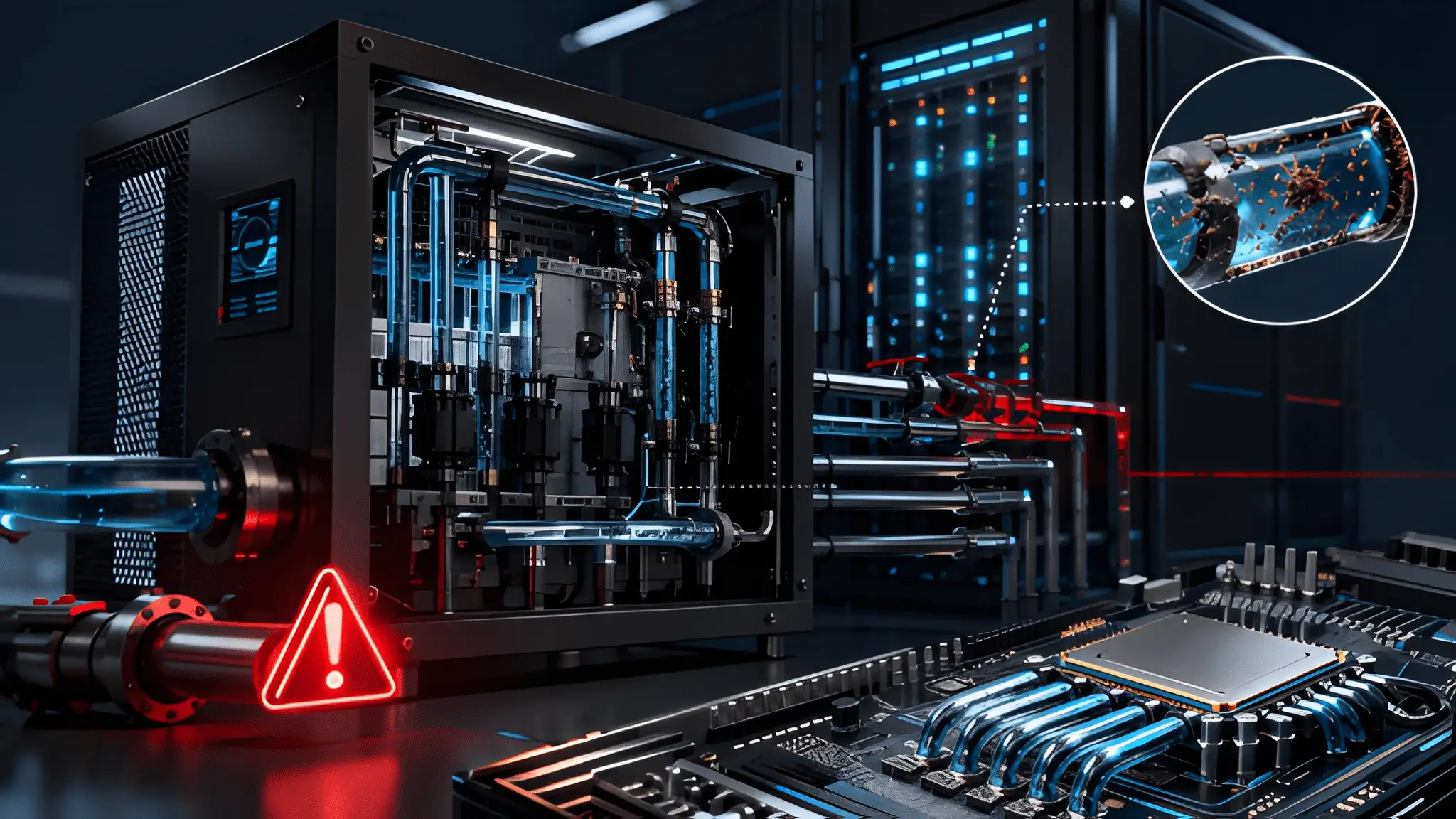
As rack power densities continue increasing in direct-to-chip deployments, thermal infrastructure no longer behaves like a passive utility because hydraulic response increasingly influences silicon operating conditions. Engineers now spend as much time evaluating coolant delivery stability as they spend sizing electrical distribution because both systems increasingly determine application availability. A coolant redundancy distribution unit may appear resilient on a commissioning checklist while still containing failure mechanisms that only emerge during sustained production workloads. Hardware redundancy alone cannot eliminate common-mode events when multiple hydraulic components depend on identical operating conditions and shared control strategies. This shift has moved engineering attention toward dynamic system behavior rather than simple equipment duplication.

Reliable liquid cooling depends on interactions between pumps, valves, sensors, filtration assemblies, controllers, manifolds, and facility water systems instead of any single mechanical component. High-density direct-to-chip deployments compress thermal margins to the point where milliseconds of delayed control action may influence processor throttling during transient load spikes. Traditional redundancy calculations primarily emphasize component availability, while hydraulic coupling, controller synchronization, and long-term operational degradation may require additional system-level evaluation during reliability analysis.. Designers therefore need reliability models that reflect operational physics instead of assuming every backup path behaves independently under identical stress conditions. Executive decision makers commonly evaluate cooling resilience using operational continuity, maintenance flexibility, and recoverability alongside conventional equipment redundancy metrics. Understanding these relationships allows infrastructure teams to design cooling systems that remain predictable under conditions far beyond historical enterprise workloads.
When N+1 Means Zero: The Math Behind Redundant Systems That Still Fail
Redundancy calculations often assume that independent cooling paths experience unrelated failures, yet hydraulic systems rarely satisfy that assumption during real operating conditions. Dual-path coolant distribution units frequently share similar inlet temperatures, pressure characteristics, controller logic, maintenance practices, and environmental conditions throughout their service life. A rapid increase in processor demand can trigger simultaneous valve movement, pump response, and pressure redistribution across both circuits within seconds. If those responses follow identical control algorithms, correlated behavior may reduce the practical benefit of installing duplicate equipment despite meeting conventional N+1 architecture requirements. Engineering models focused primarily on component failure probabilities may not fully capture the influence of synchronized operating states on overall system reliability. Instead, transient hydraulic behavior deserves equal consideration because dynamic interactions increasingly determine whether redundancy performs as expected during extreme thermal events.
Failover sequences introduce another layer of complexity because backup activation rarely occurs under steady-state hydraulic conditions inside high-density cooling loops. Valve sequencing can briefly alter differential pressure before secondary pumps stabilize flow, creating localized thermal disturbances near the most demanding processor cold plates. Hydraulic shock generated during abrupt flow transitions may propagate throughout connected manifolds and temporarily influence multiple racks instead of remaining isolated to one branch. Consequently, reliability engineering now extends beyond installing duplicate equipment toward validating the timing, sequencing, and coordination of every automated control action. Simulation of transient events under representative production loads complements static acceptance testing by providing additional insight into cooling system behavior during dynamic operating conditions. Organizations that include dynamic hydraulic validation within commissioning strategies typically gain clearer visibility into operational risks before production workloads expose them unexpectedly.

The Forgotten Valve: Control Lag Becoming Thermal Cascade
Control systems increasingly define cooling performance because high-density processor packages respond to thermal fluctuations much faster than conventional facility infrastructure can compensate. Actuator response time, sensor sampling frequency, and controller execution intervals collectively determine how rapidly coolant flow adapts to changing computational demand. Direct-to-chip architectures concentrate heat removal at localized interfaces where even small delays may temporarily reduce thermal stability before mechanical systems recover. Pump redundancy cannot by itself address delayed valve response when flow regulation becomes a significant factor during rapid workload transitions. Engineering teams therefore evaluate control loop performance alongside hydraulic capacity because both influence sustained processor operation under demanding inference and training workloads. Reliable thermal management now depends upon coordinated mechanical and digital responses instead of treating automation as a secondary design consideration.
Controllers also encounter practical limitations when multiple racks simultaneously increase power consumption during synchronized computational activity. Temperature sensors observe changing conditions only after heat transfers through cold plates and coolant channels, creating unavoidable measurement delays before corrective actions begin. Valve actuators then require additional time to reposition while flow stabilization continues throughout the hydraulic circuit under varying pressure conditions. Meanwhile, processors continue generating heat throughout this sequence, leaving minimal opportunity for control systems to absorb unexpected disturbances without exceeding preferred operating margins. Engineers increasingly validate closed-loop response using transient load profiles instead of constant thermal conditions because production environments rarely remain static for extended periods. Control latency has therefore become an important operational engineering parameter that should be evaluated alongside pump selection and pipe sizing during system design.
Filtration Blind Spots: How Particulates Neutralize Redundancy
Mechanical redundancy cannot compensate for coolant quality that gradually deteriorates across every hydraulic pathway serving the same cooling ecosystem. Fine particulates originating from installation residue, component wear, corrosion products, or external contamination may circulate through both primary and standby circuits over extended operating periods. Biological growth can also emerge when coolant chemistry, maintenance practices, or environmental conditions permit microbial activity within closed-loop systems despite preventive measures. Shared filtration strategies may therefore experience simultaneous loading that progressively reduces flow performance without triggering immediate operational alarms. Reliability assessments focused primarily on pumps and valves should also consider how common contaminants can influence multiple redundant flow paths within the same cooling system. Cooling resilience depends equally upon long-term fluid management because hydraulic cleanliness directly supports predictable thermal performance throughout the infrastructure lifecycle.
Filter differential pressure alone rarely provides a complete understanding of system health because contamination distributes unevenly throughout complex coolant networks. Narrow cold-plate channels, balancing valves, heat exchangers, and flexible hose assemblies each present locations where gradual accumulation may influence localized hydraulic resistance before facility instruments detect significant deviations. Maintenance intervals based solely on calendar schedules may overlook operating conditions that accelerate particulate generation under sustained high-flow environments. Similarly, laboratory analysis of coolant chemistry and particulate content provides additional operational insight that conventional instrumentation cannot continuously deliver during production service. Organizations increasingly integrate fluid condition monitoring into preventive maintenance programs because contamination develops gradually rather than appearing as a sudden equipment failure. Long-term reliability improves when engineers treat coolant as a managed operational asset instead of assuming filtration alone permanently preserves hydraulic performance.
Commissioning Isn’t Insurance: Startup Imbalances That Haunt Year Three
Commissioning confirms that cooling infrastructure satisfies defined acceptance criteria at a specific point in time, yet long-term operating conditions often evolve beyond those initial measurements. Minor flow-balancing differences between parallel branches may remain operationally insignificant during moderate utilization while gradually becoming more influential as rack densities increase over successive deployment phases. Instrument calibration also changes incrementally because sensors experience aging, environmental variation, and continuous service across demanding thermal environments. Small measurement offsets can influence automated control decisions long before operators recognize a developing imbalance through routine monitoring dashboards. Maintenance teams therefore benefit from periodic hydraulic verification that evaluates actual operating behavior rather than assuming original commissioning values remain representative throughout the equipment lifecycle. Reliability depends upon continuous validation because production infrastructure rarely operates under the same conditions that existed during initial acceptance testing.
Extended operation above 120kW per rack exposes hydraulic characteristics that frequently remain hidden during factory testing or staged infrastructure commissioning. Flow distribution may gradually diverge between cooling branches as component tolerances, valve wear, filter loading, and control adjustments accumulate across several years of continuous service. These changes rarely produce immediate failures because thermal systems typically compensate until workload intensity approaches available operating margins. Therefore, organizations increasingly perform operational reassessment using production-scale thermal profiles that reflect current infrastructure density rather than historical design assumptions. Digital monitoring platforms provide valuable trend information, although engineering interpretation remains essential for distinguishing gradual degradation from normal operating variation. Periodic performance verification transforms commissioning from a one-time milestone into an ongoing engineering discipline that supports predictable cooling resilience over the full service life of the installation
Designing for Graceful Degradation: What Comes After Redundancy Fails
Cooling resilience increasingly depends upon controlled performance reduction rather than expecting uninterrupted full-capacity operation after every equipment fault. High-density compute environments benefit from architectures that preserve critical processing capability while progressively reducing thermal demand instead of allowing abrupt infrastructure collapse. Thermal ride-through strategies provide additional response time by coordinating workload scheduling, processor power management, and cooling system behavior during unexpected hydraulic disturbances. Staged load shedding also enables operators to protect priority services while reducing stress on remaining cooling capacity until corrective maintenance restores normal operating conditions. These approaches acknowledge that complex infrastructure occasionally experiences failures despite careful engineering and preventive maintenance. Designing for graceful degradation creates operational flexibility that supports business continuity without assuming every component always performs under ideal conditions.
Current cooling architecture development increasingly incorporates predictive monitoring, adaptive control algorithms, modular hydraulic segmentation, and operational automation to strengthen resilience as compute densities continue increasing. Infrastructure teams can reduce common-mode exposure by separating control dependencies, validating transient system behavior, and continuously monitoring hydraulic health instead of relying exclusively on equipment redundancy. Investment decisions increasingly favor designs that maintain stable thermal performance during abnormal operating scenarios because uninterrupted service often carries greater business value than theoretical redundancy metrics. Engineering discussions increasingly emphasize survivability, recoverability, and operational adaptability as higher-density AI infrastructure introduces new cooling design considerations. Reliable liquid cooling now reflects the coordinated behavior of mechanical equipment, intelligent controls, fluid quality management, and disciplined operational practices working together under sustained computational demand. Understanding those interconnected relationships allows organizations to build infrastructure that remains predictable even when individual cooling elements no longer perform exactly as originally intended.











