
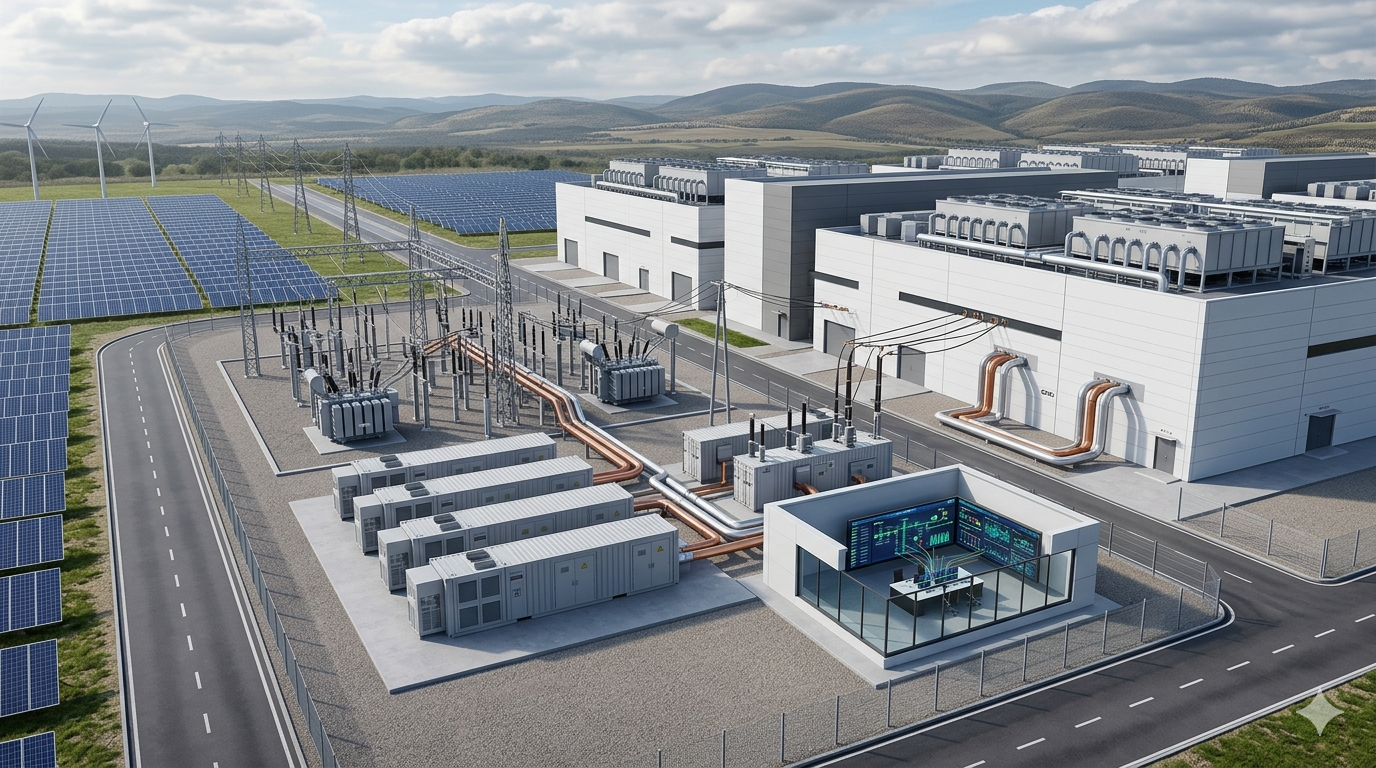
For decades, electricity was treated as a predictable input for data center development. Operators secured land, arranged financing, built facilities, and connected to the grid as part of a relatively straightforward process. The rapid growth of artificial intelligence has disrupted that model. Across major data center markets, power availability has become the primary constraint on new infrastructure deployment. Utilities face mounting requests for large-scale connections while transmission networks struggle to keep pace with demand. Developers increasingly discover that obtaining electricity can take longer than constructing the facility itself. This challenge is creating an entirely new category of companies focused on accelerating access to power for digital infrastructure.

AI’s Biggest Bottleneck Is No Longer Computing
The conversation around artificial intelligence often centers on semiconductors, GPUs, and large language models. Yet many infrastructure developers now view electricity as the industry’s most important limiting factor. Modern AI clusters consume far more power than traditional cloud environments because training and inference workloads operate continuously across dense computing environments. As organizations deploy larger AI systems, demand for electricity continues to rise faster than many utilities anticipated. Grid operators in major markets are receiving connection requests that exceed available capacity by significant margins. The result is a growing backlog of projects waiting years for access to power. In several regions, the challenge has become one of infrastructure readiness rather than technology availability.
This shift is changing how developers evaluate potential projects. Historically, access to fiber connectivity and customer proximity influenced site selection decisions. Today, power availability often ranks above those factors. Hyperscale operators increasingly seek locations capable of delivering hundreds of megawatts within commercially viable timelines. Delays can disrupt deployment schedules, increase costs, and create competitive disadvantages. As AI adoption accelerates across industries, reliable electricity is becoming a strategic asset rather than a background utility service. The growing importance of power has opened opportunities for companies focused specifically on solving infrastructure bottlenecks.
Why Utilities Cannot Keep Up With Data Center Demand
Electricity networks were not designed around the rapid growth of AI infrastructure. Many transmission systems require years of planning, permitting, and construction before new capacity can be added. Utilities must balance the needs of industrial customers, residential communities, renewable energy integration, and reliability requirements. Data centers now represent one of the fastest-growing categories of electricity demand in several regions. The scale of requested capacity often exceeds what local infrastructure can immediately provide. Grid modernization projects remain underway, but development timelines frequently lag behind market demand. Consequently, operators face growing uncertainty around connection schedules.
The challenge extends beyond generation capacity alone. New data centers often require transmission upgrades, substations, interconnection studies, and regulatory approvals before receiving power. Each step introduces additional complexity and potential delays. Large projects can become trapped in lengthy queues while utilities assess network impacts and plan infrastructure investments. Some operators report waiting periods that stretch several years before electricity becomes available. Such delays create significant risks for investors and developers working within fast-moving AI markets. These conditions have encouraged the emergence of companies dedicated to helping customers navigate and accelerate the power procurement process.
The Rise of Power-as-a-Service for AI Infrastructure
A new infrastructure category is beginning to take shape around what many describe as Power-as-a-Service. These companies operate between utilities and large power consumers, helping data center developers secure energy more efficiently. Their services range from grid interconnection planning and energy storage deployment to microgrid development and power management software. Instead of generating electricity themselves, they focus on reducing friction throughout the infrastructure development process. The goal is to make power available faster, more reliably, and with greater operational flexibility. As AI infrastructure expands, these services are attracting increasing attention from investors and developers alike.

The emergence of this category reflects broader changes within digital infrastructure. Cloud computing introduced platforms that abstracted complexity away from physical servers. Similarly, power infrastructure startups are beginning to abstract complexity away from grid interactions. Developers no longer want to spend years navigating utility processes without clear visibility into outcomes. Power-focused companies provide specialized expertise, software tools, and infrastructure solutions that simplify decision-making. Their role is becoming increasingly important as electricity transitions from a supporting resource to a core determinant of project feasibility. The market opportunity continues to expand alongside AI adoption.
The Startups Building a New Grid Layer
Several companies are positioning themselves within this emerging ecosystem. Aston Power is developing a private power platform designed to help data center operators access electricity through alternative infrastructure models. The company recently secured new funding to scale its approach as developers search for faster pathways to power. Rather than relying exclusively on traditional utility timelines, Aston focuses on creating flexible infrastructure solutions that can support high-growth digital workloads. Its model reflects a broader shift toward privately managed energy systems for critical infrastructure. Investors increasingly view such approaches as essential for future data center expansion.
Another notable player is Verse, which is applying software and data analytics to accelerate grid interconnection processes. The company focuses on identifying opportunities to reduce delays associated with connection studies and utility planning. By improving visibility into grid conditions and infrastructure requirements, Verse aims to shorten timelines that traditionally slow project development. Similar approaches are emerging across the sector as developers seek alternatives to lengthy utility workflows. GridCARE is also attracting attention for its work on transmission optimization and congestion management. Together, these companies are building what amounts to a new digital layer between power networks and AI infrastructure operators.
Energy Storage Is Becoming Part of the Data Center Stack
Battery energy storage is increasingly viewed as a strategic component of modern data center development. Historically, operators deployed backup power systems primarily for resilience and redundancy. Today’s projects are beginning to use energy storage as an active infrastructure asset capable of supporting grid flexibility and demand management. Batteries can reduce peak electricity consumption, improve reliability, and provide additional options when grid capacity remains constrained. These capabilities are becoming particularly valuable as AI workloads create larger and more variable power requirements. Energy storage is therefore evolving from a backup solution into a core operational tool.
Several companies are focusing on this opportunity. Base Power is developing distributed battery infrastructure that can support broader grid flexibility objectives. Enchanted Rock has built a business around resilience-focused energy services designed to help critical facilities maintain operations during disruptions. Meanwhile, emerging firms continue to explore ways to integrate storage assets into broader power management platforms. The convergence of batteries, software, and AI-driven forecasting tools is creating new possibilities for infrastructure operators. As electricity demand grows, storage technologies are expected to become increasingly important components of digital infrastructure ecosystems.
Software Is Becoming a Power Infrastructure Tool
The transformation extends beyond physical assets. Software platforms are playing a growing role in how electricity is managed across modern infrastructure networks. Companies such as Camus Energy focus on helping utilities orchestrate increasingly complex power systems. Their platforms improve visibility into network conditions and support more dynamic decision-making. As grids become more distributed and interconnected, software tools are becoming essential for maintaining efficiency and reliability. These capabilities help utilities respond to changing demand patterns while supporting new categories of large energy consumers.
Artificial intelligence is also beginning to influence power management directly. Emerald AI is developing technologies designed to optimize workload scheduling based on electricity availability and grid conditions. Rather than treating computing and power as separate domains, such approaches seek to align both systems more closely. Demand-response providers including Voltus are exploring similar opportunities by helping large customers adjust electricity usage in response to market conditions. These developments illustrate how digital tools are becoming increasingly integrated into energy infrastructure. The result is a more flexible and responsive operating environment for large-scale computing facilities.
A New Infrastructure Category Is Emerging
The rise of AI is reshaping more than data centers and semiconductor markets. It is also creating demand for an entirely new layer of infrastructure companies focused on solving power-related challenges. These organizations occupy a position between traditional utilities and the hyperscale operators driving AI growth. Their services span grid acceleration, energy storage, transmission optimization, software orchestration, and resilience planning. Together, they are building capabilities that help developers overcome one of the industry’s most significant bottlenecks. Their importance is likely to increase as electricity demand continues to rise.
The broader significance of this trend extends beyond individual startups. Power is becoming a competitive differentiator within the AI economy. Access to electricity increasingly determines where facilities can be built, how quickly they can be deployed, and how effectively they can scale. Infrastructure developers can no longer assume that utility connections will arrive on predictable schedules. As a result, the market is creating new solutions that bridge the gap between growing demand and constrained supply. The companies emerging in this space may ultimately become as important to AI infrastructure as cloud providers became to enterprise computing. Their success will help shape how the next generation of digital infrastructure is built.











