
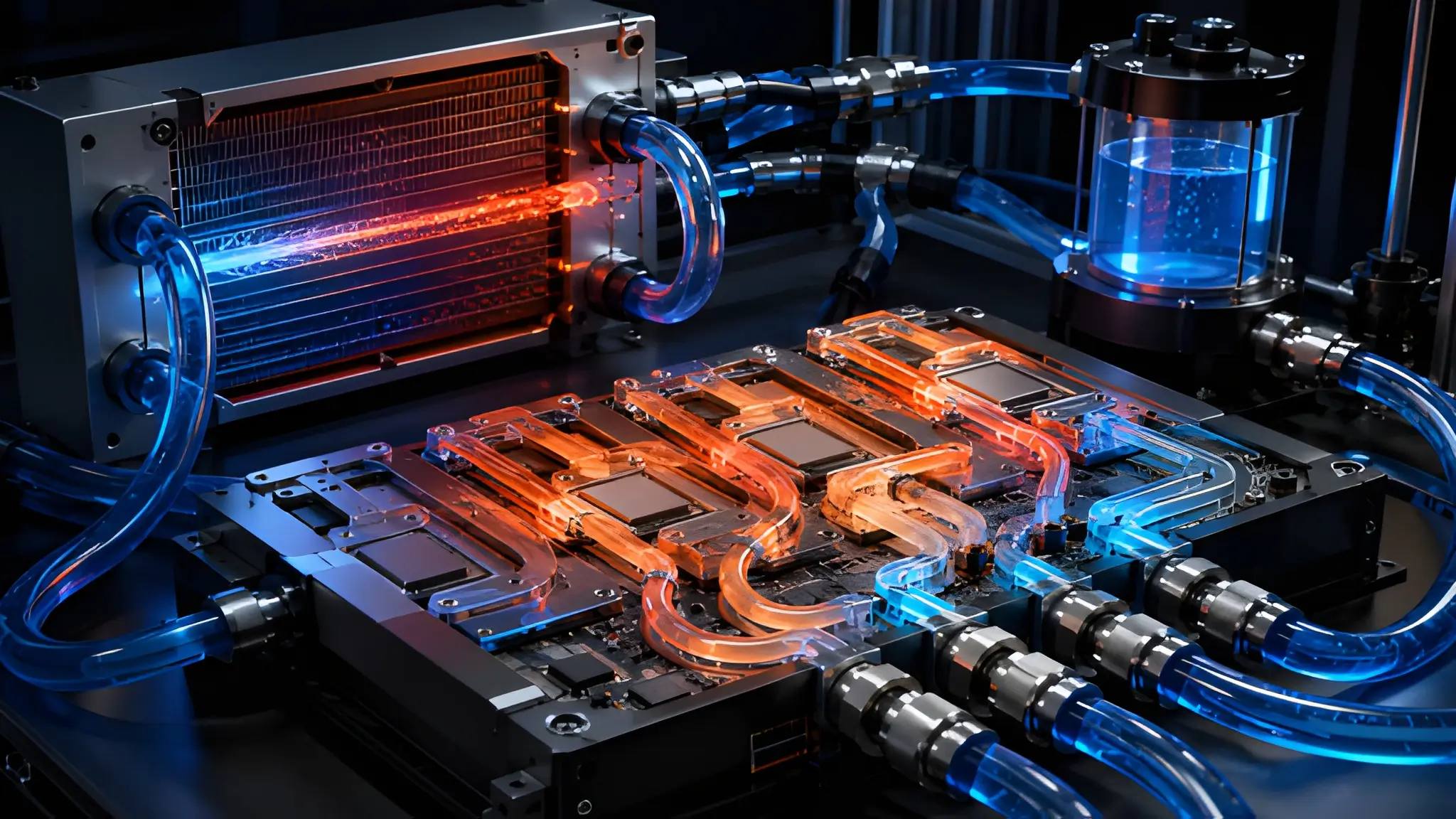
Modern liquid cooling discussions often focus on thermal conductivity, dielectric safety, or immersion readiness, yet one engineering compromise quietly dictates system performance long before equipment arrives on site. Mechanical teams frequently discover that a fluid capable of meeting electrical isolation requirements introduces hydraulic penalties that were never visible in preliminary sizing exercises. Heat removal capacity and flow resistance rarely move in the same direction, which creates competing demands across pumps, manifolds, piping, and control systems. Designers can improve one side of the equation only to discover that the other side now constrains the entire loop. As AI infrastructure pushes rack densities upward, this compromise becomes more visible because every additional kilowatt amplifies fluid property limitations. Understanding how these opposing properties interact is often more valuable than comparing coolant marketing claims.

Many dielectric fluids carry significantly lower heat storage capacity than water-based coolants while also exhibiting higher viscosity across typical operating temperatures. That combination forces engineers to move larger fluid volumes through the system to remove the same thermal load, which increases velocity, pressure drop, and pumping power simultaneously. Equipment vendors often provide component-level specifications, but system-level interactions emerge only after hydraulic models are completed. Pressure losses accumulate through fittings, cold plates, quick-disconnects, and branch circuits in ways that remain hidden during early design reviews. Engineers therefore face a balancing act where thermal requirements and hydraulic realities continuously pull the design in opposite directions. Successful liquid cooling systems account for both thermal and hydraulic fluid properties during equipment selection, sizing, and operational planning.
When Thermal Capacity Loses to Friction
Heat removal follows a simple relationship where thermal transport equals mass flow multiplied by specific heat and temperature rise. Because many dielectric fluids exhibit substantially lower specific heat capacity than water, engineers must increase mass flow to achieve equivalent heat removal under the same thermal conditions. For dielectric fluids with specific heat capacities near half that of water, maintaining the same heat removal rate and temperature rise can require more than twice the volumetric flow. That increase immediately changes hydraulic conditions throughout the network because flow velocity rises inside every pipe, valve, and cold plate passage. Pressure drop grows rapidly as flow increases, especially in complex cooling architectures containing multiple restrictions. Thermal performance therefore appears achievable on paper while hydraulic requirements begin escalating much faster than expected.
The second challenge emerges when higher flow meets substantially higher viscosity. Pressure drop does not respond only to increased volume movement but also to the fluid’s resistance to deformation within the flow path. A coolant requiring substantially higher flow while also exhibiting higher viscosity can produce hydraulic resistance levels that differ significantly from water-based design assumptions. Pump power scales according to flow and developed head, so both variables can rise simultaneously under these conditions. Engineers often discover that a moderate thermal adjustment translates into a disproportionately large electrical demand from pumping equipment. Consequently, increased pumping requirements and pressure losses can reduce operational margins that would otherwise be available for future capacity growth.

The Pump Curve Cliff No Spec Sheet Warns You About
Most centrifugal pump curves originate from testing conducted with water because it provides a consistent reference condition for manufacturers. Those curves establish expected relationships between flow, head, efficiency, and power across the operating range. Once a more viscous fluid enters the system, the published curve no longer represents actual performance with sufficient accuracy. Hydraulic losses inside the pump increase, efficiency decreases, and achievable flow shifts away from the original prediction. Engineers who select equipment using uncorrected curves often discover that field performance differs materially from design expectations. The discrepancy becomes increasingly significant as viscosity rises beyond values typically associated with water-like fluids.
The most overlooked consequence involves operation near the best efficiency point. Many cooling systems are designed so normal operation occurs near this region because energy consumption, vibration, and reliability generally improve there. However, viscosity corrections can shift the actual operating point away from the intended location, creating an invisible performance cliff. Flow decreases, developed head changes, and motor power requirements move in directions not reflected by standard catalog data. When thermal loads increase, higher flow requirements can shift the operating condition further from the point assumed during initial pump selection. Meanwhile, the pump may continue operating within its mechanical limits while delivering efficiency levels far below expectations.
Why Your Manifold Turns Into a Bottleneck
Flow balancing discussions frequently focus on distribution manifolds because they serve as the primary control point for liquid delivery throughout the rack. Equal flow measurements at a coolant distribution unit often create confidence that downstream circuits receive identical hydraulic conditions. Real systems behave differently because each branch contains unique restrictions, geometric variations, and temperature-dependent fluid behavior. As viscosity increases, small differences between branches generate larger consequences at the cold plate level. A branch with slightly higher resistance can experience a disproportionately larger reduction in delivered flow. Uniform measurements at the manifold therefore do not guarantee uniform cooling performance at the processor.
Branch circuits become especially sensitive when cold plates contain narrow channels designed to maximize heat transfer surface area. Those channels generate localized pressure losses that interact directly with fluid viscosity. As flow divides across multiple branches, the path offering slightly lower resistance attracts a larger portion of the available flow. The resulting imbalance may remain invisible until temperature deviations appear across servers operating under similar computational loads. Engineers often investigate thermal anomalies before recognizing that the underlying issue originated in hydraulic distribution. Furthermore, correcting hydraulic imbalance after deployment often requires evaluation of the broader network because flow conditions in one branch can influence performance elsewhere in the system.
Pipe Diameter Decisions You Can’t Undo
Increasing pipe diameter appears to offer a straightforward response to higher flow requirements because larger cross-sectional area reduces velocity and pressure drop. Design teams often consider upsizing as a practical way to recover hydraulic margin lost to fluid properties. Larger piping can indeed reduce friction losses, but that decision introduces secondary consequences throughout the cooling architecture. Heat exchangers, control valves, manifolds, and connection hardware must accommodate the revised hydraulic profile. Equipment footprints grow while installation complexity increases across mechanical spaces already constrained by infrastructure requirements. Early diameter choices therefore influence much more than the pressure drop calculation itself.
Pipe sizing also affects velocity management, which directly influences heat transfer behavior and long-term equipment integrity. Excessive velocity can increase wear rates at fittings, elbows, and localized restrictions where flow direction changes abruptly. Reducing velocity through larger piping may alleviate those concerns, although heat exchanger performance must still be evaluated against the resulting operating flow conditions. Component manufacturers optimize performance around specific flow ranges, and deviations can reduce thermal effectiveness even when hydraulic losses improve. Therefore, the decision cannot focus solely on friction reduction because thermal and hydraulic objectives remain linked. Once major piping infrastructure enters construction, reversing that choice becomes expensive and operationally disruptive.
Materials Tell on You Before the Sensors Do
Instrumentation often receives the first call when cooling systems begin behaving unexpectedly, yet physical components frequently reveal problems earlier. Hoses, seals, gaskets, and quick-disconnect assemblies respond continuously to hydraulic stress generated by elevated differential pressure. Increased viscosity can raise resistance throughout the system, forcing pumps to generate higher pressures to maintain required flow. Those conditions place additional mechanical loading on elastomeric and polymer-based components. Material deformation can develop gradually, particularly in systems where monitoring thresholds are configured to detect larger performance deviations. Physical inspection can reveal wear patterns that are not always immediately apparent through operational performance metrics alone.
Common indicators of elevated hydraulic stress include connector distortion, seal compression changes, increased maintenance requirements, and localized leakage near high-resistance sections. Engineers sometimes attribute these symptoms to manufacturing variability when the actual cause originates in hydraulic loading beyond original assumptions. Repeated pressure cycling can accelerate degradation mechanisms that remain largely absent under lower differential pressure conditions. Component failures rarely occur in isolation because the same hydraulic environment affects multiple materials throughout the cooling loop. Monitoring programs that combine physical inspections with hydraulic trend analysis provide a more complete picture of system health. Nevertheless, material behavior often exposes underlying design compromises before sensor dashboards present a clear diagnosis.
Design for the Tug-of-War, Not the Winner
Fluid selection becomes problematic when teams evaluate thermal properties without assigning equal weight to hydraulic consequences. No coolant property operates independently because heat capacity, viscosity, density, thermal conductivity, and material compatibility influence one another throughout the system. Engineers should begin by defining the allowable thermal rise, acceptable pumping power, and target reliability metrics before comparing candidate fluids. Hydraulic modeling must incorporate realistic fluid properties across the full operating temperature range rather than a single reference condition. Pump selection should rely on corrected performance data instead of water-based assumptions whenever viscosity differs materially from water. Integrated evaluation of thermal and mechanical design variables improves visibility into system-level interactions that influence cooling performance and reliability.
A resilient cooling architecture acknowledges that neither thermal storage capacity nor flow resistance will fully dominate every operating condition. Pumping systems should retain sufficient margin to accommodate property changes caused by temperature fluctuations and future workload growth. Heat exchangers must support realistic flow ranges instead of idealized design points that assume stable fluid behavior. Control strategies should monitor pressure, temperature, and flow together because no single metric captures the complete system response. Meanwhile, component selection should account for long-term exposure to elevated differential pressure rather than focusing exclusively on initial performance. In practice, robust cooling system designs address both thermal and hydraulic requirements because each directly influences overall performance, efficiency, and reliability.











