Skip to content
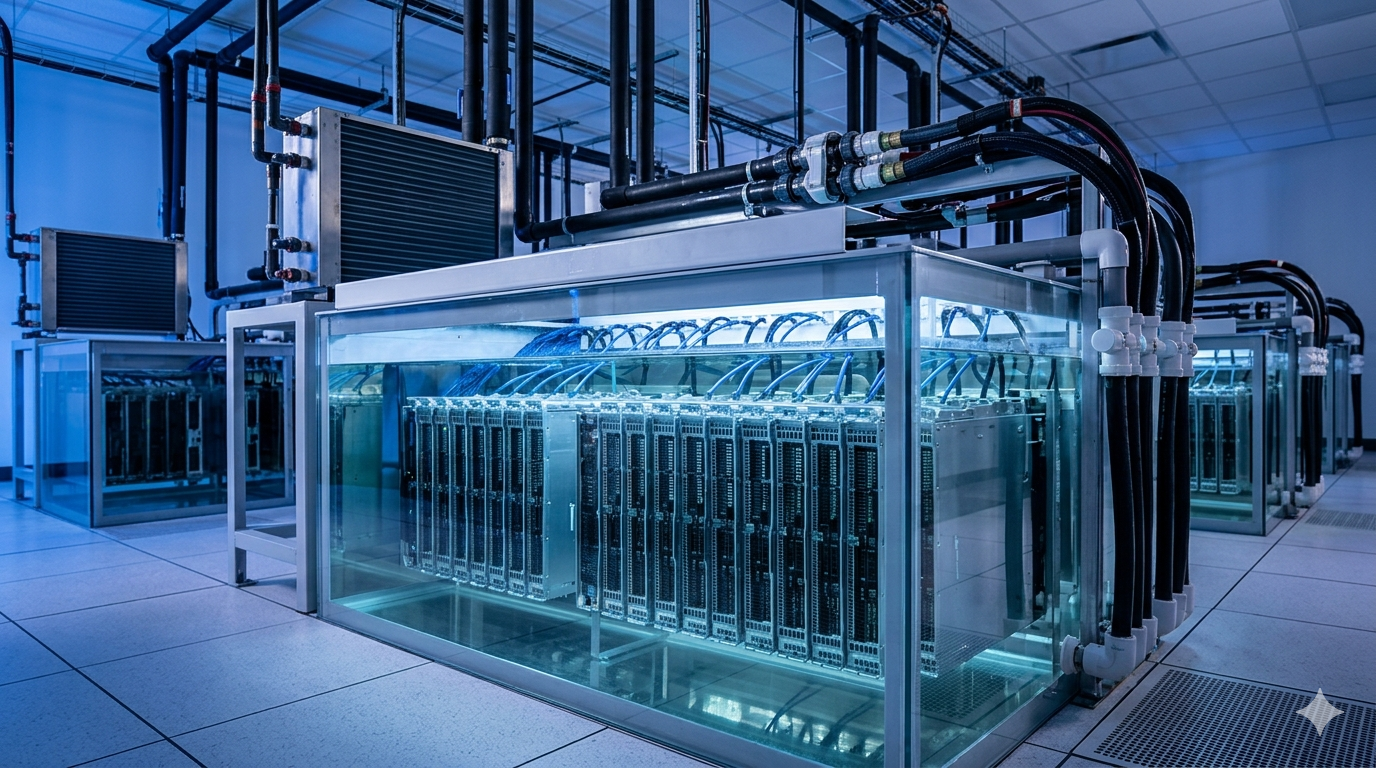
For most of the past decade, immersion cooling occupied a peculiar position in data center planning conversations. Everyone agreed the technology worked. The thermal efficiency numbers were compelling. The PUE figures were unmatched. And yet adoption remained narrow, confined to cryptocurrency mining operations, a handful of hyperscaler pilots, and specialist high-performance computing deployments where the economics justified the complexity.

The hesitation was rational. Immersion cooling carried a premium that was difficult to recover at the rack densities that most data centers operated at. Dielectric fluid costs were high, tank designs were not standardised, server OEM support was patchy, and the operational expertise required to manage an immersion deployment was scarce. The technology was technically superior but economically marginal for the majority of operators.
That calculation has changed. GPU rack densities crossing 120 kilowatts with Blackwell-generation hardware have moved immersion cooling from an efficiency enhancement to a physical necessity at the frontier of AI infrastructure. Simultaneously, dielectric fluid costs have fallen 30 to 40 percent since 2022, tank designs have standardised around Open Compute Project specifications, and leading server manufacturers including Supermicro, Wiwynn, and Gigabyte now offer immersion-ready configurations as standard product lines. The payback period for immersion cooling capital investment at high-density AI deployments has declined from five to seven years to 2.5 to 3.5 years. The TCO case is not opening. It has already closed.
What Immersion Cooling Actually Does to the Numbers
Understanding why the economics have shifted requires understanding what immersion cooling changes in the cost structure of a data center. The technology submerges servers entirely in dielectric fluid, either single-phase systems using mineral oils or synthetic fluids that remain liquid throughout, or two-phase systems using engineered fluids that boil at chip surfaces and condense on a heat exchanger above the tank. Both approaches transfer heat at efficiencies that air and direct-to-chip cooling cannot match.

Single-phase immersion delivers PUE of 1.02 to 1.08 for GPU-dense AI clusters. Air cooling at equivalent rack densities achieves PUE of 1.50 to 1.80. That gap, measured in fractions of a unit that translate directly into electricity consumption, compounds enormously at scale. A 100-megawatt AI data center running at PUE 1.03 consumes approximately 103 megawatts of total facility power. The same facility at PUE 1.65 consumes 165 megawatts. At an electricity cost of 10 cents per kilowatt-hour, that 62-megawatt difference costs roughly $54 million annually. Over a ten-year facility lifecycle, the energy savings alone from immersion cooling can exceed the total capital cost of the cooling infrastructure itself.
Why liquid cooling is now a power strategy rather than just a cooling choice reflects this shift in how operators are framing the decision. The choice of cooling architecture is no longer primarily a thermal engineering decision. It is a power procurement decision, a capital efficiency decision, and increasingly a site selection decision. Operators who can run at PUE 1.03 rather than 1.65 need to procure 37 percent less power to support equivalent IT load. In markets where power availability is constrained and grid connection costs are high, that reduction in power requirement can determine whether a site is viable at all.
Why PUE Differences Compound Into Enormous Cost Gaps at Scale
The PUE gap between immersion and air cooling is not a marginal efficiency improvement. It is a structural cost difference that grows with facility size, electricity price, and utilisation rate. Operators who model immersion cooling economics against air cooling at their specific power price and utilisation assumptions consistently find the gap larger than headline PUE figures suggest, because the compounding effect of running at lower PUE continuously over a ten-year facility lifecycle is substantially greater than a single-year snapshot implies.
The CAPEX Picture Has Changed Significantly
The historical argument against immersion cooling rested heavily on capital cost. Early immersion deployments required significant custom engineering, non-standard server configurations, expensive dielectric fluids, and facility modifications that added substantially to the upfront investment. That premium was real, and the payback calculations at the time often did not close within reasonable investment horizons.
The CAPEX premium has narrowed considerably. Dielectric fluid costs, historically the largest barrier, have declined 30 to 40 percent over the past three years through increased production scale and the emergence of lower-cost alternatives. Natural dielectric fluids including mineral oils, synthetic esters, and biodegradable alternatives now offer viable options for single-phase deployments at costs that the fluorocarbon fluids of early immersion systems could not match. A 42-unit immersion tank holding 800 to 1,200 litres of mineral oil carries a fluid cost of roughly $8,000 to $15,000, compared to $40,000 to $60,000 or more for the engineered fluorocarbon fluids that dominated early deployments.
Tank design standardisation has further reduced the custom engineering premium. The Open Compute Project’s Submerged Liquid Cooling workgroup has published reference designs and interoperability specifications that allow server OEMs to validate hardware for immersion deployment at scale. That standardisation reduces integration risk and engineering cost for operators, converting what was previously a bespoke project into a deployment that follows documented procedures against validated hardware configurations.
Why the Capital Cost Crossover Point Has Shifted Decisively
The comparison between cold plates and immersion in AI data center deployments reveals that the capital cost differential between direct-to-chip and single-phase immersion has also narrowed at high densities. Below 80 kilowatts per rack, direct-to-chip cooling typically delivers better capital efficiency because it does not require purpose-built tanks or facility floor loading modifications. Above 100 kilowatts per rack, the capital cost advantage shifts toward immersion because the tank-based architecture handles the full thermal load without the supplementary air handling infrastructure that direct-to-chip deployments require for components not covered by cold plates.
The OPEX Case Is Even Stronger Than the CAPEX Case
The operating expenditure advantages of immersion cooling are larger and more durable than the capital cost story suggests. Operators consistently report 40 to 60 percent reductions in cooling-related energy costs compared to traditional CRAC and CRAH systems. Those savings compound over time as electricity prices rise. Global electricity costs for data center operators have increased 20 to 35 percent since 2022, which means the energy savings from immersion cooling are growing in absolute terms even as the technology’s capital premium declines.
Why Fan Elimination Changes More Than the Energy Budget
Hardware longevity improvements add a second OPEX advantage that receives less attention in immersion cooling discussions but is economically significant at AI infrastructure scale. Servers operating in stable thermal environments experience substantially lower rates of component failure than those operating in the thermal cycling environment of air-cooled facilities. GPU junction temperatures in immersion-cooled deployments run 15 to 25 degrees Celsius lower than equivalent air-cooled configurations, reducing electromigration and thermal fatigue that drive semiconductor failure rates over time.
Operators report server lifespan improvements of 15 to 20 percent in immersion-cooled deployments relative to air-cooled equivalents. For a data center deploying hundreds of millions of dollars of GPU hardware with three to five year depreciation cycles, a 15 to 20 percent improvement in effective hardware life represents a capital efficiency gain that significantly affects the total cost of ownership calculation. The immersion cooling system that costs more upfront pays for a portion of that premium through reduced hardware replacement costs over the facility lifecycle.
The maintenance economics and service design implications of liquid cooling infrastructure introduce a third OPEX dimension that operators must model carefully. Immersion cooling eliminates server fans, which are among the highest-failure-rate components in air-cooled deployments. Fan failures account for a disproportionate share of server maintenance events in high-utilisation facilities. Their elimination reduces maintenance labour requirements and spare parts inventory costs that accumulate to meaningful sums at scale. However, the fluid management, pump maintenance, and heat exchanger servicing that immersion systems require introduce new maintenance cost categories that operators must plan for. The net OPEX effect depends on the specific deployment configuration, facility scale, and the operational maturity of the maintenance team.
The Density Inflection That Changed the Conversation
The economic case for immersion cooling has always been density-dependent. Below 30 kilowatts per rack, advanced air cooling typically delivers better return on investment than immersion. Energy savings at those densities are insufficient to recover the capital premium within a reasonable horizon, and operational complexity adds cost rather than removing it. Historically, the immersion TCO crossover point sat around 50 kilowatts per rack, where energy savings begin to accelerate and the capital premium becomes recoverable within three to five years. Blackwell pushed standard AI cluster rack densities to 120 kilowatts and above. Vera Rubin, entering production with volume availability targeted for the second half of 2026, targets rack power well beyond that threshold.
These density levels do not sit near the immersion cooling crossover point. They sit far past it, in territory where the economic case for immersion is not marginal but compelling, and where the alternative of managing 120-kilowatt racks with direct-to-chip cooling requires supplementary air handling infrastructure that adds cost and complexity without matching the thermal efficiency of total immersion.
Why the Payback Period Has Collapsed at Frontier Densities
The operational learning curve of liquid-cooled data centers shows that facilities designed for current GPU rack densities and operated effectively are already recovering immersion capital investments within two to three years at high utilisation rates and above-average electricity costs. At 80 to 100 kilowatts per tank with electricity at 15 cents per kilowatt-hour and continuous operation, payback periods reach 1.8 to 2.5 years. Those are returns that data center infrastructure investments rarely achieve in any technology category.
The Ecosystem Maturation That Removed the Adoption Barriers
The economic case for immersion cooling at high densities has been theoretically strong for several years. What prevented broader adoption was not the economics but the ecosystem. Server OEMs did not consistently support immersion deployment. Fluid vendors offered incompatible products with unclear long-term supply commitments. Tank designs varied across vendors in ways that prevented standardised operational procedures. Insurance and certification frameworks for immersion-cooled facilities were underdeveloped. And the regulatory uncertainty around PFAS-based fluorocarbon fluids created long-term risk for operators who had based their fluid strategy on those products.
That ecosystem has matured substantially since 2023. In May 2025, Shell became the first immersion fluid provider to receive official certification from a major chip manufacturer, with Intel endorsing its fluids for 4th and 5th generation Xeon processors and providing a warranty rider for immersion-cooled chips. That certification shifted the risk calculus for enterprise operators who had previously treated OEM support gaps as a dealbreaker. Server OEM certification by a major chip manufacturer validates the technology at a level that internal operator testing cannot replicate.
How OEM Certification Changed the Enterprise Risk Calculus
The PFAS regulatory risk that created uncertainty around fluorocarbon fluids has also clarified the market’s direction. The 3M exit from Novec fluid production, completed by 2025, forced the market to accelerate adoption of alternative fluids that had previously been secondary options. Natural dielectric fluids, synthetic esters, and next-generation engineered fluids from providers including Engineered Fluids, Chemours, and M24 International have scaled to fill that gap. The regulatory pressure that looked like a threat to immersion adoption has instead accelerated the transition to a more sustainable fluid ecosystem that removes a long-term cost risk from the TCO model.
The immersion ecosystem resilience frameworks and risk modelling approaches that operators now have access to reflect the maturation of the vendor landscape. Fail-safe networking controls, fluid monitoring systems, and standardised leak detection protocols have reduced the operational risk premium that early immersion adopters absorbed. Those improvements directly affect the TCO model by reducing the contingency reserves that operators must build into their operational budgets for immersion deployments.
The Waste Heat Revenue Opportunity
The TCO case for immersion cooling includes a revenue dimension that air-cooled and direct-to-chip deployments cannot access at equivalent economic value. Immersion systems deliver heat at temperatures that enable industrial and district heating applications. Single-phase immersion systems operating at 40 to 50 degrees Celsius coolant temperatures can supply heat directly to district heating networks, industrial drying processes, and agricultural applications. That heat recovery revenue is not universal — it depends on facility location and the availability of heat offtake partners — but in European markets where district heating networks are well-developed and heat pricing is explicit, waste heat revenue materially improves the immersion TCO calculation.
Why European Markets Are the Strongest Early Adopters
Microsoft’s disclosed partnership with Submer Technologies to deploy two-phase immersion cooling across select Azure AI infrastructure regions in Europe, with an initial deployment capacity of 20 megawatts scheduled for the second half of 2026, reflects the combination of thermal efficiency, hardware density, and waste heat economics that makes immersion particularly attractive in European markets. The European regulatory environment, with explicit energy efficiency requirements and carbon pricing that makes PUE improvements economically significant, provides additional TCO uplift for immersion deployments that air cooling cannot capture.
The waste heat opportunity is not limited to European markets. Operators building AI factories in locations near industrial heat users, food processing facilities, or agricultural operations can structure waste heat supply agreements that generate offsetting revenue. While no immersion cooling business case should depend primarily on waste heat revenue, the option has real value in the TCO model for operators who site facilities with heat recovery in mind.
Where the TCO Case Does Not Yet Close
Intellectual honesty in the immersion TCO analysis requires acknowledging where the economics do not yet favour adoption. Below 30 kilowatts per rack, advanced air cooling with hot-aisle containment and economisation typically delivers better return on investment than single-phase immersion. The energy savings at those densities are insufficient to recover the capital premium within a reasonable horizon, and the operational complexity of immersion adds cost rather than removing it for facilities that can be served adequately by air.
Why Mixed Workload Facilities Need a Hybrid Approach
Enterprise data centers running mixed workloads, with AI training and inference workloads alongside conventional web serving, database, and enterprise application workloads, face a more complex TCO calculation than purpose-built AI factories. The mixed workload environment means that immersion cooling delivers its strongest economics only for the AI-dense portion of the facility, while the lower-density general compute portion continues to be served more efficiently by direct-to-chip or air cooling. Operators managing mixed workload facilities are increasingly moving toward hybrid cooling architectures that apply immersion to the highest-density AI clusters and direct-to-chip to the remainder, accepting the operational complexity of managing multiple cooling systems in exchange for the TCO optimisation that each technology delivers in its appropriate density range.
The on-die liquid cooling approaches now being evaluated for next-generation AI chips introduce a longer-term consideration for the immersion TCO model. If chip manufacturers integrate liquid cooling loops directly into the processor package, the thermal management problem moves partially inside the chip, potentially changing the relative economics of immersion versus direct-to-chip at the highest densities. That development is several GPU generations away from mainstream deployment, but operators making ten-year facility investment decisions should incorporate it into their infrastructure roadmap planning.
What Operators Should Model Now
The operators who should be building immersion cooling into their infrastructure plans now are those planning facilities for current-generation AI GPU deployments at 80 kilowatts per rack and above. For those operators, the TCO case is clear, the ecosystem is mature enough to support deployment at scale, and the risk of deferring the decision is measured in energy costs, hardware replacement costs, and the operational complexity of managing dense deployments with cooling architectures that are not designed for the thermal loads they are being asked to handle.
Why Building Liquid Cooling Readiness Today Costs Less Than Retrofitting Later
The operators who should be modelling immersion cooling options seriously, even if not yet committing, are those planning facilities for the 2027 and 2028 hardware generations at current moderate densities. The Vera Rubin generation targets rack power that makes the TCO crossover point essentially certain for new facilities. Building a facility today for 60 to 80 kilowatt deployments without liquid cooling readiness is making a retrofit decision for later rather than a design decision now, and retrofit costs are consistently higher than design-stage implementation.
Market trajectory confirms what the economics already show. At approximately $1.7 billion in 2025, the global immersion cooling market is projected to reach $10.9 billion by 2035. At the frontier, the TCO case closed when Blackwell rack densities crossed 100 kilowatts. For the mainstream of AI infrastructure deployments, it will close when Vera Rubin and its successors make those densities the norm rather than the exception. The operators who act on the economics now, rather than waiting for the technology to become unavoidable, will operate at lower cost per token, with better hardware economics, and from infrastructure built for the density trajectory rather than against it.
The Competitive Implications of Moving Early
The TCO case for immersion cooling is not just an infrastructure cost story. It is a competitive positioning story. Operators who deploy immersion cooling at scale today are building facility economics that later entrants cannot easily replicate. Energy cost advantages compound over time as electricity prices rise. Hardware longevity improvements reduce replacement capital requirements across multiple GPU refresh cycles, and operational expertise accumulated through early deployments creates a learning curve advantage that new entrants must spend years to close.
Why Cooling Architecture Is a Durable Source of Competitive Advantage
The AI infrastructure market is increasingly winner-takes-most in its economics. The operators who achieve lowest cost per token gain the ability to price AI services more aggressively, invest more in the next hardware generation, or run higher margins at equivalent pricing than competitors operating less efficient infrastructure. Cooling architecture is one of the most durable sources of structural cost advantage in AI factory economics because it affects every token produced in the facility across its entire operational life.
The frontier AI labs that are building dedicated infrastructure for their own compute requirements understand this. Anthropic’s $50 billion Fluidstack commitment includes custom-designed facilities built for the workloads of frontier AI training and inference. Google’s internal data center organisation has operated liquid-cooled AI infrastructure for years. Microsoft has publicly committed to immersion cooling partnerships across European AI infrastructure regions. These decisions are not primarily driven by sustainability optics. They are driven by the same TCO calculation that any rational infrastructure operator should be performing, and reaching the same conclusion: at the densities that frontier AI demands, immersion cooling delivers better long-term economics than any alternative.
The operators building the next generation of colocation and neocloud infrastructure face a simpler version of the same decision. A colocation facility built for 120-kilowatt AI rack deployments with single-phase immersion cooling will attract and retain AI factory tenants more effectively than a facility requiring those tenants to accept the thermal throttling, higher energy costs, and operational compromises of air or direct-to-chip cooling at equivalent densities. Cooling architecture becomes part of the product, not just the infrastructure, and that TCO advantage flows through to tenant economics as well as operator margins.
The Risk of Waiting
The operators who continue to defer the immersion cooling decision face an escalating set of costs. Most immediate is the energy cost penalty of operating high-density AI hardware in facilities with less efficient cooling architectures. At current electricity prices and Blackwell-generation rack densities, that penalty runs into millions of dollars annually per 10 megawatts of AI-dense capacity. As electricity prices continue rising and GPU rack densities continue climbing, the penalty grows.
How the Retrofit Decision Costs More Than the Design Decision
The medium-term risk is facility obsolescence. A data center built today for 60-kilowatt rack deployments with direct-to-chip cooling that lacks the floor loading, tank infrastructure, and coolant distribution systems for immersion will face structural constraints when the next hardware generation demands densities that its cooling architecture cannot support. The capital cost of retrofitting immersion capability into an operating facility is substantially higher than designing for it at construction. Operators who make the retrofit decision under competitive pressure, rather than the design decision under considered planning, consistently find the retrofit more expensive and more disruptive than anticipated.
The long-term risk is competitive marginalisation. The AI infrastructure market is moving toward immersion at the frontier, and the frontier defines the economics of the entire market. Operators who are still running 2023-era cooling architectures in 2028 will face structural disadvantages in cost per token, hardware density, and energy procurement that affect their ability to attract and serve the AI workloads that drive growth in the market. That case has closed. Every operator building AI infrastructure today faces not the question of whether to adopt immersion cooling but when, and the economics consistently answer: now costs less than later.
The Standardisation That Makes Deployment Predictable
One underappreciated driver of the improving immersion TCO case is the reduction in deployment risk and engineering cost that standardisation has delivered. Early immersion deployments required significant custom work at every stage, from server modification and fluid selection through tank sizing and facility integration. That custom work added cost, extended deployment timelines, and created operational risk from non-standard configurations that had limited reference implementations to learn from.
The Open Compute Project’s Submerged Liquid Cooling specifications, ASHRAE TC9.9 guidelines for liquid-cooled data center environments, and the emerging body of operational documentation from early adopters have collectively reduced the custom engineering component of immersion deployments substantially. An operator deploying a validated server platform in an OCP-compatible immersion tank using a certified dielectric fluid follows a documented procedure with known costs and predictable outcomes. That predictability is worth real money in project planning and reduces the contingency reserves that operators must hold for immersion projects.
Why Vendor Ecosystem Depth Now Supports Enterprise Procurement
The vendor ecosystem for immersion cooling has deepened to the point where enterprise procurement processes can evaluate multiple qualified suppliers across every component category. Tank suppliers including Submer, Green Revolution Cooling, LiquidStack, and Iceotope offer products with different technical profiles and commercial terms. Fluid suppliers including Engineered Fluids, Chemours, Shell, and Cargill offer certified products with defined long-term supply commitments. Coolant distribution unit suppliers including Vertiv, Schneider Electric, and Motivair offer systems sized for facilities from single-tank pilot deployments to multi-hundred-megawatt AI factories.
That competitive supplier landscape has itself contributed to the TCO improvement. Multiple qualified suppliers competing for enterprise contracts create pricing pressure that benefits operators. It also reduces the single-source dependency risk that complicated immersion procurement when the ecosystem was thinner, allowing operators to model multi-vendor strategies that distribute technology risk across the infrastructure stack.
The Measurement Infrastructure That Proves the Business Case
A final dimension of the immersion TCO evolution that deserves attention is the improvement in measurement and monitoring infrastructure that allows operators to verify their business cases post-deployment. Early immersion deployments often operated with limited visibility into the granular energy consumption, thermal performance, and hardware reliability metrics that would have allowed operators to validate their TCO models against actual outcomes. That limited measurement capability made it difficult to build compelling business cases for subsequent phases based on demonstrated results.
Modern immersion deployments operate with comprehensive sensor infrastructure that tracks coolant temperature, flow rate, and chemistry continuously, alongside server-level power consumption and GPU performance metrics that allow operators to calculate actual PUE and cost per token in real time. That measurement capability serves two purposes. It allows operations teams to optimise the deployment continuously for maximum efficiency. It also generates the documented performance data that validates the business case and supports investment decisions for subsequent phases and facilities.
Why Operational Data From Early Deployments Is Now an Industry Asset
The operational data from immersion deployments installed since 2021 has accumulated to the point where industry benchmarks are credible rather than speculative. The 156 production deployments totalling 142 megawatts of IT load that informed current TCO modelling represent a statistically meaningful sample from which payback periods, hardware longevity improvements, and maintenance cost structures can be derived with confidence. That data quality, far better than what was available when early adopters were making their decisions, dramatically reduces the analytical risk in current immersion investment cases.
The operators who moved early on immersion cooling, absorbing the higher uncertainty and engineering complexity of the pioneer stage, have generated the operational knowledge base that makes current deployments more predictable and more economical. The immersion cooling TCO case has closed not just because the technology has improved and the ecosystem has matured, but because the industry now has the evidence base to model it accurately and defend it confidently to capital allocators and boards who require demonstrated returns rather than theoretical projections.