 Skip to content
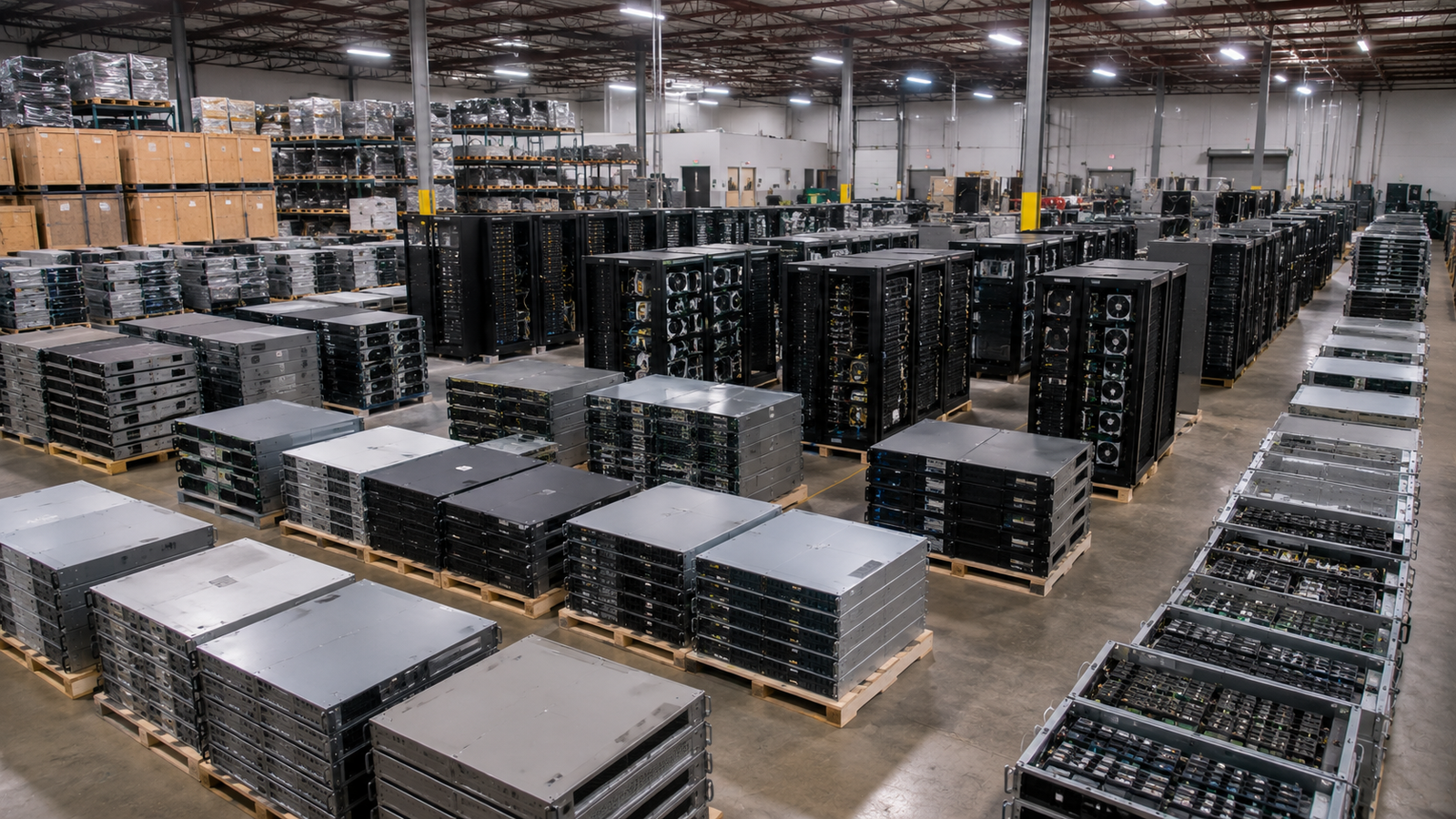
Every major narrative in the AI infrastructure market focuses on new hardware. Blackwell demand. Vera Rubin timelines. HBM supply constraints. The capital commitments that hyperscalers are making to secure the next generation of GPU capacity before competitors do. The hardware that is already deployed, already fully paid for, and now transitioning toward the secondary market gets almost no analytical attention despite the fact that it represents tens of billions of dollars in assets whose market value, economic utility, and financial implications for the operators who hold them are changing continuously.

The secondary market for AI hardware is not a footnote. It is a parallel economy that is shaping neocloud unit economics, private credit collateral valuations, emerging market AI access, and the financial models that underpin hundreds of billions of dollars in infrastructure debt. Used H100s are trading at $15,000 to $28,000. Used A100s clear at $4,000 to $18,000 depending on configuration and condition. Refurbished units command 15 to 25 percentage points more than used equivalents, creating arbitrage opportunities for ITAD firms with certification and warranty infrastructure. H100 depreciation accelerates sharply after approximately two years of service, according to Silicon Data’s analysis of thousands of secondary market listings, a finding whose implications for the six-year depreciation schedules that neocloud operators are using sit largely unexamined.
Understanding the secondary market for AI hardware is not peripheral analysis. It is the most important missing variable in the financial models that govern the largest technology infrastructure buildout in history.
How the Secondary Market for AI Hardware Actually Functions
The secondary GPU market operates across three distinct channels, each with different participants, different pricing dynamics, and different implications for the operators and investors who interact with them. Understanding which channel a transaction flows through is the first step to understanding what the price signal actually means.

The first channel is the enterprise ITAD market. Information technology asset disposition firms buy GPU hardware from enterprises and hyperscalers that are upgrading to newer generations, refurbish it to a certified standard, and resell it with warranty coverage. This is the most institutionalised part of the secondary market. Dell, HPE, and Supermicro all run certified refurbished GPU server programmes at pricing that typically runs 30 to 40% below new equivalent hardware, with warranty coverage of one to two years. The ITAD channel is where the largest volume of secondary AI hardware flows, and it is where the most reliable pricing signals originate. Refurbished H100s consistently trade at $21,000 to $34,000, against new pricing of $25,000 to $40,000.
The Grey Market’s Role in Price Discovery
The second channel is the broker market. Independent hardware brokers operate between sellers with excess inventory and buyers with immediate procurement needs. Broker pricing typically runs 20 to 30% below new hardware, with significantly less warranty coverage and more variable hardware condition. The broker market is where the most interesting pricing dynamics emerge, because broker transactions reflect real-time supply and demand imbalances rather than institutional pricing that lags the market. When Blackwell supply was constrained in late 2024, broker prices for H100s exceeded new list pricing. As Blackwell supply scaled through 2025 and into 2026, broker prices compressed materially. That compression was the first visible signal of the rental rate pressure that would later show up in published neocloud pricing.
The third channel is the grey market. Hardware of uncertain provenance, unclear condition, and no warranty coverage trades through informal networks at prices that can be 20 to 30% below broker market levels. Grey market transactions are difficult to analyse systematically precisely because they are designed to be opaque. For the infrastructure market’s analytical purposes, what matters is that the grey market exists, that it is large enough to influence price discovery at the margins, and that the absence of warranty and provenance creates risks that sophisticated buyers need to price explicitly.
The Pricing Data the Infrastructure Market Is Not Using
The secondary market for AI hardware has generated pricing data that is directly relevant to some of the most contested financial questions in the AI infrastructure market, and that data is almost entirely absent from the financial modelling that operators and investors are using to make capital allocation decisions.
Used A100 80GB units are clearing secondary markets at $12,000 to $18,000 in 2026, against a new price of roughly $25,000 at launch. That represents retention of roughly 48 to 72% of original value six years after launch, which is broadly consistent with the five to six-year depreciation schedules that hyperscalers apply to GPU assets. The A100 data point is the primary empirical evidence that the six-year depreciation schedule advocates cite in support of the waterfall thesis, and it is legitimate evidence for that generation.
Used H100 units are clearing secondary markets at $15,000 to $28,000 in 2026, against new prices of $25,000 to $40,000. That represents retention of 60 to 70% of original value roughly 30 months after launch. At the top of that range, the H100 data also appears to support extended depreciation schedules. At the bottom, where H100 rental rates have compressed from $8 to $2 per GPU hour and used H100s with expired warranty are clearing well below the midpoint of the range, the picture is less supportive.
The Warranty Premium That Changes the Economics
The critical distinction that the aggregate pricing data obscures is the difference between units with remaining warranty coverage and units without it. A used H100 with 12 or more months of transferable warranty trades at 8 to 12% above equivalent units with expired coverage, according to Compute Exchange’s analysis. That premium reflects something specific and important: in an enterprise environment where GPU failures during a production training run can cost tens or hundreds of thousands of dollars in lost compute time, warranty coverage is not a minor feature. It is the primary risk mitigation mechanism that allows buyers to deploy secondary hardware in production rather than in test environments. The secondary market for AI hardware is not a homogeneous market. It is a collection of micro-markets stratified by condition, warranty status, and provenance, each with its own pricing dynamics and buyer base.
What Secondary Market Pricing Reveals About Neocloud Economics
The most commercially important use of secondary market pricing data is in understanding the actual economic position of neocloud operators whose GPU fleets are moving through the hardware lifecycle. A neocloud that deployed H100s in late 2022 and early 2023 on three-year take-or-pay contracts is now managing assets whose contract terms are expiring at the same moment that secondary market data is providing real-time collateral valuations that are directly relevant to the debt structures secured against those assets.
CoreWeave CEO Michael Intrator cited the most compelling data point in support of the neocloud depreciation thesis: H100 GPUs from 2022 contract expirations immediately rebooked at 95% of their original pricing in late 2025. That data point is real and it is important. It demonstrates that the enterprise demand for H100-class compute remained robust through the initial Blackwell supply ramp, supporting the waterfall thesis at the most critical moment of its first real-world test. The 95% rebooking rate is the strongest available evidence that the value cascade works as its advocates described.
The Second Renewal Test the Market Has Not Faced Yet
What the 95% rebooking data does not resolve is the question of what happens at the second contract expiration, when those same H100s come up for renewal in 2027 or 2028, after Vera Rubin has shipped, after Rubin Ultra has entered the market, and after the performance gap between Hopper-class and Rubin-class hardware has reached the same magnitude as the gap between Hopper and Ampere that drove the initial H100 price premium. The first rebooking happened in a market where Blackwell supply was constrained and H100 alternatives were still capable of running the workloads that the most demanding enterprise customers needed.
The second rebooking will happen in a market where two subsequent architecture generations have shipped and the H100’s position in the workload hierarchy has moved two tiers down from where it started. Secondary market data for A100 hardware in 2026 provides the closest analogy available for what that trajectory looks like.
The Hardware Refresh Timing Decision That Secondary Market Data Should Be Driving
One of the most consequential operational decisions a neocloud operator makes is when to refresh its GPU fleet. Refresh too early and the operator abandons residual value in deployed hardware before it has been fully extracted. Refresh too late and the operator is serving customers with hardware that has cascaded too far down the workload hierarchy to command the rental rates needed to service debt and generate returns. The optimal refresh timing window is narrow, and the secondary market pricing data that should inform it is the same data that the market is systematically failing to track.
The hardware refresh decision has three components. The first is the revenue component: at what point does the decline in rental rates for current-generation hardware make it more economical to deploy next-generation hardware and accept the capital cost of the upgrade. The second is the collateral component: at what point does the secondary market value of current-generation hardware, if sold now, represent a better financial outcome than the projected revenue stream from continuing to deploy it. The third is the customer component: at what point does customer demand for next-generation capability make retaining current-generation hardware a competitive disadvantage that affects the operator’s ability to attract and retain the most valuable enterprise relationships.
The Secondary Market Signal That Should Inform Refresh Decisions
Secondary market pricing is the most direct input to the collateral component of that decision. An operator holding a fleet of H100s in mid-2026 can observe that refurbished H100s with warranty coverage are clearing at twenty-one thousand to thirty-four thousand dollars, that used H100s without warranty are clearing at fifteen thousand to twenty-eight thousand dollars, and that A100 hardware following the same pattern several years earlier has retained forty-eight to seventy-two percent of original value. That data defines the exit value available from a hardware sale rather than continued deployment, and it should be compared explicitly against the net present value of the projected rental revenue from continued deployment over the remaining contract and post-contract period.
Most neocloud operators do not make that comparison systematically because they lack access to reliable secondary market pricing data, and because their debt covenants incentivise them to keep hardware in service rather than realise secondary market values that could signal collateral impairment. The way investors financed the neocloud sector created that misalignment between lender incentives and optimal fleet management, and it will continue to distort refresh timing decisions until robust secondary market pricing data makes the trade-off impossible to ignore.
The operators building the most sophisticated fleet management approaches in 2026 are the ones that have created internal secondary market tracking functions, established relationships with ITAD firms that provide regular pricing intelligence, and built refresh timing models that incorporate secondary market exit values alongside rental revenue projections. These operators are making refresh decisions that maximise the economic value of their hardware across its full lifecycle rather than optimising solely for deployment revenue, and the difference in returns between that approach and naive hold-to-depreciation fleet management is material on a fleet valued at hundreds of millions of dollars.
The Emerging Market Opportunity That Secondary Hardware Is Creating
The secondary market for AI hardware is not only a story about financial risk and depreciation schedules. It is also the mechanism through which AI compute access is extending beyond the tier one enterprise and hyperscaler markets into emerging markets, academic institutions, and smaller enterprises that cannot access or afford frontier-generation hardware at new prices.
An A100 available at $4,000 to $9,000 on secondary markets is an entirely different access proposition than the same hardware at its original $25,000 list price. Universities and research institutions in India, Southeast Asia, Latin America, and Africa that cannot negotiate hyperscaler cloud contracts or afford frontier GPU cloud pricing can build meaningful AI research infrastructure with refurbished A100 hardware at secondary market prices. The performance-per-dollar at $6,000 for a used A100 is competitive with cloud rental rates for the same hardware at $1.49 to $3.43 per GPU hour for any workload with a multi-month training timeline.
This is not a trivial point for the global AI infrastructure market. The secondary market for AI hardware is the primary mechanism through which GPU compute democratisation actually happens, as opposed to the press release version of democratisation that model size reductions and API accessibility represent. Physical hardware that can run inference locally, without cloud dependency, at capital costs that emerging market researchers and enterprises can realistically access is a different category of opportunity than cheaper cloud API pricing. The secondary market is already creating that access. The enterprises and non-profits building ITAD programmes, refurbishment infrastructure, and secondary market logistics in emerging markets are doing more for global AI access than most of the foundation model labs that describe democratisation as a goal while building infrastructure that serves predominantly G7 markets.
The Arbitrage Opportunities That the Secondary Market Is Creating
The gap between the three pricing channels in the secondary GPU market, ITAD certified refurbishment at thirty to forty percent below new, broker market at twenty to thirty percent below new, and grey market at fifty to seventy percent below new, creates genuine arbitrage opportunities for operators with the infrastructure to move hardware between channels at scale.
The most straightforward arbitrage is certification arbitrage. A broker market H100 unit acquired at twenty-five percent below new can be passed through a refurbishment and certification programme that adds warranty coverage and documented condition assurance, and resold through an ITAD channel at only fifteen percent below new. The margin between those two prices, net of refurbishment cost and handling, represents the economic value of quality assurance in a market where buyers pay meaningful premiums for risk reduction. The firms that have built the refurbishment capability to execute this arbitrage at scale are capturing value that flows directly from the market structure rather than from any particular hardware advantage.
Geographic Arbitrage Across Uneven Markets
The second arbitrage is geographic. Secondary GPU pricing varies significantly across geographies for reasons that include import duties, logistics costs, currency dynamics, and local demand conditions. H100 hardware that clears secondary markets in the United States at twenty thousand dollars may command twenty-five to thirty percent premiums in markets with high GPU scarcity, strong local AI investment programmes, and limited secondary market development. The firms that have built cross-border GPU logistics infrastructure are capturing that geographic price differential on every transaction that crosses a border where the arbitrage exists. As secondary market volume grows with each successive GPU generation entering the cascade, the scale of that geographic arbitrage opportunity grows proportionally.
The third arbitrage is temporal. GPU secondary prices follow a predictable pattern around major Nvidia architecture launches: they compress in the six months before a new generation ships as buyers defer purchases anticipating better hardware, and they stabilise or recover in the six months after launch as the new generation proves its differentiation and demand for the previous generation stabilises at its new workload tier position. An operator that can accurately time its secondary market exits and acquisitions around that cycle can systematically capture the temporal price differential at every generation transition. The data to identify that pattern exists in public marketplace listings and broker pricing. The analytical infrastructure to exploit it systematically does not yet exist in most market participants.
The Window Before the Market Matures
The arbitrage opportunities in the secondary GPU market are not permanent. As more institutional capital enters the market, as pricing transparency improves, and as the ITAD infrastructure develops toward the efficiency of more mature secondary markets for physical assets, the margins available from channel arbitrage, geographic arbitrage, and temporal arbitrage will compress. The firms building positions in this market now, while the information asymmetries that create arbitrage opportunities remain large, are in the equivalent position to the early participants in any secondary market whose institutionalisation is still in progress. The secondary market for AI hardware is in the early stages of that institutionalisation, and the returns to participants with superior market intelligence and operational infrastructure are highest precisely at this stage.
The ITAD Infrastructure That Determines Market Quality
The secondary market for AI hardware is only as useful as the infrastructure that supports it. Refurbishment capability, warranty provision, and provenance documentation are the three variables that separate the secondary market functioning as a legitimate and reliable source of enterprise-grade hardware from functioning as a source of uncertain-condition equipment that creates operational risk for buyers who cannot absorb it.
The certified refurbishment programmes that Dell, HPE, and Supermicro operate provide the most robust quality assurance available in the secondary market. They run GPU hardware through standardised burn-in testing, firmware validation, and performance benchmarking before selling it with warranty coverage that gives enterprise buyers the risk protection they need to deploy secondary hardware in production environments. The premium those programmes command, typically 30 to 40% below new rather than the 50 to 70% below new that used hardware without certification trades at, reflects the real value of that quality assurance rather than simply brand premium.
The emerging ITAD infrastructure that is most interesting from a market development standpoint is the category of specialist GPU refurbishers building programmes specifically for AI data center hardware. These firms are not running general IT asset disposition operations with GPU capability added. They are building GPU-specific testing infrastructure, developing the firmware and driver expertise needed to validate Hopper and Blackwell hardware at the component level, and creating warranty programmes that cover the failure modes specific to high-density GPU server environments. The 2026 PTC Conference observation that ITAD relationships will become more important as hardware supply tightens reflects the beginning of an institutional recognition that secondary market infrastructure is a strategic asset rather than a procurement afterthought.
The Private Credit Exposure That Secondary Market Data Makes Visible
The most financially significant implication of secondary market AI hardware pricing is its direct relevance to the collateral valuations underlying the private credit structures that have financed the neocloud buildout. The debt secured against GPU fleets is only as sound as the market’s ability to realise value from those assets if the primary revenue stream that services the debt fails to perform.
CoreWeave holds $21.6 billion in total debt against its GPU fleet. Fluidstack, Lambda Labs, and Crusoe hold further billions in GPU-collateralised debt across the neocloud sector. The covenant structures that lenders wrote against these positions depend on collateral valuations that should, in theory, reflect secondary market pricing for the hardware in question. In practice, the private credit structures financing the neocloud buildout were written against collateral valuations that relied on limited secondary market data, optimistic depreciation assumptions, and the take-or-pay contract structures that provided primary revenue support.
Secondary market pricing data is now providing the real-time collateral valuations that those structures were underwritten without. H100 secondary prices stabilising at $15,000 to $28,000, with the lower end of that range reflecting units without warranty coverage and facing competition from Blackwell supply, are the actual market’s assessment of the collateral value underlying debt that was priced against more optimistic assumptions. The operators whose covenant compliance depends on collateral values holding within the range the original debt structures assumed are the ones with the most direct financial exposure to the secondary market pricing data that nobody in the infrastructure market is tracking systematically.
The Market Infrastructure That Needs to Develop
The secondary market for AI hardware is currently operating with less price transparency, less standardised quality certification, and less institutional participation than its financial importance warrants. The equity markets have exchanges. The bond markets have TRACE. The real estate secondary market has multiple listing services and standardised appraisal methodology. The secondary market for AI hardware has broker networks, ITAD firm catalogues, and marketplace listings that provide pricing signals but not the systematic price discovery infrastructure that a market of this financial significance requires.
The development of more transparent secondary market infrastructure for AI hardware is not an academic concern. It is a prerequisite for the private credit structures financing the neocloud buildout to have reliable collateral valuations, for neocloud operators to make rational decisions about hardware refresh timing, for emerging market buyers to access secondary hardware with confidence about the quality and provenance of what they are purchasing, and for the operators managing large GPU fleets to extract maximum value from hardware that is transitioning out of its primary use case.
The firms building that infrastructure, whether through specialist GPU marketplaces, ITAD programmes with systematic pricing transparency, or secondary market analytics platforms that track transaction prices across all three market channels, are building something that the AI infrastructure market needs and does not yet have. The secondary market for AI hardware is already large enough to matter and opaque enough to create risks that better information infrastructure would reduce. The private credit bet on GPU infrastructure would be better underwritten with reliable secondary market data than without it, and the operators and investors who develop access to that data before it becomes widely available will have an analytical advantage that compounds as the hardware lifecycle matures and the secondary market volume grows.










