
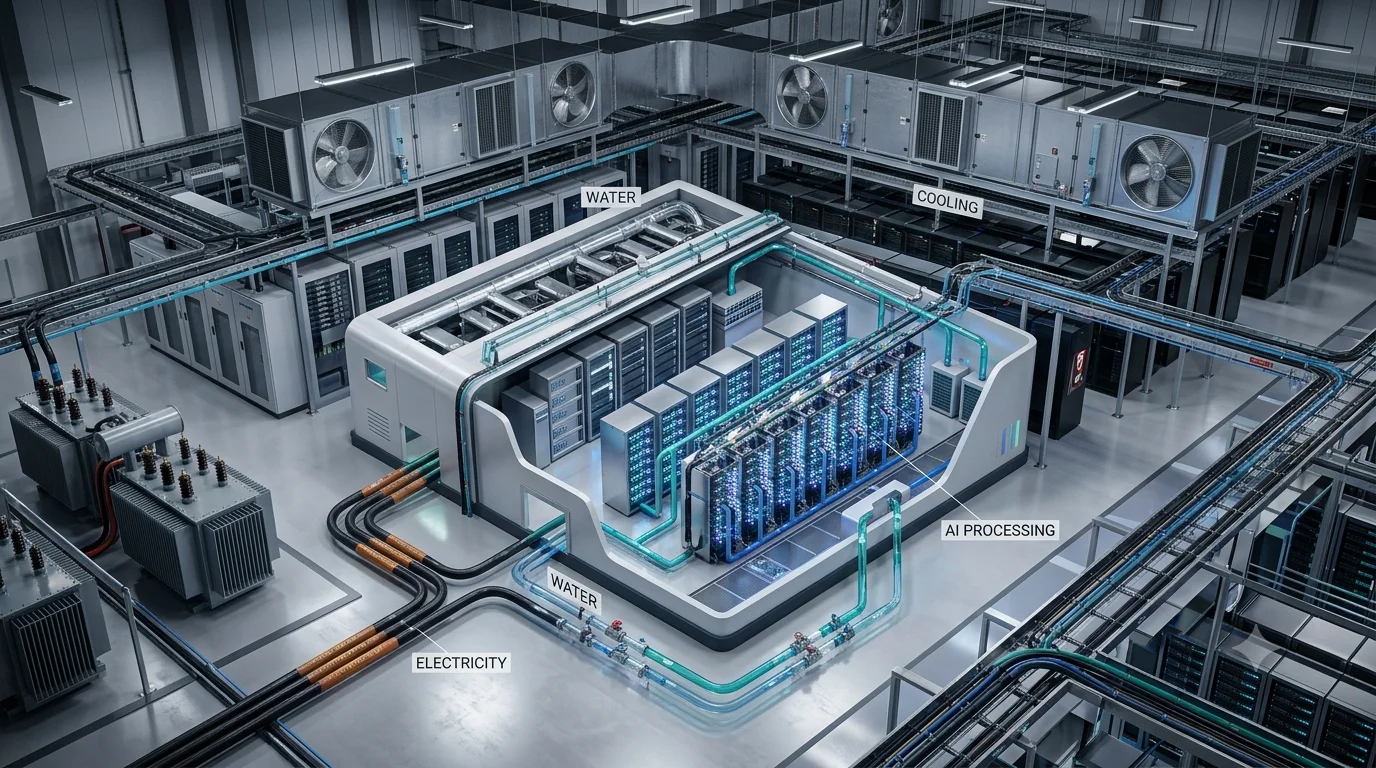
Artificial intelligence has transformed the economics of digital infrastructure. Every new AI model requires more computing power than its predecessor. Consequently, operators continue building larger data centers across global markets. However, expansion alone cannot solve every infrastructure challenge. Efficiency now determines whether AI growth remains economically and environmentally sustainable. For years, sustainability discussions centered on renewable electricity and carbon emissions. Those priorities remain essential today. Meanwhile, another question has become equally important. How much useful AI work can each facility produce from every megawatt consumed? This shift is redefining how operators evaluate infrastructure performance. The industry’s next breakthrough will likely come from improving efficiency rather than expanding capacity alone. Operators increasingly optimize power delivery, cooling, networking, and workload management together. Therefore, sustainable infrastructure now depends on intelligent engineering as much as renewable energy. The greenest AI data center may simply become the one that wastes the fewest resources.

AI Growth Has Created an Efficiency Challenge
Global AI demand continues growing across enterprises, governments, and consumers. Organizations deploy increasingly sophisticated models for search, software development, healthcare, manufacturing, and scientific research. Consequently, infrastructure demand rises alongside every new AI application. Computing capacity alone can no longer satisfy future requirements. Building larger facilities remains important for frontier model development. However, each additional megawatt introduces higher operating costs and greater resource requirements.
Electricity, cooling systems, networking equipment, and supporting infrastructure all expand together. Therefore, operators increasingly pursue efficiency before pursuing additional scale. Smarter infrastructure delivers greater long-term value. Traditional performance metrics no longer tell the complete story. Rack density and installed GPU counts remain valuable measurements. Nevertheless, they reveal little about how effectively infrastructure operates. Organizations increasingly evaluate how much productive AI computing existing assets actually deliver. Utilization has become as important as capacity.
Every AI Token Carries a Physical Infrastructure Cost
Every AI interaction begins with a physical process inside a data center. GPUs perform calculations while processors exchange enormous amounts of information. Networking equipment moves data across high-speed connections continuously. Cooling systems remove heat to maintain stable operating conditions. Therefore, every AI-generated response carries a measurable infrastructure cost. Most users never see this physical layer of artificial intelligence. They interact with chatbots, search engines, or enterprise assistants through simple interfaces.

Behind those services, however, thousands of infrastructure components operate simultaneously. Power systems, storage arrays, fiber networks, and cooling equipment all contribute to each response. AI ultimately depends on physical infrastructure rather than software alone. This reality changes how operators approach sustainability. The objective no longer focuses only on reducing electricity consumption. Instead, organizations seek to maximize useful AI output from existing infrastructure. Every unnecessary computation wastes electricity, cooling capacity, and valuable GPU resources. Efficiency therefore becomes a direct measure of sustainability.
Better Engineering Delivers Bigger Sustainability Gains
Infrastructure efficiency begins long before servers enter production. Engineers now design AI facilities around higher rack densities, improved airflow, advanced power distribution, and liquid cooling. These improvements allow operators to support greater computing performance without proportional resource growth. Consequently, smarter engineering produces measurable operational benefits. Liquid cooling represents one of the industry’s most significant efficiency advances. Direct-to-chip cooling removes heat more effectively than traditional air cooling for high-density AI racks. Operators can therefore deploy more powerful hardware within the same physical footprint. Improved thermal management also reduces energy lost through cooling systems. Power distribution has become equally important. Modern AI clusters require stable electricity delivery across thousands of accelerators operating simultaneously. Infrastructure teams increasingly redesign electrical systems to minimize conversion losses. Every efficiency improvement reduces operating costs while increasing computing capacity. Small engineering gains create significant benefits at hyperscale.
How Software Is Becoming Part of Sustainable Infrastructure
Infrastructure efficiency no longer depends only on physical equipment. Software increasingly determines how effectively AI hardware performs. Intelligent workload scheduling allows operators to allocate computing resources more efficiently. Consequently, GPU clusters spend less time sitting idle between workloads. Model optimization also reduces infrastructure demand. Developers increasingly use quantization, pruning, and optimized inference techniques to deliver comparable performance with fewer computing resources.
These improvements lower electricity consumption while maintaining application quality. Better software therefore contributes directly to infrastructure sustainability. AI platforms increasingly coordinate computing, networking, and storage as unified systems. Resource orchestration software continuously adjusts workloads according to demand. Operators avoid unnecessary energy consumption while maintaining service quality. Efficient software has become just as valuable as efficient hardware.
The Next Performance Metric Could Be AI Output per Megawatt
For decades, the industry relied on metrics such as Power Usage Effectiveness (PUE) to evaluate data center performance. Those measurements remain valuable because they quantify facility efficiency. However, AI infrastructure demands broader performance indicators. Operators increasingly care about the amount of useful AI work produced from every unit of energy. A new generation of performance metrics is beginning to emerge. Instead of measuring only facility overhead, operators want to understand infrastructure productivity.
Questions now focus on AI output rather than electricity consumption alone. Consequently, infrastructure efficiency becomes directly linked to business performance and operational value. Future AI facilities may compare infrastructure using metrics such as AI inference per megawatt or tokens generated per kilowatt-hour. These measurements would connect engineering decisions with commercial outcomes. Organizations could evaluate how efficiently their infrastructure converts electricity into useful computing. That shift would redefine how the industry measures sustainable growth.
Efficiency Is Becoming a Competitive Advantage
Infrastructure efficiency now influences far more than sustainability goals. Lower energy consumption reduces operating costs while improving long-term profitability. Better cooling extends equipment life and supports higher computing densities. Consequently, organizations achieve stronger financial performance alongside environmental improvements. Efficient infrastructure also accelerates deployment. Modular designs, optimized power systems, and standardized cooling technologies simplify expansion across multiple locations. Operators respond more quickly to rising AI demand without increasing operational complexity. Faster deployment has become an important competitive advantage in the AI economy. Investors increasingly evaluate infrastructure through operational efficiency rather than installed capacity alone. Facilities that maximize utilization and minimize resource waste deliver stronger long-term returns. Therefore, efficiency has evolved from an engineering objective into a strategic business priority. Sustainable infrastructure now creates measurable commercial value.
Building Smarter Instead of Simply Building Bigger
The AI industry will continue investing in larger data centers for years to come. Frontier models still require enormous computing resources and sophisticated infrastructure. However, future success will depend on how intelligently those facilities operate. Expansion without efficiency will become increasingly difficult to justify. Operators are entering an era where every watt, every GPU, and every cooling system must contribute measurable value. Infrastructure decisions increasingly balance performance, cost, resilience, and sustainability together. As a result, engineering optimization will define the next generation of AI infrastructure more than physical scale alone. The industry’s biggest sustainability gains may not come from building entirely new facilities. Instead, they will come from extracting greater value from existing infrastructure. Organizations that maximize efficiency across computing, cooling, networking, and software will lead the next phase of AI development. The future belongs not to the largest data centers, but to the smartest ones.











