
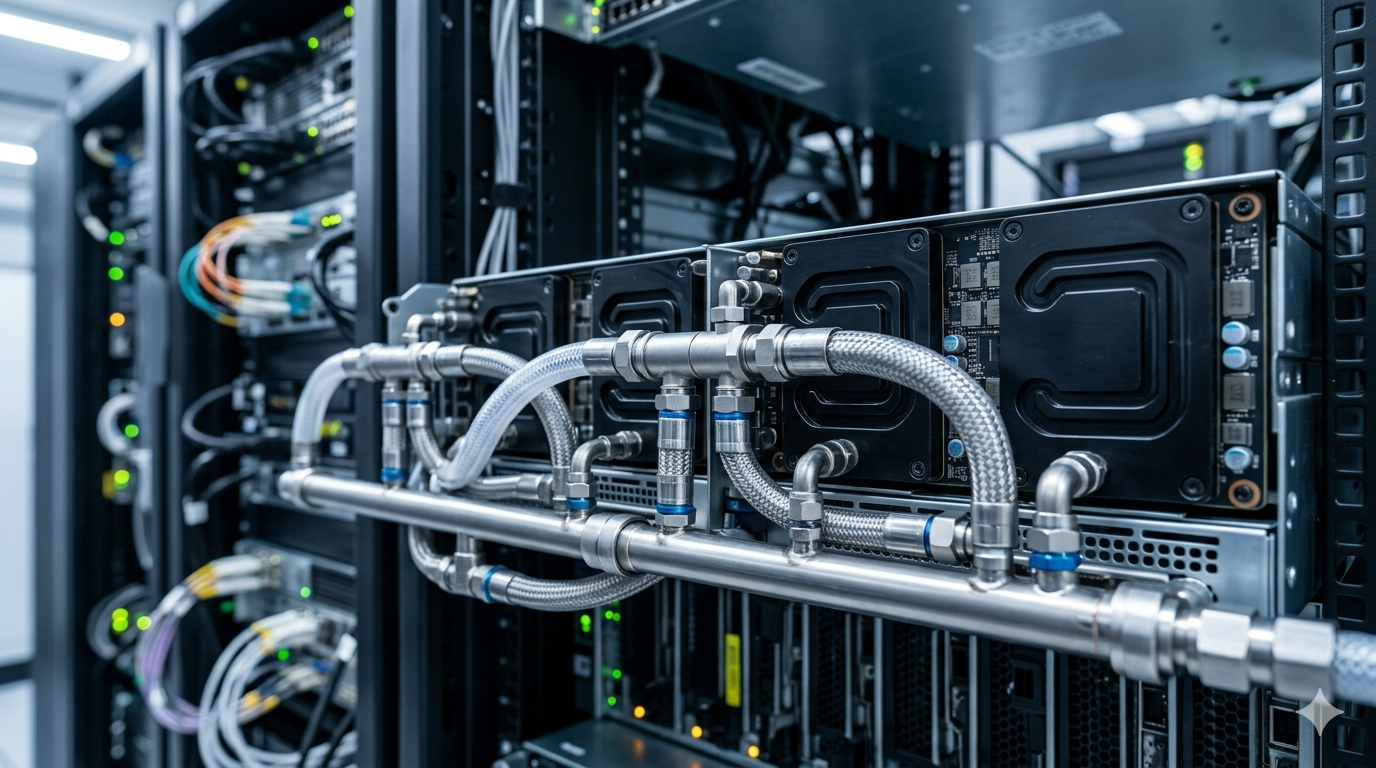
Direct-to-chip liquid cooling has moved from a niche solution for specialised high-performance computing environments into one of the most consequential infrastructure decisions that data center operators make when planning AI deployments. The shift has happened faster than the industry anticipated, driven by a combination of hardware density that has outrun air cooling’s physical limits and a growing recognition that the economics of dense AI infrastructure are inseparable from thermal management strategy. Understanding how direct-to-chip cooling actually scales, what the engineering and operational challenges look like at each stage of deployment, and where the approach meets its own limits is now essential knowledge for anyone making infrastructure decisions around AI workloads.

The term direct-to-chip cooling covers a specific thermal management approach: delivering liquid coolant directly to the processor package, removing heat at the source rather than relying on air movement to carry heat away from the server and out of the facility. This is distinct from immersion cooling, where entire servers are submerged in dielectric fluid, and from rear-door heat exchangers, which cool the exhaust air from conventional servers rather than addressing heat at the chip level. Each approach has different engineering characteristics, different capital requirements, and different operational implications. Direct-to-chip occupies a specific position in this landscape, offering higher heat removal capacity than air cooling while maintaining greater compatibility with existing server designs than full immersion requires.
Why the Physics of Heat Removal Make Direct-to-Chip Inevitable
The reason direct-to-chip has accelerated from optional to essential for serious AI infrastructure operators comes down to physics. Modern AI accelerators generate heat flux at densities that conventional cooling architectures were not designed to handle. A single Nvidia H100 GPU generates up to 700 watts of thermal load. A Blackwell B200 generates over 1,000 watts. When operators deploy these chips in dense configurations, the aggregate thermal load per rack reaches levels where air cooling systems would need to move impractical volumes of air at impractical velocities to maintain operating temperatures within the ranges that hardware vendors specify for reliability and performance. Water carries approximately 3,400 times more heat per unit volume than air at standard conditions, and direct-to-chip cooling exploits that physical property advantage to remove heat at the source with a medium that air-based systems simply cannot match at these densities.
Why Air Cooling Hit Its Ceiling for AI Infrastructure
The transition away from air cooling as the default thermal management approach for AI infrastructure is not a preference or a trend. It is a response to a physical constraint that became binding as GPU power density increased through successive hardware generations. Air cooling works by moving large volumes of air across hot components, transferring heat from the component surface to the air, and then removing the heated air from the facility. For conventional server workloads running at 10 to 15 kilowatts per rack, air cooling handles this heat removal effectively with conventional raised-floor or hot-aisle containment architectures.

As rack power density has climbed past 30, 50, and now 100 kilowatts per rack in AI configurations, the air volumes required to maintain adequate cooling grow proportionally. At 100 kilowatts per rack, the air flow requirements exceed what conventional Computer Room Air Handler systems can deliver without significant overprovisioning of cooling infrastructure. The mechanical systems required to move adequate air volumes at high rack densities consume substantial power themselves, and the efficiency losses compound as density increases. Redefining thermal battles and why traditional cooling loses ground is ultimately a story about air cooling’s structural inability to keep pace with the thermal loads that AI hardware generates at scale.
Why the Facility Implications of Staying With Air Go Beyond the Cooling System
Operators who attempt to maintain air-cooled architectures while deploying high-density AI hardware encounter facility-level constraints that extend well beyond the cooling system itself. Power distribution infrastructure designed for conventional server densities lacks the capacity to deliver power at the rates that dense AI racks require, meaning that operators face electrical upgrades alongside cooling upgrades. The physical footprint of the additional cooling infrastructure required to handle high-density air-cooled deployments consumes floor space that could otherwise house additional compute capacity. AI accelerators running above their thermal design point throttle their performance to reduce heat output, meaning that inadequately cooled AI infrastructure delivers less compute per dollar than properly cooled infrastructure. When chips dictate cooling and the rise of silicon-level thermal design made clear that the economics of operating AI infrastructure have become inseparable from the effectiveness of the thermal management approach underneath it.
How Direct-to-Chip Cooling Actually Works
Direct-to-chip liquid cooling systems deliver chilled water or a proprietary coolant fluid through a distribution manifold to cold plates that mount directly on the processor packages within each server. The cold plates are precision-engineered thermal interface devices that maximise the surface area in contact with the coolant while maintaining reliable thermal contact with the chip package. Heat transfers from the chip package into the cold plate, from the cold plate into the flowing coolant, and from the coolant to a facility-level heat rejection system that may include cooling towers, dry coolers, or connection to a district cooling loop.
The coolant distribution system that connects the facility heat rejection infrastructure to the individual server cold plates is where most of the engineering complexity in direct-to-chip deployments lives. Each server requires a supply and return connection, and a rack containing dozens of servers requires manifolding that distributes flow evenly across all connected cold plates while maintaining the pressures and flow rates that each cold plate requires for effective heat removal. Cold plates versus immersion in AI data centers involves engineering trade-offs that go well beyond simple heat removal capacity, and the manifolding and distribution architecture is one of the most important of those trade-offs at the point where the two approaches diverge most clearly.
Why Direct-to-Chip Is Never a Complete Cooling Solution on Its Own
A critical and often overlooked aspect of direct-to-chip deployments is that they do not eliminate the need for air cooling. Modern AI servers contain components beyond the primary GPU and CPU packages that also generate significant heat. Memory modules, voltage regulators, storage devices, and networking components all require thermal management, and direct-to-chip systems typically address only the highest-heat-generating processors. The residual heat load from these components still requires conventional air cooling, meaning that direct-to-chip deployments operate as hybrid systems rather than pure liquid cooling solutions. The era of hybrid cooling in modern data centers describes this precisely: a well-designed direct-to-chip deployment routes the majority of the thermal load, often 60 to 70 percent of total rack heat, through the liquid cooling system while managing the residual air-side load with a reduced air cooling system that operates at much lower intensity than a fully air-cooled deployment would require.
Scaling From a Single Rack to a Multi-Rack Cluster
Deploying direct-to-chip cooling at single-rack scale is manageable with off-the-shelf components and relatively straightforward engineering. The challenges multiply as operators scale from a single rack to a multi-rack cluster, and multiply again as they scale from a cluster to the kind of large-scale AI training infrastructure that hyperscalers and well-funded AI labs now operate. Each scaling step introduces new engineering requirements around coolant distribution, flow balancing, pressure management, and heat rejection that single-rack deployments do not expose.
At multi-rack scale, the coolant distribution manifolding must maintain consistent flow rates and pressures across all connected racks even as operators add, remove, or replace individual servers. Uneven flow distribution across a large manifold network results in some cold plates receiving inadequate coolant flow and therefore inadequate cooling, while others receive excess flow that does nothing to improve thermal performance. The operational learning curve of liquid-cooled data centers is steepest precisely at this scaling transition, because the failure modes that manifest at multi-rack scale are not visible in single-rack pilots and require a different level of operational sophistication to manage reliably.
Material compatibility requirements add another layer of engineering consideration that operators sometimes underestimate when scaling from pilot to production. Different coolant chemistries interact differently with the metals, polymers, and sealing materials used in servers and cooling infrastructure. A coolant formulation that works well with one generation of servers may not be compatible with materials used in the next generation, creating compatibility validation requirements that add time and cost to hardware refresh cycles. Operators who standardised their coolant chemistry early and validated it against their server hardware across multiple generations have significantly smoother refresh processes than those who treated coolant selection as an afterthought.
Why Leak Management at Scale Is a Non-Trivial Engineering Challenge
The introduction of liquid into server environments creates a failure mode that air-cooled data centers do not face: leaks. At single-rack scale, a leak is a manageable incident with limited blast radius. At multi-hundred-rack cluster scale, a systematic failure in the coolant distribution infrastructure carries far more serious consequences. Operators scaling to large direct-to-chip deployments must invest in leak detection systems, containment infrastructure, and emergency shutdown procedures that have no equivalent in conventional air-cooled facilities. Liquid cooling maintenance economics and service design are substantially more complex at scale than at single-rack deployments, and the cost of getting maintenance wrong is proportionally larger as the deployment grows.
The Power Economics That Make Direct-to-Chip Compelling at Scale
The power consumption advantages of direct-to-chip cooling become more pronounced as deployment scale increases. Air cooling systems consume a growing proportion of total facility power as rack densities rise, because the fans, pumps, and air handling systems required to move adequate air volumes scale non-linearly with the thermal load. Direct-to-chip systems, by contrast, move heat through a liquid loop with much lower mechanical energy expenditure per unit of heat removed. At 100-kilowatt rack densities, a well-designed direct-to-chip system can reduce cooling-related power consumption by 30 to 40 percent compared to an air-cooled system attempting to manage the same thermal load.
That power reduction compounds into a meaningful facility-level advantage. A data center operator running 1,000 AI racks at 100 kilowatts each is managing 100 megawatts of IT load. A 35 percent reduction in cooling power at that scale translates to roughly 12 megawatts of avoided cooling consumption, representing both a direct operating cost reduction and a reduction in the total power capacity the facility needs to procure and distribute. Why liquid cooling is now a power strategy and not just a cooling choice makes this economics case clearly: the decision to deploy direct-to-chip cooling is not primarily a thermal engineering decision at scale. It is a power procurement decision, a capital efficiency decision, and increasingly a site selection decision.
Why Power Efficiency Advantages Grow With Electricity Price Volatility
The power cost advantage of direct-to-chip cooling is not static. It grows as electricity prices rise, and electricity prices for data center operators have increased 20 to 35 percent since 2022 across the major markets where AI infrastructure concentrates. Operators who locked in direct-to-chip cooling infrastructure in 2022 and 2023 are now benefiting from that investment at higher electricity prices than their original business cases assumed. Where liquid cooling finds its cheapest power advantage identifies the geographic and market conditions where the power economics are most compelling, but the direction of the advantage is consistent across all markets: as electricity prices rise, the value of cooling efficiency increases proportionally. The operators who deferred direct-to-chip adoption because the business case looked marginal at 2021 electricity prices are now running those same calculations against 2026 prices and finding that the marginal case has become a compelling one.
The AI Factory Scale and What Changes There
The hyperscale AI training clusters that the largest AI labs and hyperscalers now operate represent a scale where the engineering challenges of direct-to-chip cooling take on a different character entirely. A cluster of 10,000 or 20,000 GPUs represents a thermal load in the hundreds of megawatts, and the cooling infrastructure required to manage that load at chip level involves coolant distribution networks of considerable complexity. At this scale, the facility design and the cooling system design become inseparable: the physical layout of the cluster, the routing of coolant supply and return lines, the sizing of the central cooling plant, and the heat rejection infrastructure all need to optimise together in ways that smaller deployments can address sequentially.
The heat rejection question becomes particularly significant at AI factory scale. The waste heat that a 100-megawatt AI cluster extracts represents a substantial thermal energy flow that must go somewhere. In facilities with access to large bodies of water for cooling tower operation, this heat rejection is manageable at reasonable cost. In dense urban environments or water-scarce regions, rejecting hundreds of megawatts of waste heat requires either large dry cooler arrays with significant footprint and fan power requirements, or investment in heat recovery infrastructure that captures the waste heat for useful purposes such as district heating. Thermal sovereignty and the strategic control of heat is not just a sustainability concept at AI factory scale. It is a site selection and infrastructure planning constraint that determines where facilities can economically operate.
Why Heat Rejection Becomes a Site Selection Constraint at AI Factory Scale
Operators who have designed AI factory scale facilities from the ground up with direct-to-chip cooling as a first-class constraint consistently report that cooling infrastructure routing was as significant a design driver as power distribution routing. Treating it as secondary in the design process creates constraints that are difficult and expensive to resolve after construction. The rise of liquid cooling in next-generation AI infrastructure documents how this planning discipline has evolved as the industry has accumulated more experience at scale.
Where Immersion Cooling Becomes More Competitive at the Highest Densities
At the upper end of the density spectrum, direct-to-chip cooling faces increasing competition from full immersion approaches. Single-phase immersion cooling, which submerges entire server boards in dielectric fluid at atmospheric pressure, offers simpler per-server cooling architecture than direct-to-chip because the entire server bathes in coolant rather than requiring precision-engineered cold plates on each processor package. The trade-off is the requirement for servers designed or modified for immersion operation, the complexity of managing large volumes of dielectric fluid, and the challenges of servicing submerged hardware. Immersion ecosystem resilience and the networking, controls, and risk modelling required at AI factory scale involves managing challenges that direct-to-chip deployments at the same scale also face, but in different forms and with different tooling requirements.
The Operational Dimension That Infrastructure Planning Underweights
The shift from air-cooled to direct-to-chip liquid-cooled infrastructure is not just an engineering transition. It is an operational transition that requires data center teams to develop new skills, new procedures, and new monitoring capabilities. The failure modes of liquid-cooled infrastructure are fundamentally different from those of air-cooled infrastructure, and the consequences of responding incorrectly to those failure modes are more severe. A team that knows how to manage an air-cooled data center does not automatically know how to manage a liquid-cooled one, and underinvesting in operational capability development is one of the most common reasons that direct-to-chip deployments underperform their design specifications.
The monitoring and instrumentation requirements of large direct-to-chip deployments exceed those of air-cooled equivalents. Operators need real-time visibility into coolant flow rates, pressures, temperatures, and chemistry across the entire distribution network to detect developing problems before they become acute incidents. The data volumes that comprehensive liquid cooling monitoring infrastructure generates are substantial, and integrating that data with broader data center infrastructure management systems requires investment in tooling and integration that air-cooled facilities have not historically needed.
Coolant chemistry management is another operational discipline that air-cooled teams have no prior experience with. Coolant formulations degrade over time as they absorb contaminants from the metals and sealing materials they contact, and without regular chemistry monitoring and appropriate treatment, degraded coolant becomes corrosive, accelerating the very hardware failures that liquid cooling is meant to prevent. Hybrid cooling architectures and why data centers will not go fully liquid addresses the operational reality that most large facilities will manage both liquid and air cooling systems simultaneously for the foreseeable future.
Why the Staffing and Skills Gap Is Constraining Deployment Timelines
The talent required to design, deploy, and operate large-scale direct-to-chip liquid cooling infrastructure is in short supply relative to the demand that the AI infrastructure buildout has created. Mechanical engineers with data center cooling experience, fluid systems specialists, and the hybrid expertise in both IT infrastructure and cooling plant operation that large deployments require are scarce. The staffing constraint is not just a cost issue. It is a schedule constraint that lengthens deployment timelines for operators who cannot find the people they need to execute at the pace the hardware procurement pipeline demands. Operators who have built internal liquid cooling expertise through earlier smaller deployments are now running new facilities faster and more reliably than those encountering the operational learning curve for the first time at large scale.
What the Next Hardware Generation Demands From Cooling Infrastructure
The Vera Rubin architecture that Nvidia is targeting for volume availability in the second half of 2026 pushes rack-level power requirements well beyond what the Blackwell generation already demands. Infrastructure operators designing facilities today are not just designing for current hardware. They are designing for the hardware generation that will arrive before their current facilities complete their first full depreciation cycle. That forward-looking requirement changes how direct-to-chip cooling infrastructure should be specified, because a system sized for today’s thermal loads will constrain the compute density achievable with tomorrow’s hardware.
The most consequential specification decision for direct-to-chip systems in facilities designed today is the coolant supply temperature and flow capacity available at the rack level. Systems designed for lower coolant flow rates or higher supply temperatures than next-generation hardware requires will either need expensive retrofitting when that hardware arrives or will force operators to limit the GPU density they can deploy. The cooling-power nexus and energy storage as thermal strategy is relevant here because the interaction between cooling system capacity and power delivery capacity determines the maximum deployable GPU density, and both need to be sized for the hardware roadmap rather than just the current generation.
Why On-Die Liquid Cooling Changes the Long-Term Architecture Picture
A longer-term development that infrastructure planners designing facilities for 10-year operational lifetimes should incorporate is the emerging research into on-die liquid cooling, where liquid cooling loops integrate directly into the processor package itself rather than attaching as a cold plate to the chip surface. Cooling the chip itself and the emerging frontier of on-die liquid cooling identifies this as a development that is several GPU generations away from mainstream deployment, but one that would change the thermal management architecture at the facility level significantly when it arrives. Facilities built today that maintain flexibility in their coolant distribution architectures, rather than hard-coding assumptions about where thermal interfaces will sit, are better positioned to accommodate this transition without requiring full infrastructure replacement.
The Business Case That Closes at Current Densities
The total cost of ownership case for direct-to-chip cooling has become straightforward to make at the rack densities that current AI hardware demands. The capital cost of the cold plates, manifolding, and facility-level cooling plant adds to the upfront investment, but the operating cost reductions from lower cooling power consumption, combined with the hardware reliability improvements that stable thermal management delivers, produce payback periods that well-run AI data center operators consistently report in the two to four year range at current electricity prices and GPU rack densities.
The hardware reliability improvement is an often-underappreciated component of the TCO calculation. GPU junction temperatures in direct-to-chip cooled deployments run 15 to 25 degrees Celsius lower than equivalent air-cooled configurations, reducing the thermal stress that drives long-term semiconductor degradation and failure. Operators who have run direct-to-chip cooled GPU clusters for 18 to 24 months consistently report lower hardware failure rates than comparable air-cooled deployments, and the capital cost of avoided GPU replacements contributes meaningfully to the TCO advantage. The colocation and neocloud market is also beginning to price the direct-to-chip cooling advantage into its commercial terms, with facilities offering direct-to-chip cooled AI infrastructure commanding higher per-rack pricing than air-cooled equivalents. Liquid cooling transforming edge and distributed infrastructure shows this commercial dynamic playing out beyond the centralised data center, with the same logic applying wherever AI hardware density demands proper thermal management.
Why the Decision to Deploy Direct-to-Chip Is Now About Timing, Not Whether
The operators who are still evaluating whether to deploy direct-to-chip cooling for AI workloads at current rack densities are asking the wrong question. At 100-kilowatt rack densities, the physics of air cooling have already answered the whether. The question that remains is when, and the economic answer is consistently that deploying direct-to-chip cooling at design stage costs significantly less than retrofitting it into a live operating facility. Retrofitting liquid cooling inside existing data centers is technically achievable but operationally expensive and disruptive in ways that design-stage deployment avoids entirely. Operators who deploy direct-to-chip cooling now are also building operational expertise that compounds over time, and in a market where operational efficiency increasingly determines which AI infrastructure operators sustain margins and which compress them, that expertise advantage is a competitive asset that late movers will spend years trying to close.











